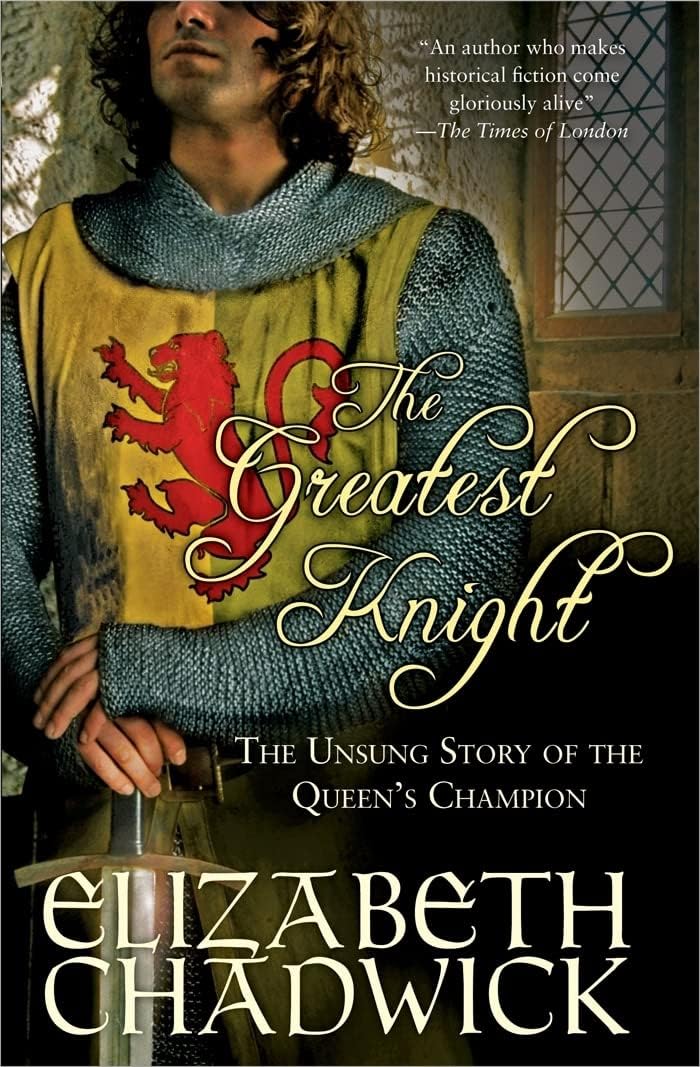
The Greatest Knight: The Unsung Story of the Queen's Champion (William Marshal)
Product ID: 11041564
Buy anything from 5,000+ international stores. One checkout price. No surprise fees. Join 2M+ shoppers on Desertcart.
Desertcart purchases this item on your behalf and handles shipping, customs, and support to Austria.
THE NEW YORK TIMES AND USA TODAY BESTSELLER! "The best writer of medieval fiction currently around."― Historical Novels Review Royal protector. Loyal servant. Forgotten hero. 12th century, England: A penniless young knight with few prospects, William Marshal is plucked from obscurity when he saves the life of Henry II's formidable queen, Eleanor of Aquitaine. In gratitude, she appoints him tutor to the heir to the throne, the volatile and fickle Prince Henry. But being a royal favorite brings its share of danger and jealousy as well as fame and reward. A writer of uncommon historical integrity and accuracy, Elizabeth Chadwick resurrects the true story of one of England's greatest forgotten heroes in a captivating blend of fact and fiction. The Greatest Knight restores William Marshal to his rightful place at the pinnacle of the British Middle Ages, reflecting through him the triumphs, scandals, and power struggles that haven't changed in eight hundred years. Fans of Phillipa Gregory, Susanna Kearsley, or Diana Gabaldon are sure to recognize The Greatest Knight as exceptional historical fiction, bringing medieval Britain to brilliant life. More Novels of Elizabeth Chadwick's William Marshal: The Greatest Knight The Scarlet Lion For the King's Favor Templar Silks To Defy a King Review: AN ENTERTAING & ENJOYABLE NOVEL(4.5 STARS) (FEW SPOILERS) - If you like the novels of Sharon Kay Penman and Phillipa Gregory, you should enjoy this one. I think this is better than some novels from authors that write in this genre and time period. Elizabeth Chadwick has written a very good tale, with well-drawn characters and she does a great job in immersing the reader in the twelfth centaury. From the rigors of defending a castle under siege ,the sounds and smell from burning villages, the action and injuries that occur during tournaments, and many other details you feel transported back into this turbulent era. William Marshall was a hero, as was his father. (For more detail on John Marshall, Williams father, read "A PLACE BEYOND COURAGE, by Ms. Chadwick). Not many men who love their family will risk having a child killed while he is being held hostage by the enemy, because of his honor. His father had pledged his support to a dying king's daughter right inherit to the throne. When his son, William is captured by Stephen, who has usurped the throne, he is held as a hostage to ensure that his father will not continue his support of Matilda and her followers. If his father continues to support Matilda and her son, Henry, he will kill young William. He realizes that even if his son is not killed he may end up having his father for keeping his word and endangering him. William manages to charm Stephen who cannot bring himself to kill the child. When Stephen releases him, he returns home. Far from hating his father, he admires his father for adhering to his principles and keeping his oath William continues to live a charmed life. As the younger son, he has two choices, the church or knighthood. After many years as a squire, he finds himself in the right place and time to save Queen Eleanor. This action gains her favoritism, he is appointed to teach and advise her sons in the arts of fighting and chivalry. In time, he becomes an advisor to Hal, who is the heir to the throne. Hal has many faults, he is too charming, impetuous, spoiled and easily led astray be the advice of those who are looking out for themselves. Not William, he tries to talk Hal out of things many times and he fails. Despite his loyalty to King Henry and Queen Eleanor, his honor and personal code will not let him abandon Hal when he makes decisions that wrong and dangerous to everyone who follows the prince. He does his best to keep the young prince safe and away from those who are attempting to use him for their own means. This is a long novel but it's easy and enjoyable to read. While this is a fictional novel, it is based on history. You will come away with a greater understanding of the era in which William Marshall, King Henry, Queen Eleanor, Richard the Lionheart and many other historical figures lived. If you like this novel, you should read, "THE SCARLET LION", which continues the life of William Marshall, who will become the first Earl of Pembroke. While the author could have put Marshal's story in one novel, many people are overwhelmed by the idea of reading a book over 1100 pages long. I urge you to get them both at the same time, unless you are getting it for your Kindle, which downloads almost instantaneously. After reading this one, you will most likely want to read the second one without waiting for it to be delivered in the mail. Review: Starts slow but transforms into a page-turner, 4.5 stars... - The second son of John Marshal, Lord Marshal of England during the reign of King Stephen in the 12th century, William is a child whose renown and influence was destined to surpass his father -- yet his name remains lost to the popular, generally taught history of today. I know appallingly little of the Plantagenet kings, other than Richard I and Prince John's famous rivalry, which gave birth to one of my favorite legends -- that of Robin Hood. William's service to the Plantagenets spans four kings, and Chadwick begins her recreation of his life nearly forty years before Richard the Lionheart took the throne. As a child of five William's life was forfeit by his father, in rebellion against King Stephen, and only spared by Stephen's whim. His boyhood was spent apprenticed to his mother's cousin, training as a knight in Normandy. Though his career as a knight had an inauspicious start, riddled by insinuations of favoritism as a relative of his liege, William found his true mettle on the tourney field, winning acclaim and wealth. When the opportunity arose to join his uncle the Earl of Salisbury, in service to Eleanor of Acquitaine's household, his life becomes irrevocably entwined with the Plantagenet princes. The young princes, with stars in their eyes and dreams of power and valor -- dreams fed by William's faithful service, service that will cost the young knight more than he'd ever dreamed, but whose determination to live a life of loyalty and honor will see this second son's star leave an indelible impression on five tumultuous decades of English rule. I've seen glowing reviews of Chadwick's novels throughout the blogosphere, ever since Sourcebooks began re-releasing her novels in the States a few years ago. As I've recently been on something of a Tudor-era fictional kick, I thought it was past time to try one of her works. Roughly the first fifteen to twenty percent or so of the novel -- touching on William's childhood and then covering his youth as a squire in Normandy in more depth -- were a bit of a rough go for me. The narrative seemed sluggishly paced and William's youthful growing pains were frankly less than compelling reading. I confess that my absorption into the novel was somewhat further hampered by an error I made in perusing Chadwick's website, were she goes into some depth into her belief in the "Akashic Record" and her use of a "reader" in her research to tap into the feelings and sensations of those long dead somewhat distracting, as every time William "felt" something I was overcome with the urge to burst out laughing. But, my perception of this methodology as somewhat sketchy aside, I am SO glad I persevered, as The Greatest Knight proved to be a thoroughly absorbing read, and William Marshal a hero I'm most happy to have met within the pages of this novel. Chadwick's narrative gains traction when William finally joins Salisbury's household, his entrée into the rarefied and dangerous world of English royalty. His fine figure, courtly manner, and prowess as a knight earns him the favor of Queen Eleanor, leading to a lifelong friendship destined to weather the storms both endure in and out of royal favor, under-girt by William's unflagging loyalty and Eleanor's savvy judgement and fierce dedication to her sons' futures. I LOVED Chadwick's characterization of the legendary lady of Acquitaine. Her charisma, formidable will, and determination to remain unbowed in the face of imprisonment and warring sons is beautifully sketched on the page -- I couldn't be more thrilled to learn that in Chadwick's latest trilogy, Eleanor takes center stage. William's time as head of the Young King Henry's household, Henry II's heir, proves to be a crucible in which he learn the cost of loyalty and court politics, as Henry II and his heir apparent spend over a decade quarreling over the Young King's desire to exercise his right to rule -- a right his father was loathe to cede to in any measure. The young Henry's death sparks a crisis of conscience in William's life, spurring a pilgrimage to the Holy Land and a personal moral reset. Forsaking the fame of tourney life and artfully playing the game of court politics, William's unflagging loyalty and strength of purpose sees him rewarded with new honors, culminating in marriage to Isabelle de Clare, heiress to the earldom of Pembroke. As a man who had thought never to marry, I LOVED their story. Though over two decades her senior, their marriage appears to have grown into a love match, resulting in ten children and a true marital partnership, the likes of which was rare in the 12th century. Though hampered by a slow start, The Greatest Knight proved to be a rewarding portrait of a refreshingly honest hero. Far from perfect, William Marshal was nevertheless notable for his unflagging loyalty and devotion in the face of persecution and failure. This is likely the most principled man I've ever met within the pages of a book, and though far from perfect through Chadwick's characterization he is nevertheless a refreshingly honorable hero. Chadwick does an excellent job packing the narrative with the flavor of the time period, from descriptions of food and clothing to the political intrigue that would challenge William's honor and resolve time and again throughout his life. I do feel that the book is somewhat hurt by its scope -- even clocking in at nearly 600 pages, to cover over four decades in a life so packed, so well lived, seems rushed. That said, I ultimately found this first volume illuminating William's extraordinary story fascinating, page-turning reading -- the final third in particular is SO GOOD. William Marshal seems to have defined the phrase a life well lived, and I am so looking forward to learning more of this man and his family in Chadwick's sequel, The Scarlet Lion!


| Best Sellers Rank | #2,057,667 in Books ( See Top 100 in Books ) #280 in Medieval Historical Fiction (Books) #917 in Biographical Historical Fiction #52,081 in Literary Fiction (Books) |
| Customer Reviews | 4.5 out of 5 stars 2,963 Reviews |
L**E
AN ENTERTAING & ENJOYABLE NOVEL(4.5 STARS) (FEW SPOILERS)
If you like the novels of Sharon Kay Penman and Phillipa Gregory, you should enjoy this one. I think this is better than some novels from authors that write in this genre and time period. Elizabeth Chadwick has written a very good tale, with well-drawn characters and she does a great job in immersing the reader in the twelfth centaury. From the rigors of defending a castle under siege ,the sounds and smell from burning villages, the action and injuries that occur during tournaments, and many other details you feel transported back into this turbulent era. William Marshall was a hero, as was his father. (For more detail on John Marshall, Williams father, read "A PLACE BEYOND COURAGE, by Ms. Chadwick). Not many men who love their family will risk having a child killed while he is being held hostage by the enemy, because of his honor. His father had pledged his support to a dying king's daughter right inherit to the throne. When his son, William is captured by Stephen, who has usurped the throne, he is held as a hostage to ensure that his father will not continue his support of Matilda and her followers. If his father continues to support Matilda and her son, Henry, he will kill young William. He realizes that even if his son is not killed he may end up having his father for keeping his word and endangering him. William manages to charm Stephen who cannot bring himself to kill the child. When Stephen releases him, he returns home. Far from hating his father, he admires his father for adhering to his principles and keeping his oath William continues to live a charmed life. As the younger son, he has two choices, the church or knighthood. After many years as a squire, he finds himself in the right place and time to save Queen Eleanor. This action gains her favoritism, he is appointed to teach and advise her sons in the arts of fighting and chivalry. In time, he becomes an advisor to Hal, who is the heir to the throne. Hal has many faults, he is too charming, impetuous, spoiled and easily led astray be the advice of those who are looking out for themselves. Not William, he tries to talk Hal out of things many times and he fails. Despite his loyalty to King Henry and Queen Eleanor, his honor and personal code will not let him abandon Hal when he makes decisions that wrong and dangerous to everyone who follows the prince. He does his best to keep the young prince safe and away from those who are attempting to use him for their own means. This is a long novel but it's easy and enjoyable to read. While this is a fictional novel, it is based on history. You will come away with a greater understanding of the era in which William Marshall, King Henry, Queen Eleanor, Richard the Lionheart and many other historical figures lived. If you like this novel, you should read, "THE SCARLET LION", which continues the life of William Marshall, who will become the first Earl of Pembroke. While the author could have put Marshal's story in one novel, many people are overwhelmed by the idea of reading a book over 1100 pages long. I urge you to get them both at the same time, unless you are getting it for your Kindle, which downloads almost instantaneously. After reading this one, you will most likely want to read the second one without waiting for it to be delivered in the mail.
R**N
Starts slow but transforms into a page-turner, 4.5 stars...
The second son of John Marshal, Lord Marshal of England during the reign of King Stephen in the 12th century, William is a child whose renown and influence was destined to surpass his father -- yet his name remains lost to the popular, generally taught history of today. I know appallingly little of the Plantagenet kings, other than Richard I and Prince John's famous rivalry, which gave birth to one of my favorite legends -- that of Robin Hood. William's service to the Plantagenets spans four kings, and Chadwick begins her recreation of his life nearly forty years before Richard the Lionheart took the throne. As a child of five William's life was forfeit by his father, in rebellion against King Stephen, and only spared by Stephen's whim. His boyhood was spent apprenticed to his mother's cousin, training as a knight in Normandy. Though his career as a knight had an inauspicious start, riddled by insinuations of favoritism as a relative of his liege, William found his true mettle on the tourney field, winning acclaim and wealth. When the opportunity arose to join his uncle the Earl of Salisbury, in service to Eleanor of Acquitaine's household, his life becomes irrevocably entwined with the Plantagenet princes. The young princes, with stars in their eyes and dreams of power and valor -- dreams fed by William's faithful service, service that will cost the young knight more than he'd ever dreamed, but whose determination to live a life of loyalty and honor will see this second son's star leave an indelible impression on five tumultuous decades of English rule. I've seen glowing reviews of Chadwick's novels throughout the blogosphere, ever since Sourcebooks began re-releasing her novels in the States a few years ago. As I've recently been on something of a Tudor-era fictional kick, I thought it was past time to try one of her works. Roughly the first fifteen to twenty percent or so of the novel -- touching on William's childhood and then covering his youth as a squire in Normandy in more depth -- were a bit of a rough go for me. The narrative seemed sluggishly paced and William's youthful growing pains were frankly less than compelling reading. I confess that my absorption into the novel was somewhat further hampered by an error I made in perusing Chadwick's website, were she goes into some depth into her belief in the "Akashic Record" and her use of a "reader" in her research to tap into the feelings and sensations of those long dead somewhat distracting, as every time William "felt" something I was overcome with the urge to burst out laughing. But, my perception of this methodology as somewhat sketchy aside, I am SO glad I persevered, as The Greatest Knight proved to be a thoroughly absorbing read, and William Marshal a hero I'm most happy to have met within the pages of this novel. Chadwick's narrative gains traction when William finally joins Salisbury's household, his entrée into the rarefied and dangerous world of English royalty. His fine figure, courtly manner, and prowess as a knight earns him the favor of Queen Eleanor, leading to a lifelong friendship destined to weather the storms both endure in and out of royal favor, under-girt by William's unflagging loyalty and Eleanor's savvy judgement and fierce dedication to her sons' futures. I LOVED Chadwick's characterization of the legendary lady of Acquitaine. Her charisma, formidable will, and determination to remain unbowed in the face of imprisonment and warring sons is beautifully sketched on the page -- I couldn't be more thrilled to learn that in Chadwick's latest trilogy, Eleanor takes center stage. William's time as head of the Young King Henry's household, Henry II's heir, proves to be a crucible in which he learn the cost of loyalty and court politics, as Henry II and his heir apparent spend over a decade quarreling over the Young King's desire to exercise his right to rule -- a right his father was loathe to cede to in any measure. The young Henry's death sparks a crisis of conscience in William's life, spurring a pilgrimage to the Holy Land and a personal moral reset. Forsaking the fame of tourney life and artfully playing the game of court politics, William's unflagging loyalty and strength of purpose sees him rewarded with new honors, culminating in marriage to Isabelle de Clare, heiress to the earldom of Pembroke. As a man who had thought never to marry, I LOVED their story. Though over two decades her senior, their marriage appears to have grown into a love match, resulting in ten children and a true marital partnership, the likes of which was rare in the 12th century. Though hampered by a slow start, The Greatest Knight proved to be a rewarding portrait of a refreshingly honest hero. Far from perfect, William Marshal was nevertheless notable for his unflagging loyalty and devotion in the face of persecution and failure. This is likely the most principled man I've ever met within the pages of a book, and though far from perfect through Chadwick's characterization he is nevertheless a refreshingly honorable hero. Chadwick does an excellent job packing the narrative with the flavor of the time period, from descriptions of food and clothing to the political intrigue that would challenge William's honor and resolve time and again throughout his life. I do feel that the book is somewhat hurt by its scope -- even clocking in at nearly 600 pages, to cover over four decades in a life so packed, so well lived, seems rushed. That said, I ultimately found this first volume illuminating William's extraordinary story fascinating, page-turning reading -- the final third in particular is SO GOOD. William Marshal seems to have defined the phrase a life well lived, and I am so looking forward to learning more of this man and his family in Chadwick's sequel, The Scarlet Lion!
W**N
The Greatest Knight: Historical Fiction At Its Best
William Marshal is a forgotten footnote in British history but his story is a metaphor for 12th Century England and the consequences of the Norman Conquest. If Don Quixote shows all that was wrong with chivalry, The Greatest Knight demonstrates all that could be right about this code of honor. Elizabeth Chadwick turns Twelfth Century British society, with all of its light and darkness, into a movie that a reader can touch, smell, hear, and fully experience. She manages to grasp the details and essence of both the insanity and necessity of feudal culture, with the reader bearing witness to it all. We are led from Marshal's near hanging as a failed hostage for his father's lack of loyalty to his knighting with royal largess. Then he faces the reality of knighthood and is forced to barter his royal gifts for sustenance. Chadwick did her homework well. Royalty needed knights to wage their internecine wars and knights were he tank divisions of their day. But the strife only lasted a few years at best, leaving landless knights penniless lesser nobility, constantly searching for a new master or a new war. To keep their fighting skills sharp and to show off their combat skills, knights turned to tournaments, Henry banned these contests in England, so English Knights who could afford the passage flocked to France where tourneys were common. In addition to keeping their skills honed and demonstrating their prowess, tournaments added the prospect for wealth if a combatant could secure a rich hostage or win the eye of a wealthy royal. Into this society strode William Marshal, the proverbial penniless knight. Many of us might gag at the food offered at royal banquets. Of course they lacked freezers and microwaves, making leftovers problematic. Chadwick provides us with insights into the results of this lack of sanitary food preparation and storage. Armies become decimated and individuals die horribly from tainted food. Nobody is spared, regardless of wealth or position. These details are wrapped into the narrative so well written that the reader takes them as a seamless part of the story. Given the accuracy of the events and details of every day life, this novel was more informative and interesting than a college degree in Twelfth Century Medieval English History. Read it before taking your exams. It's probably more accurate than your notes and definitely more readable and exciting. This book is well worth reading as a great story as well as a great example of historical fiction at its best.
G**8
The Knight who was the Greatest and most Honorable Knight of his age, as perceived by his own time and after
Elizabeth Chadwick mostly writes fiction set in Medieval times. In this book: "The Greatest Knight: the Unsung Story of the Queen's Champion" she tells the true story of William Marshal, (who in his own era would have been called "Guillaume le Marechal") the man who was the exemplar of chivalry, honor and the knightly virtues as they were meant to be lived; not as they so often really were. I don't want to give away much of the plot and will try not to. In summary, this was a real person who lived over 800 years ago, in England, during the rule of the wonderful Eleanor of Aquitaine and her husband, King Henry II of England. Marshal's life is so well documented due to a lengthy poem written after his death as a commemoration of his life; arranged for and paid for by his sons. There were still many living people at the time the poem was written, who had known Marshal well, and so most of his life could be accurately described. The poem, by pure chance, survived in its' entirety, and shows us the reality of the Medieval world in the time of the Plantagenets. Also, it is, according to the Medieval historian Georges Duby, written in "the dialect of Western France" (Angevin) "hence, this poem, which was composed on the banks of the Thames, is one of the first monuments of French literature". Duby's history of the life of William Marshal should be read before or after Chadwick's book, for a more complete look at the man and his times. Chadwick, like Duby and the other historians who have written about Marshal, have all used this poem or "chanson" as the basis of their writing. Marshal, though the son and grandson of the King's "marechal" (marshall) of his household, a fairly high ranking position, and from which our word for marshall comes, was illiterate---probably typical of most men, even upper class, noble men, of his time. That hereditary position also gave him his last name. Marshal did not speak the form of English which the native English would have spoken then. As with all nobleman of his time in England, he spoke what is sometimes called Norman French, or Angevin, the language of their ancestors, the invaders who had come with William the Conquerer in 1066 and become rulers of England. William Marshal's mother was the sister of the Earl of Salisbury and therefore of much higher noble rank than William's father. His father, John Marshal, was, however, a supporter of Queen Matilda in the civil war which pitted her against her cousin King Stephen, for the crown of England, and Matilda's side won the war, which set the Marshal family on the road to greatness and wealth. During that era of fighting between Queen Matilda and King Stephen, John Marshal, leading troops in a fight against King Stephen's, was asked to give as a hostage (in a truce) one of his sons. John Marshal handed over the five-year old William, his fourth son, therefore, in that era, a superfluous child. In very many cases during the Middle Ages and through the War of the Roses much later in time, hostages were routinely executed if their family broke their word. John Marshal broke his word to King Stephen. The supporters of King Stephen wanted to kill the child, and warned John Marshal, who said essentially, it didn't matter, "I still possess the hammer and the forge to produce another such, even finer" (from Duby's history). According to the history written by Georges Duby, based on the poem, the king "took the child in his arms"... (refused) "the (men)..."because the boy wanted to play with the javelin of a knight escorting him to the gallows" (and) "wanted to swing on the catapult" (which would have thrown his dead body over the wall to his father's side)...and "because he kept asking what the game was while" (men) "strove to make the preparations for his execution"...."Marshal, summoning his earliest memories, also said...while he remained hostage, (he and the king) played together on the flower-strewn (tent) floor, enjoying games of skill and chance---all of which the child won, of course". (Duby, pp63-65). This event, which must have forever stayed in Marshal's memory, and once he was old enough to realize how close he had come to death, and that it was all due to his own father's choice...one wonders what effect that had on him through his life? I wish Chadwick had explored it more in depth, and given it more life...frankly, Duby's short sentences carry more of the "feeling" of that episode, the innocence of the child, and his obvious frank, friendly, outgoing personality which won over the king and likely saved his life, where a child screaming and crying for his mother might have been quickly done away with. As a younger son Marshal did not inherit anything from his father, for custom and law then decreed that only the oldest son would inherit the title, the home, the lands, and the wealth, except for perhaps a small pittance given to younger sons who were expected to "make their own way" in the world. In the case of William Marshal, starting as a simple squire in the household of a distant relative of his mother's, he rose to become a knight errant, that is, a landless knight, who made his livlihood by participating in tournaments, in which capturing other knights, or even better, the higher nobility, their horse and belongings they had on them, and ransoming them, earned money and fame. Tourneys were THE important activity in which knights and nobles of all ranks participated, and which were how honor, chivalry, prowess with weapons, horsemanship, were all exhibited to their peers. William Marshal, in his long life, was never defeated in a tourney, this put him into the class of the super athlete, the super celebrity of his time. Because of his fame, he was named by the English king, Henry II, to be the arms instructor (combat) and instructor in knightly values for his heir, the younger Prince Henry. For all of Prince Henry's life, from childhood on, William Marshal was his mentor, his friend, companion and role model. It was William Marshal that Prince Henry asked to knight him, before a battle, not someone of higher rank in the nobility, or his father. (Being knighted was perhaps the most important ceremony of a nobleman's life, highly symbolic, ritualistic, and tied in with religious faith and a life of battle in most cases. No nobleman could take up a profession (other than the Church), so only knighthood, and attempt to rise in the ranks to higher wealth, fame and nobility were the only choices left to the great majority, those who were not first-born sons). William Marshal was also close friends with Queen Eleanor of England, the former French Queen, usually known as "Eleanor of Aquitaine" the greatest heiress of the age. This woman, so fascinating in her own right, respected and trusted William Marshal as she did few others. It was due to her influence, it is believed, that he eventually was raised to the higher nobility (as well as his own status among his peers, and the respect in which most of the members of the Plantagenet family held him.) In early middle age he made a pilgramage to the Holy Land, a duty considered important for any Christian of the time who could manage to do so. During that period he met the Knights Templars, then in an important position in ever-ongoing Crusades of the day, and apparently fought with them there, as well as being very impressed by their doctrines and beliefs. Afterwards, in the vicious power struggle between King Henry II and his sons (if anyone remembers the old movie: "The Lion in Winter") : it was during that time period when Eleanor and Henry were estranged, and their sons tried to gain the throne---William Marshal was pulled in various directions. His sworn loyalty was to Henry the young prince, then to King Henry...at this point in time the second son Prince Richard, known as Richard the Lion-Hearted or Coeur de Lion, went on Crusade and was captured by enemies and held for a huge ransom that nearly bankrupted England. In his absence his younger brother Prince John, had gone into open revolt against his father. John was the prince famous in the "Robin Hood" stories, and also known as "John Lackland"...as a younger son, he too had no great legacy of land and wealth to expect when his father died. To reward William Marshal's loyalty and bind him closer to the Plantagenet family, he was given lands and eventually the title of Earl of Pembroke. I do not want to go further at this point, as the Chadwick book ends here, and is completed in the sequal "The Scarlet Lion". This is good historical fiction that holds the reader's interest. In comparison with Duby's biography, it is clear Chadwick puts much more emphasis on Marshal's various "loves" than is perhaps true for that time period when all marriages were arranged. In reality the tourneys, the battles, the politics of the court, would likely have been more important to him. In his lifetime his fame was so overwhelming, in England and in Europe--anywhere that chivalry, knighthood and feudal society existed---that it is difficult to find anyone to compare him with now. Never defeated; always true to his honor and his sworn word; a loyal vassal of the Plantagenet family even in the difficult time of open civil war within that family, he was praised and sung of throughout the western world. Yet it is also apparent he remained modest, kind, and served his king without an any wish for gain of wealth or title, though he did receive those, finally. I would recommend this book to anyone interested in the Medieval world, to those who loved Sharon Kay Penman's Plantagenet series: (ASIN:B001RNI1UU]The Devil's Brood" and others; and those who are fascinated by Eleanor of Aquitaine and the cult of romantic but pure love of a knight for a lady."[[ASIN:0674242548 " Eleanor of Aquitaine and the Four Kings" (Harvard paperbacks)by Amy Kelly.) I would also recommend Georges Duby's[ASIN:039475154X) "William Marshal: The Flower of Chivalry" a short but incisive look at his life and the importance of the "chanson de geste" or "estoire" written about him after his death.
B**.
Update to Previous Review
When I first got the request to review this book, I gave one star because I hadn't actually received it, despite messages that it was delivered. When I told the seller I didn't get it, they immediately refunded my money AND told me that I could still keep the book if and when it arrived, which it did a few days later. I thought that was very commendable on the part of the seller which gives me confidence to purchase from them again. In addition, the book was outstanding. Elizabeth Chadwick is an excellent writer and I enjoyed her Eleanor of Aquitaine books so much, I wanted to read more, especially about Marshall who was one of her knights.
H**C
The Greatest Knight - A True Hero
The Greatest Knight is the first part of a tale about William Marshall. He begins his life as a lowly hearth knight scrabbling his way up the social hierarchy of the medieval period. "A penniless young knight with few prospects, William Marshal is plucked from obscurity when he saves the life of Henry II's formidable queen, Eleanor of Aquitaine. In gratitude, she appoints him tutor to the heir to the throne, the volatile and fickle Prince Henry. But being a royal favorite brings its share of danger and jealousy as well as fame and reward (from Sourcebooks website)" When this book first came out, a bunch of my blog friends were reading this book and raving about it, and I felt left out because I didn't have the book or have any time to read it. Then, when I heard about the sequel coming out, The Scarlet Lion, I knew I had to read this before I could read the sequel. I really enjoyed reading about the life of a knight during the medieval period. I had not read anything from this time period so the whole world was very new to me. Chadwick did a phenomenal job at describing all the aspects of this world. I gained an entirely new vocabulary as well (like mesnie!). After reading about the Tudor period for so long - it is a very, very different world - which was very refreshing. The characters were so well rounded and very real. I loved all of the women in his life - Clara, Isabelle, and Eleanor. Each one brings out a different part of William and contributed to the growth and evolution of his person. Without all of them, he wouldn't be the same person. William is definitely someone you can admire. The pages just flew by and before I knew it I was finished with 500+ pages. I luckily have The Scarlet Lion on hand to jump right into, and it feels like I am reading one continuous book. The only complaint I have is that almost each chapter jumps at least 2 years. I found it difficult to remember how much time had passed between events and had to keep flipping back to figure out the year. I will need to become a little more familiar with the layout of France (where many of the events take place), I don't know the map all that well. Other than that, a fantastic introduction to the medieval period and William Marshal. 4.5 out of 5 stars
C**Y
True to life (as it was then)
Although this is Historical Fiction, it is very true to what is known of his life, and makes his story come alive. It is also well written, well edited, and an engrossing story. As a descendant of William Marshall I have a special interest and have read other books about him. This one is true both to what is known and the probabilities of the time. William Marshall was the 4th son of a minor noble family during the wars between Stephen & Matilda for the rule of England. He was given to Stephen as a hostage as a very young boy, and then was betrayed by his father who reneged on his pledges to Stephen and said that if his hostage son was killed he could still make other sons. Despite an unloving family, and being a very junior squire in the household where he was placed, over time William became the best known (and very arguably the best and most skilled) knight in all of the lands of the Plantagenet monarchy. The story of how he became what he was, and his battles and successes, both in war and in politics, is made into a truly wonderful historical novel here. If you like historical biography, you will love this book..
C**E
Well worth a read.
Nicely written. I like the author anyway. The knight's life was not easy, and he had to make his own reputation and place in the world. The woman in his life was good to him and good for him. Life was not easy, and the harshness of the times comes across well in the way the story is told. Though it is fiction, the historical accuracy is defended and supported by the author, who researched it well. I liked the descriptions of characters and their clothing and customs. It was better than most in this genre as it was a fictionalized story about an actual person. It wasn't too long, and each page went by quickly. It was enjoyable and useful in terms of getting a picture in my head about the times it represents.
A**N
William Marshal
Elizabeth Chadwick continues to prove she is the best historical fiction writer today. She continues to turn out amazing books on some of the most interesting and pivotal moments in medieval history. "The Greatest Knight" is a close second to my all-time favorite novel, "Katherine." Chadwick brings to life an amazing man, who was the epitome of medieval chivalry. William Marshal's early life is dealt with in great detail, living the reader a glimpse into the life of a lowly knight-errant, who works his way into the upper echelons of court power and intrigue. As the second son of John Marshal, Williams's life is often hard and unknown, but his skill as a jouster brings him fame, especially the attention (and friendship) of Eleanor of Aquitaine. He marries the young and wealthy, Isabel de Clare (suo jure Countess of Pembroke), who offers him a life of love and contentment, but also an unbreakable partnership of respect and commitment. Their marriage (the main of focus of "The Scarlet Lion") was rare in the middle ages, and they are a great complement to one another. I highly recommend this book for anyone who loves a story of bravery, love, romance, and chivalry. Chadwick's prose is effective, her history accurate, and her characters believable.
S**O
Love E. Chadwick
William Marshal goes right up with my liking for Richard III and Simon the Montfort, he is a charismatic, loyal, brave and valiant knight, who will see his duty fulfilled to the last. Such loyalty is highly valued by kings so his alliances are to them. He's is a magnificent story, that I loved to discover. In her book Elizabeth Chadwick presents a man driven by the need to acquire a status for himself, being a fourth son he cannot expect to receive and inheritance from his father, who had proved not been willing to provide for him at all. Marshal's ascent into royal favor comes when he and his uncle Salisbury, perform a great service to Henry II's queen Eleanor of Aquitaine. The queen rescues him paying a ransom and he becomes her man, protecting first the Young King, her eldest son Henry, then her stranged husband King Henrry II, and this book leaves us with him serving her favorite son, the son of her heart, Richard I or Richard the Lion Heart. Prince John says to his wife on his wedding day that Marshal always manages to land on his fit, and he does. He gets Richard to give him Isabelle the Clare who apart from been a great heiress, is an intelligent woman, a kind heart one and a kindred spirit to William, who finds solace and contentment in the match. He sees this traits in her in their brief acquaintance but cannot be sure until the wedding is done with, specially since she is more than twenty years younger, only eighteen by the time of their marriage. Non the less they come to form a family, and their story goes on for more years in Chadwick's next novel, The Scarlet Lion. This is the second book of this author that I've read and loved, she is an amazing writer and have so many books, that I'm happy with the task ahead.
C**E
Leitura atraente
Ecrita inteligente e interessante. Boa contextualização histórica. William Marshall é um dos mais conhecidos e influentes cavaleiros da Idade Média.
R**E
Well done William Marshall
Another very enjoyable book by Elizabeth Chadwick. Historically interesting too.
S**R
The greatest knight
This is my favorite book by Elizabeth Chadwick. Not only is it a very exciting and entertaining read , but the main character is so endearing and honorable. Super,
Trustpilot
2 weeks ago
3 days ago