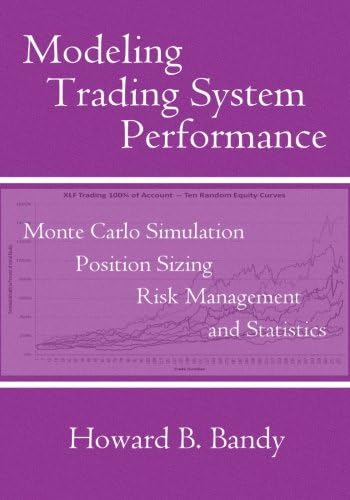
Modeling Trading System Performance: Monte Carlo Simulation, Position Sizing, Risk Management, and Statistics
Product ID: 12578400
Buy anything from 5,000+ international stores. One checkout price. No surprise fees. Join 2M+ shoppers on Desertcart.
Desertcart purchases this item on your behalf and handles shipping, customs, and support to Austria.
Trading system development, with emphasis on Monte Carlo simulation, position sizing, risk management, and statistics. Review: Five Stars - Thanks Review: Five Stars - Perfect.
| Best Sellers Rank | #1,736,546 in Books ( See Top 100 in Books ) #1,993 in Investment Analysis & Strategy |
| Customer Reviews | 4.0 out of 5 stars 22 Reviews |
L**F
Five Stars
Thanks
T**S
Five Stars
Perfect.
S**A
I was dismayed at first read but is now my *favorite* book on trading system development.
I became an active investor and a serious student of trading in 2008. In subsequent years, buoyed by my initial success I began intraday trading. After a lucky start in a bullish period, inadequate money management techniques caught up with me and led to disaster. During that period of soul searching in late 2011, I ordered Modeling Trading System Performance (MTSP). Excitedly, I skimmed through it and at first my heart sank. Why? I have Dr Bandy's other books and I consider them excellent. Why didn't I like this one at first glance? Because it laid out all the concepts I needed to *really* understand in order to build robust systems. My dismay was not at the quality of the book but at the recognition of all the things I needed to learn. Is learning to model trading systems useful? Turns out it is an extremely valuable and necessary first step before any system development should begin! Like all of Dr Bandy's books, this one is extremely well written with his characteristic attention to detail to every aspect including the layout, font-size, illustrations and step-by-step instructions. Complex topics are explained astonishingly well. At first read I could understood the individual concepts. It took me repeated readings to get the big picture but since that 'Aha!' moment, MTSP has become my *favorite* book on the topic of trading systems. This book provides the best framework that I've come across to begin thinking about trading systems and now I understand why this book omits specific buy/sell rules as they are just a small part of system development (and besides Dr Bandy has other books that address these topics). This book covers: - How to think about the basic statistics of a trading system -- expectancy, CAR, MDD. - An excellent discussion on how longer holding period increases risk. - Position sizing and the importance of understanding the distribution of trades. This is a pernicious problem that plagues every rosy back test result. The book links to an excellent excel plug-in to compute a realistic estimates of draw downs using Monte Carlo simulation and complete step by step instructions. I found the hands-on exercise in the appendix to be immensely beneficial in helping me learn and internalize the concepts. - How to determine the health of the trading system. This is a goldmine of information with practical techniques for this very important phase of monitoring trading system you placed into production. The treatment of this topic alone is well worth the price of the book! Will this book alone change anything? Yes! It changed the way I approach system development and validation. It has provided me a solid logical foundation and as I build new systems I find myself constantly referring to my dog-eared copy resplendent with neon post-it page markers. I think this book is one of those timeless classics and I can't thank Dr Bandy enough for writing it.
J**B
The comparison of trading to games like roulette, blackjack and poker were both interesting and ...
I had to read the book several times over to make sense of the ideas and how they fit around my existing knowledge of mechanical trading systems. To me, my main criticism is that the most important part of the book, i.e. step by step guide to conducting the Monte Carlo process to generate the drawdown and terminal wealth relative distribution curves were in the Appendix! I felt all the results would have been more convincing the first time around if this part was introduced first. The comparison of trading to games like roulette, blackjack and poker were both interesting and entertainment - probably the easiest part of the book to read. I'm still in the process of understanding and trying out the ideas in "Is it broken?". I agree with the ideas on a fundamental level - my statistics knowledge is a bit rusty (I'm an engineer) so I struggled to follow the logic line by line. Some more clear examples could have helped. Chapter 8 - Bar Length and Holding Period - I felt could've been written a little better. Fell asleep after page 3 of the chapter. Skipped to end of chapter summary when I next picked up the book. Chapter 10 - Position Sizing - this was not as I expected. I expected to see the effect of various mainstream position sizing techniques such as scaling in, scaling out, volatility adjusted (=f(ATR, account risk) ) on the drawdown and final equity curves. The appendix calculation shows an example of a fixed fraction (vs fixed ratio) position sizing in the Monte Carlo simulation. It would have been good to expand those appendix calculations to show how fixed ratio, scaling in and out would have been incorporated in those calcs. Chapter 9 - Tradables - this chapter felt like filler material. I failed to see the relevance of this to modeling trading system performance. Overall, it was a good book. I just wished the sequence of information presented in the book was a bit more orderly. I greatly benefited from reading the book, and it's given me some sound ideas on using MC simulation to measure risk, and some fundamental ideas on testing whether the system is broken - tools I can add to my belt when constructing these mechanical trading systems. Thanks for the read Howard.
C**L
Excellent addition to trading system literature!
“Modeling Trading System Performance,” one of several recent books by Dr. Howard Bandy, is devoted to analysis of trading performance. Beginning with a set of trades called the “best estimate,” Dr. Bandy shows in complete detail how to estimate the future drawdown, compute the maximum safe position size, and estimate the future profit potential. The best estimate set of trades can come from anywhere. It could be actual trades or backtest results. The trades could be an arbitrary set or a theoretical distribution. This book provides an excellent introduction to simulation, and its application to trading. The Monte Carlo analysis techniques described in the book are supported by a free Excel addin that can be downloaded from the book’s website. A major focus of the book is determining whether a trading system is healthy or broken. Several practical statistical tests are described. This book is a companion to Dr. Bandy’s “Quantitative Trading Systems” and “Mean Reversion Trading Systems.” The three complement each other wonderfully. I highly recommend this book, and all of his other books as well. All of them are important, valuable, and useful contributions to the literature of trading system development, analysis, and management. If you get an opportunity to hear Dr. Bandy talk, do not miss it. (Some of his presentations can be found on YouTube.) He is original, dynamic, and enthusiastic. His approach is straight-forward and completely devoid of smoke, mirrors, and fuzzy concepts. Everything he discusses has been tested and analyzed. He is ruthless in criticism of bad system development and bad trading advice. His theoretical background in mathematics, modeling, and simulation is unassailable. He has real-world experience as a trader, and consulting experience with managers of serious money.
R**N
Excellent Quantative Trading book highly reccomended
Ive been following Dr Howard Bandy since 2009 and have attended 2 of his excellent workshops and read all his books. I recommend you read all his books as they provide an ever deeper learning as you progress from book to book. This review therefore covers all three of his books . Quantative Trading Systems Modelling Trading System Performance Mean Reversion Trading Systems Howard provides an excellent quantitative methodology for System development testing and validation. More important he shows how to develop systems which suit your own personal psychology focusing on your tolerance for risk i.e. draw-down. As Howard points out, most traders stop trading because they experience a draw-down that exceeds their risk tolerance. Howard provides tools using position sizing, Monti-carlo analysis and probability based statistical analysis to help design and manage the system to help stay within your nominated risk tolerance. Equally important he gives techniques to evaluate performance to identify when a system moves out of sync with the market ie when the system should be taken off line to protect your capital. In summary ive spent many hours and dollars buying/reading trading books, attending seminars and trading courses. Howard's work stands head and shoulders above any of the others. If you are prepared to put the work into understanding the tools and methods in his books, im sure it will pay dividends, as it has for me.
R**I
Invaluable book on trading system performance
Among the numerous trading related books in my collection, this one is by far the most worn, thumbed-through, highlighted, margin-annotated book. The book is chock-full of practical techniques for assessing trading system performance. Howard makes some very powerful and sophisticated statistical tests accessible to autodidacts and relative novices in statistics like me. Being a mechanical systems developer and trader, I find the chapter "Is it Broken" one of the more powerful ones which addresses the issue of statistically sound methods of working out if the trading system is worth continuing trading at any given time. This is a subject not ordinarily dealt with by other authors in any objective detail. I would highly recommend this book to all systems traders.
C**I
Best practical and scientific book to evaluate and monitor a trading system
Dr. Bandy has a knack for explaining complex topics in an easy way. He presents a scientific method for evaluating and monitoring live trading systems. Not only does he present the theoretical framework in a clear and concise way but He also provides the step-by-step methodology to implement the evaluation and the monitoring through excel without any other additional software. Maybe the position sizing techniques could have been treated more extensively but overall this is an excellent book. The definitive guide for someone who wants to become a systematic trader by using the rigorous scientific method.
D**N
What did I just read?
hmm, I think he wrote this book to show how clever he is. It is not useful. At no point does he explain what he is trying to achieve, and then walk you through that objective in structured steps. It is just a stream of his writing and charts. It must have been very hard to compile all of this, well done... but I suspect he is not a trader that makes money, and has 100 excuses why he doesn't. He is a researcher.
W**Y
Trop de théorie
Je suis très déçu par ce livre car je pensais trouver des cas pratiques me permettant de tester la validité d'un système de trading. Ce bouquin est trop théorique
A**A
Excellent
Clear wriitten. Excellent book
Trustpilot
2 months ago
5 days ago