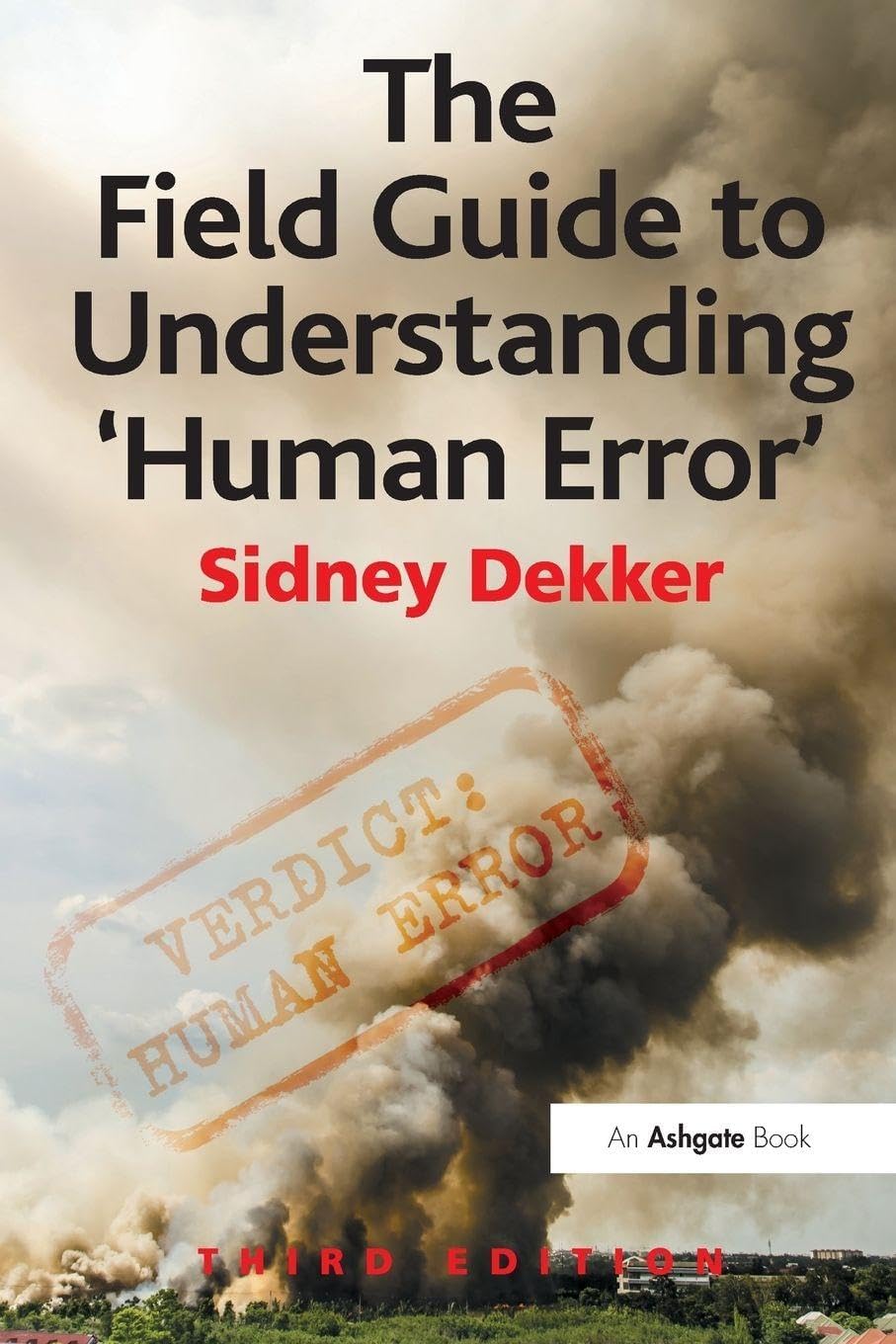
The Field Guide to Understanding 'Human Error'
Product ID: 12590283
Desertcart purchases this item on your behalf and handles shipping, customs, and support to Austria.
When faced with a ’human error’ problem, you may be tempted to ask 'Why didn’t these people watch out better?' Or, 'How can I get my people more engaged in safety?' You might think you can solve your safety problems by telling your people to be more careful, by reprimanding the miscreants, by issuing a new rule or procedure and demanding compliance. These are all expressions of 'The Bad Apple Theory' where you believe your system is basically safe if it were not for those few unreliable people in it. Building on its successful predecessors, the third edition of The Field Guide to Understanding ’Human Error’ will help you understand a new way of dealing with a perceived 'human error' problem in your organization. It will help you trace how your organization juggles inherent trade-offs between safety and other pressures and expectations, suggesting that you are not the custodian of an already safe system. It will encourage you to start looking more closely at the performance that others may still call 'human error', allowing you to discover how your people create safety through practice, at all levels of your organization, mostly successfully, under the pressure of resource constraints and multiple conflicting goals. The Field Guide to Understanding 'Human Error' will help you understand how to move beyond 'human error'; how to understand accidents; how to do better investigations; how to understand and improve your safety work. You will be invited to think creatively and differently about the safety issues you and your organization face. In each, you will find possibilities for a new language, for different concepts, and for new leverage points to influence your own thinking and practice, as well as that of your colleagues and organization. If you are faced with a ’human error’ problem, abandon the fallacy of a quick fix. Read this book. Review: Open your mind - This is a must read for anyone that deals in a world of errors. This book has much broader implications then just standard safety. It will also bring to light how we have errors. Review: First book on safety - This was an easy read. Excellent intro to old and new view on safety. I read it as part of a masters program on human factors and systems safety. It touches upon many central topics and the it is easy to follow the language (English is not my first language) . I would recommend this to anyone interested in safety.

| Best Sellers Rank | #152,658 in Books ( See Top 100 in Books ) #4 in Industrial Ergonomics #19 in Industrial Health & Safety #20 in Technology Safety & Health |
| Customer Reviews | 4.6 out of 5 stars 366 Reviews |
D**P
Open your mind
This is a must read for anyone that deals in a world of errors. This book has much broader implications then just standard safety. It will also bring to light how we have errors.
D**S
First book on safety
This was an easy read. Excellent intro to old and new view on safety. I read it as part of a masters program on human factors and systems safety. It touches upon many central topics and the it is easy to follow the language (English is not my first language) . I would recommend this to anyone interested in safety.
S**Z
very helpful at understanding the language and intent of accident ...
very helpful at understanding the language and intent of accident investigation and offers insight into the cause and effect of action taken in advance of adverse events
T**H
More light shed on The New View!
Thank you for returning to this critically important book to help many more people understand the New View in different ways. This edition's approach will resonate with many that need this transformation. An insightful and helpful reorganization of foundational content with many additional perspectives, this edition will help me communicate New View alternatives to those with ears to hear this good news!
W**R
Great application to software development
Read this on recommendation from a colleague in our book club. Mostly software developers and architects. Solid examples drawn heavily for transportation, but good application across other industries. Really helped open my eyes to where draw attention to human error instead of continuing investigation into systemic problems that we want to surface in our retros. Highly recommend.
I**S
Field Guide to Understanding Human Error
I read this book as part of preparation for a three day course on Human Performance Fundamentals, which was provided by Shane Bush from BushCo. The book was very informative and helped me a lot during the course, which was excellent.
T**R
Not bad, but padded like a bra on prom night
It's definitely worth a read, but it seriously needs the assistance of a professional editor before the next revision. The message is in there, buried under layers of redundancy so thick you'd swear they had a target word count they were aiming for. I can sum it up thusly: "You can't understand why an accident occurred until you discover why the actions taken that led up to it made sense at the time. Pointing out mistakes made along the path to disaster is nowhere near as useful as figuring out why the people who made them didn't know they were mistakes".
C**N
Completely mind blowing
This book plus Dr. Conklin's pre accident investigations has completely altered my thinking. I've been in the safety field for 15+ years.. my thinking of human error was misaligned.. I strongly recommend this book to anyone in HSE or operations or businesses that hurt people
R**N
Changed forever the way I think about safety and errors.
Excellent book with a slight tendency for repetition. The central ideas are clearly presented, and bear repetition as the resistance to these new ways of looking at human error can be considerable - actually fixing things is harder than blaming someone else. If you work at the 'pointy end' of a safety critical job or industry, ever have to fill in safety reports or analyse incidents, you should have read this book. It will help you. If you manage a safety critical industry you should adopt the philosophy of this book immediately. Mr Dekker's background is aviation safety and this comes out in his examples which tend to be aviation-heavy but not exclusively so. Nonetheless, his examples are made clearly and demonstrate strongly his arguments and the sense and practicality of his analysis. A really interesting read which will definitely help me in my efforts to stay out of trouble.
D**H
Gegen "Menschliches Versagen"
Hauptsächlich anhand von Beispielen der Luftfahrtindustrie zeigt Dekker anschaulich, wie wenig Sinn es macht, den Verantwortlichen zu suchen. Dies führt nur zu Informationsmangel und Rückzug, so dass sich der Fehler vermutlich wiederholen wird. Der bessere Weg ist herauszufinden, wie die Handelnden auf ihre Ideen kamen und wie man so verhindern kann, dass dem nächsten die gleichen Fehler passieren. Ein Bissche Theorie, dann viele klare Darstellungen und Konzepte, das Problem anzugehen.
R**O
Fundamental!
Sidney Dekker é, de longe, o melhor autor sobre a nova visão de segurança e fatores humanos. E esse livro é um dos primeiros dele, onde aborda de forma bem didática uma porção de conceitos fundamentais da área. Leitura obrigatória. Pena que ainda não tem traduzido.
M**Y
Great Book
Great book to read
W**M
A very usefull reference
Well written, easy to follow and very usefull to those of us who work in the field
Trustpilot
1 week ago
5 days ago