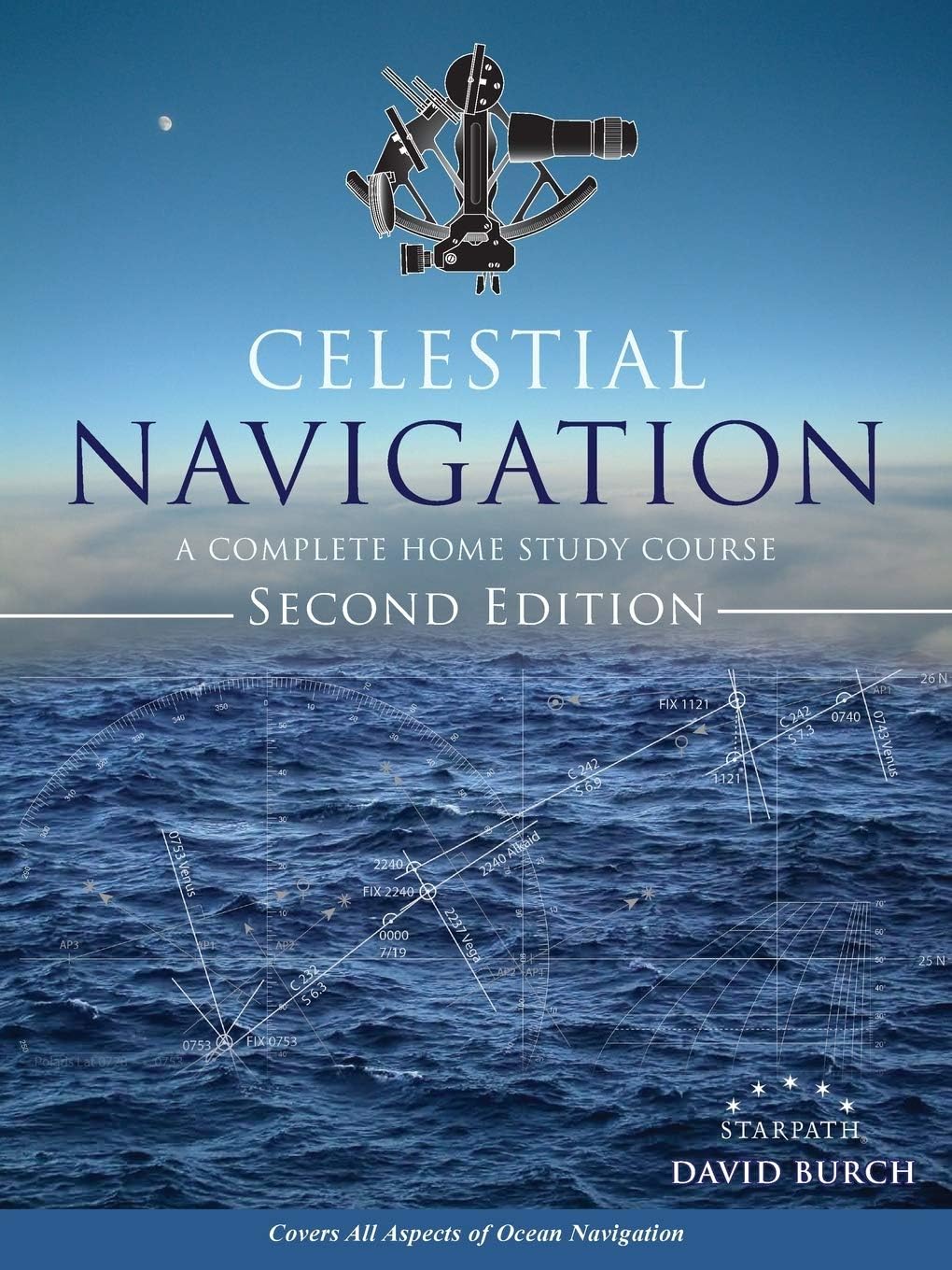
Celestial Navigation: A Complete Home Study Course, Second Edition
Product ID: 16050130
Buy anything from 5,000+ international stores. One checkout price. No surprise fees. Join 2M+ shoppers on Desertcart.
Desertcart purchases this item on your behalf and handles shipping, customs, and support to Austria.
This book has been used for 30 years, updated periodically as needed. More than 20,000 students have successfully learned ocean navigation from these materials and gone on to cross oceans or circumnavigate the globe. This book covers how to find position at sea from timed sextant sights of the sun, moon, stars, and planets plus other routine and special procedures of safe, efficient offshore navigation. No previous navigation experience is required. The only math involved is arithmetic (adding and subtracting angles and times). This is a practical, how-to-do-it book, which also includes clear explanations of how it works and how to do it well. Plus this book includes other crucial factors of ocean navigation besides just finding out where you are from the stars, such as logbook procedures, dead reckoning, error analysis, route planning, and more. At the end of this book, you will be ready for ocean navigation. The book includes: text, practice problems, tables selections, detailed glossary, and full solutions. Printable work forms, plotting sheets, and other resources are available at no charge from starpath.com/celnavbook. Our Fit-Slope Method presented in this textbook is cited in the latest (2017) edition of Bowditch: "The common method of averaging sights is the Fit-Slope Method, e.g. Burch, D. 2015, Celestial Navigation, Second Edition (Seattle, Starpath Publications) pp. 176-177." --Bowditch, American Practical Navigator, NGA Pub 9. Section 1805. Preface to the Second Edition. We are pleased to say that after ten more years of using this text we do not find reason to change the basic approach and methods of the teaching. We still use most of the same examples, which are now quite old, but that is the beauty of celestial navigation. It has not changed, so we do not benefit in any way from making all new examples, which would bring with them more chance of error in a book of many numbers. We have, however, notably improved and expanded the book. Each section has been updated and reformatted for a clearer presentation, often in response to student questions over the years. New graphics have been added and older ones all updated. There is much new content in the text, especially in the In-Depth chapter, including more detailed discussion of the sailings and more background on the principles. New sections were added on general ocean navigation and optimizing the fixes. We have also updated the electronic navigation section, as most ocean navigators will also be using other tools besides celestial. Review: If You Can Master This Book, You'll Be Ready For Transoceanic Celestial Navigation - This is a fantastic book, but be prepared for some deep study - and that's my kind of study! This is definitely a classroom-style textbook, and I can imagine being tutored along through the topics with an instructor along with fellow students. When you read thru each chapter and complete any of the study tests you may find therein, don't simply chalk the lesson up and move on to the next. Every chapter is a treasure trove of concepts, terminology, and procedures that you'll use in the future should you rely on the never-failing celestial version of GPS. Along with a basic overview in the choice and use of a sextant, Burch provides numerous work sheets for use after taking your sextant sights. He includes excerpts from Bowditch and several annual Nautical Almanac charts, which for the most part allows you to peer into the morass of trigonometry required for measuring and plotting the spherical triangles of celesital navigation. It's a fascinating subject, one which merits deep study with this textbook. I HIGHLY recommend this book with a reminder: This is not a simple, easy read. You'll find yourself thumbing back and forth through the pages, studying hard, testing yourself, copying and filling out forms, and leaving sticky notes that hang outside the pages for future reference. But when you're finished with it, you'll sure know celestial navigation. Review: This is an amazingly awesome textbook!!!! - OMG this is more than I expected. It is truly a celestial navigation home course that teaches you as if you were sitting there in the class. Starts out with the basics and progresses in a very concise and understandable manner. Because there is no student-instructor interaction (to clarify problems or explain material) I thought this might be overwhelming. The examples given and the explanations that follow allow you to review, re-do, re-do, and re-do the problems until you have a complete and thorough understanding of the processes. StarPath (of Seattle) is the school that uses this text and I actually contacted them when I had a question. They gave me a free 1-month WebCard pass to their public discussion board on-line and I was able to ask the instructor to explain something - and he did in a very quick manner. I would say that this book works well for me because I spent a lot of time looking at celestial navigation tutorials on-line and Googled everything - so I at least had a basis of understanding before starting. I'm not sure how easy it would be to start with this book (or any book) absolutely cold on the subject. If you are interested in this subject I suggest you buy "The Barefoot Navigator" by Jack Lagan first, watch the tutorials on celestial navigation at THE PRACTICAL NAVIGATOR ( [...] ), and then buy this book and your equipment needed.
| Best Sellers Rank | #85,627 in Books ( See Top 100 in Books ) #22 in Sailing (Books) #26 in Boating (Books) #340 in Transportation (Books) |
| Customer Reviews | 4.7 out of 5 stars 378 Reviews |
W**.
If You Can Master This Book, You'll Be Ready For Transoceanic Celestial Navigation
This is a fantastic book, but be prepared for some deep study - and that's my kind of study! This is definitely a classroom-style textbook, and I can imagine being tutored along through the topics with an instructor along with fellow students. When you read thru each chapter and complete any of the study tests you may find therein, don't simply chalk the lesson up and move on to the next. Every chapter is a treasure trove of concepts, terminology, and procedures that you'll use in the future should you rely on the never-failing celestial version of GPS. Along with a basic overview in the choice and use of a sextant, Burch provides numerous work sheets for use after taking your sextant sights. He includes excerpts from Bowditch and several annual Nautical Almanac charts, which for the most part allows you to peer into the morass of trigonometry required for measuring and plotting the spherical triangles of celesital navigation. It's a fascinating subject, one which merits deep study with this textbook. I HIGHLY recommend this book with a reminder: This is not a simple, easy read. You'll find yourself thumbing back and forth through the pages, studying hard, testing yourself, copying and filling out forms, and leaving sticky notes that hang outside the pages for future reference. But when you're finished with it, you'll sure know celestial navigation.
R**H
This is an amazingly awesome textbook!!!!
OMG this is more than I expected. It is truly a celestial navigation home course that teaches you as if you were sitting there in the class. Starts out with the basics and progresses in a very concise and understandable manner. Because there is no student-instructor interaction (to clarify problems or explain material) I thought this might be overwhelming. The examples given and the explanations that follow allow you to review, re-do, re-do, and re-do the problems until you have a complete and thorough understanding of the processes. StarPath (of Seattle) is the school that uses this text and I actually contacted them when I had a question. They gave me a free 1-month WebCard pass to their public discussion board on-line and I was able to ask the instructor to explain something - and he did in a very quick manner. I would say that this book works well for me because I spent a lot of time looking at celestial navigation tutorials on-line and Googled everything - so I at least had a basis of understanding before starting. I'm not sure how easy it would be to start with this book (or any book) absolutely cold on the subject. If you are interested in this subject I suggest you buy "The Barefoot Navigator" by Jack Lagan first, watch the tutorials on celestial navigation at THE PRACTICAL NAVIGATOR ( [...] ), and then buy this book and your equipment needed.
P**R
A Lot of Good Knowledge, but a Prescriptive Method of Teaching
By “prescriptive method” I mean that they show you a work form and tell you how to fill in the numbers without telling you what you are filling in or why. Some people prefer to learn this way. Personally I do not learn well from that sort of instruction. I have to understand what it is I am doing even if it is only in layman’s terms. However in Chapter 10 they do offer an overview. To be fair I must point out that this book is primarily intended to be a reference text for an instructor-led course, and perhaps with an instructor to answer questions it would work better. For home study you should start with Chapter 10. Chapter 10 is a good introduction to the basic concepts of celestial navigation. Then returning to the first nine chapters, where they provide the various forms and tell you where to find the numbers to put into those forms, you might not be quite so utterly lost. It is the nature of celestial navigation that there are a great many look-up tables that one must learn to use. I don’t see enough guidance in this book for beginners on how to interpret those tables. I am no stranger to look-up tables, but darned if I didn’t find many in both The Nautical Almanac and various Sight Reduction Tables to be initially confounding. Sure…once you see how they are laid out they are as dirt-simple to use as any look-up tables, but on first blush you can easily get confused. On the plus side Burch is quick to acknowledge many other beginners’ blunders and to point them out along the way. For an example: he is careful to explicitly teach how to add and subtract clock times and angles which at first can seem tricky when you have to carry over whole hours into the minutes or whole degrees into arc-minutes. Furthermore in various places throughout the book he will put in a notation along the lines of : “If you got the wrong answer go back and check this step for thus-and-such error.” A sign of a very experienced teacher, and a great comfort and help to those who are destined to make those blunders. (Myself included!) He also provides a great many practice problems with worked-out answers which are a huge help to any student taking any course in the subject. Even if you learn your celestial from some other source these worked examples would still be a good reason to purchase this book. Once you have got the concepts down (by use of this text or some other course) then moving along to Chapter 11 will reward you with a great wealth of advanced insight and interesting tips. I enjoyed Chapter 11 a great deal, but I already knew how to do celestial navigation when I read it. Regarding the Kindle edition: This book and course relies heavily on work forms. The work forms are actually very well laid out once you understand what it is you are looking for. Although I personally disdain reliance on work forms in preference for fully understanding what you are doing they would certainly be helpful in stressful or fatigued situations. Unfortunately it isn’t easy to flip back and forth in the Kindle book to the various forms, nor is it easy to flip back and forth to the snippets of the various tables from the Nautical Almanac and sight reduction methods. If you already understand that stuff the Kindle version is perfectly OK. You can enlarge any of the illustrations or tables and they are quite intelligible. On the other hand if you are hoping to execute the course with this book alone you would do better to acquire it in hard-copy format. The forms are also available at Starpath-dot-com and you really should buy yourself a hard-copy Nautical Almanac in any case – so you could tackle this particular shortcoming by downloading and printing out the forms and acquiring an almanac before you start. IMHO there isn’t a single course in celestial navigation that would not be greatly enhanced by having a hard copy Nautical Almanac on hand to thumb through even if it is a couple of years out of date. I highly recommend that any student of celestial navigation acquire this book, but I sincerely doubt that one can learn celestial navigation with this one book alone without an instructor to guide you. If an instructor is not available you will probably want to get a hold of a few additional books on the subject to supplement this one. However to be perfectly clear, I do not know of any other single book that will adequately teach you the subject on your own either. Chances are good that if you are attempting to learn this stuff on your own you will end up with at least a few books on the subject. The excellent features enumerated above far outweigh the few slight criticisms I have made so I rate this book five stars. It certainly deserves to be counted among the very best available on the subject.
A**R
Would like.
I like these items (toy) too . . . But without a boat, a navy and their tools or in the top 5%. Does not look save to go out by myself to enjoy life’s fun toy-tools. Or its peace of pie. Equally speaking. Good read and trainer, am sure it is, a game to coarse sailing out, as a sailors would wanta-bee do.
R**N
Practicing Celestial Navigation doesn't have to be difficult
Let me start with...this book is AWESOME! I haven't read every book on Celestial Navigation, but I have read one of the most loved books on the theory, and I will say that after learning from this book, the theory is rather irrelevant in the practice. Just as a child doesn't need to know what subjects/predicates, verbs, nouns, prepositional phrases and so on are to speak, you really don't need to know all the details of what the numbers mean that you plug into the convenient forms provided with this book (and online pdfs) to plot your position. I understand the theory rather well, and it did NOTHING to help me put it all on paper. This book is really like having your hand held. "Get 'this' number from 'here,' and 'this' number from 'here,' and add them together and you have everything you need. Nuts and bolts. You have the rest of your life to learn the theory. For now, all the theory is going to do is block your mind from realizing how straightforward the practice is. Learn the practice now. It's not a mystery.
D**A
The best of my 5 Cel Nav books. Started as a complete novice. Now I can cel nav without calculator or GPS.
All five are good, but only one really walks you through the actual steps, with examples, of cel nav. I wish I saw this book first. The beginning has just the right amount of theory, and then he jumps into the sextant, spending time on the vernier, actual old-school plotting, and then specific examples, ie., noon sighting, sun sighting, moon, and stars. Then there is a thick section of detailed "extra study" material, more or less like an appendix, filled with tips and tricks of all sorts. Finally, there is a glossary, examples, problems, answers, and copies of the forms he suggests you use from his firm. He even covers topics like "short dip" sightings, to use on a lake or land, when you are practicing and can't get out to blue water. This is critical for all us beginners.... I am sure that if you go through this book carefully, work the problems, and so on, and then set up your cel nav station, you will be able to do a pretty good job of cel nav from start to finish without so much as a pocket calculator or GPS: just his material, an Almanac or equivalent, a good watch, and a pencil, paper and some plotting tools. I started with the e-book although another reviewer complained about the reproduction of the figures and the difficulty jumping around in the book while working the problems. Like the other reviewer of the ebook, I bought the actual book, and continue to study from the ebook when the regular book is not convenient. If you only have $30 to spend on Cel Nav literature, skip the rest, although they are all good, and go straight to Burch. The ebook is a good add-on, but not easy to work in, secondary to inherent problems with ebooks. Burch has managed to put a whole bunch more into one easy book than anyone else has. I "guarantee" you won't be disappointed....... Amateur boater in Southern California
R**R
Great book, even for beginners
I became interested in sextant use when I learned they could be used on land. So I bought a used Davis plastic sextant and got to reading. Bought many many books. Most sub par, some plain terrible. Two I think are AI generated text. This book is number 1 of any I have read. It starts with teaching you how to read the various scales and verniers. Then on to noon day sightings. Work together problems and practice quizzes are a way of teaching, and I am learning. I have to say, the math although only addition and subtraction have made me scratch my head more than once. 24 hours and 360 degrees of rotation doesn't line up in the mind, and then using degrees (360) minutes (60) and tenths of a minite can provide interesting mistakes. Use the practice problems, the forms provided, and the convient links to print off your own hard copies as necessary. Since I am on land for now, in fact in the mountains of NC, a section on how to set up an artificial horizon is most important. Realizing this is how Lewis and Clark navigated and made some of the first maps of our western regions brings a sense of awe and reverence to their work. Sidetracked again, old timers disease. Two weeks into this home study class I am very happy with my teacher David Burch, the author. His way of explaining, with lots of diagrams is sinking in even though I have never been on blue water. So pleased with this book that I purchased another one of his "Emergency Navigon" Well, it's been a nice break, back to studying.
P**L
The Next-Best Thing to a Classroom
I have learned so much from this book! Working chapter by chapter it builds solid, practical knowledge on an admittedly complex and difficult topic. The practical examples and problems are realistic, real-world situations. They provide downloadable work sheets, plotting sheets and tables necessary to do on-board celestial navigation. A wonderful, readable, useful learning tool and reference source. All you need are sextant, watch and plotting tools, and of course a boat and ocean
A**O
The best book on the topic I have to date
Absolutely the best book, clear, complete, I had on the topic. I am Italian, of course I know English, but I can say it’s easier to study on this book compared to my native language ones. Highly recommended for those interested in Celestial Navigation (and in culture). Really outstanding.
G**Y
Great book
A very practical guide to celestial navigation with lots of worked examples and practice questions with answers.
A**N
Große Freude!
David Burch ist mir schon lange ein Begriff durch sein wunderbares Buch KAYAK NAVIGATION. Bin jetzt mitten drin in CELESTIAL NAVIGATION. Klare Sprache, gute Erklärungen. In vielen kleinen Schritten, angereichert mit Kontrollübungen und Wiederholungen, fasst man entspannt Fuß in der von vielen gefürchteten und gemiedenen Materie.
K**N
Muy completo y sencillo de seguir
El mejor libro para iniciarse o repasar el uso del sextante, muy detallado y con ejemplos para estrellas, planetas, sol... Calidad de impresión bastante mejorable.
S**E
Conforme à mes attentes
Très utile pour les utilisateurs novices de sextant. Le cadeau a été très apprécié. Ouvrage à conseiller pour les navigateurs
Trustpilot
1 month ago
5 days ago