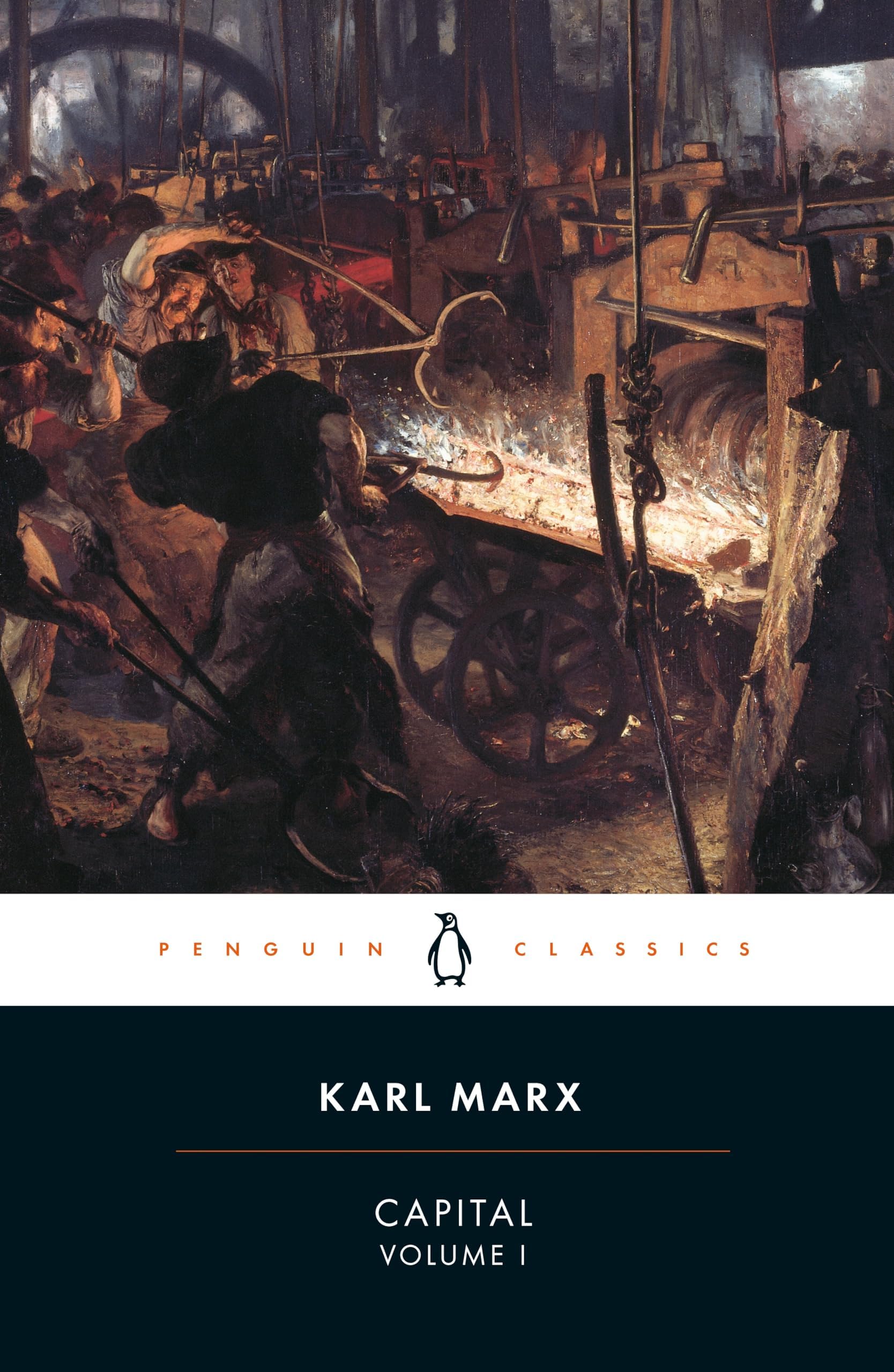
Capital: A Critique of Political Economy, Volume 1 (Penguin Classics)
Product ID: 1705068
Buy anything from 5,000+ international stores. One checkout price. No surprise fees. Join 2M+ shoppers on Desertcart.
Desertcart purchases this item on your behalf and handles shipping, customs, and support to Austria.
The first volume of a political treatise that changed the world One of the most notorious works of modern times, as well as one of the most influential, Capital is an incisive critique of private property and the social relations it generates. Living in exile in England, where this work was largely written, Marx drew on a wide-ranging knowledge of its society to support his analysis and create fresh insights. Arguing that capitalism would cause an ever-increasing division in wealth and welfare, he predicted its abolition and replacement by a system with common ownership of the means of production. Capital rapidly acquired readership among the leaders of social democratic parties, particularly in Russia in Germany, and ultimately throughout the world, to become a work described by Marx friend and collaborator Friedrich Engels as “the Bible of the working class.” For more than seventy years, Penguin has been the leading publisher of classic literature in the English-speaking world. With more than 1,700 titles, Penguin Classics represents a global bookshelf of the best works throughout history and across genres and disciplines. Readers trust the series to provide authoritative texts enhanced by introductions and notes by distinguished scholars and contemporary authors, as well as up-to-date translations by award-winning translators. Review: Not a polemic but a keeper nonetheless - There is an enormous collection of valuable information in volume 1 of Marx's Capital. Volume 1, moreover, serves very effectively as the first of three volumes in which Marx gives truly compelling evidence of his genius -- how else could one author come to terms with this massive account of the reality of capitalist production as Marx uniquely understands it? While it soon becomes abundantly clear that Marx was a master prose stylist, there is no mistaking the fact that he did not write for the ease and convenience of his readers. I can't imagine taking the full measure of this volume, much less the two volumes which follow, without the sustained help of explanatory material such as that provided by David Harvey, a veteran American academician who takes Marx very seriously indeed. Without question, even for exceptionally well informed and intellectually capable readers, this book is a bear. If you invest the substantial amount of time and prodigious effort needed to master it, you will definitely come to understand why Marxists become Marxists, and you may very well become one yourself. At the very least, you'll see the world differently, and you'll have a firmer grasp on the character of our contemporary world, not just its economic make-up, but in a socially expansive way. It's hard to imagine anyone reading the book carefully and with a modicum of understanding and coming away with the judgment that this is merely an ideologically motivated, long-winded exercise in willful self-deception and the deception of others. If you encounter someone who characterized Marx as a willfully wrong-headed ideologue, you may safely assume that you're dealing with someone who has not read Capital. Capital Volume 1 is, in fact, a richly informative and very difficult piece of world-class research. I imagine that most readers who take its full measure will come back to it again and again. I can't imagine doing justice to Capital Volume 1 without putting forth the kind of effort that makes for the creation of a life-long connection. Marx himself claims to have sacrificed his health, happiness, and family to writing the book. This has the pathetic sound of self-pitying exaggeration. But given what I know of Marx and the necessarily prodigious demands of the kind of work he produced, I'm sure he's being dispassionately truthful. You may be disappointed to find that Capital is much less polemical than it is rigorously analytical. That was my first response. For the long term, however, I realized the book is a keeper, and I acknowledged that I'd have to look elsewhere for a call-to-arms that is not also embedded in massive learning. It's true, of course that Marx was an active professional revolutionary, but he was also a world-class scholar with a prodigiously cultivated mind. Reading Marx makes me want to spend a year or two in the library of the British Museum, where Marx did his best scholarship. Marx and Charles Darwin exchanged fairly frequent correspondence. Everyone knows that Darwin transformed our understanding of the world and our place in it. Much the same is true of Marx's contribution to human knowledge. It's interesting to acknowledge that social and religious conservatism were barriers to the rightful dissemination of both. That Marx maintained an ongoing relationship with others of undeniable genius, such as Darwin, bespeaks Marx's own intellectual prowess and reflects his status as a wonderfully original thinker. In his own authentic way, Marx was at least as much a brilliant scientist as Darwin. Darwin changed the way we thought about ourselves, but Marx changed the way we live. Review: To those who wish to understand Marx & Capitalism in general. - This is a dense book that you must read as best as you can. The first volume contains basic block understand how capitalism comes to be. This book, however, can be complex enough to be tiresome as it contains a lot of information. If you get tired or you're at the point that you do not understand what you're reading, then stop and take a rest from reading. Missing information can be confusing to the continuous reading of this book, and to the next two volumes of The Capital. Another important aspect of this book is that this is not a one-read only to understand entirely. You might have to return to this book to completely understand what Marx is trying to present. The good thing about this book is that it achieves to be objective. It is not a book to lift one up into become a revolutionary, like some propaganda tries to claim. This book is truly trying to understand the birth, development and potential effects of capitalism. However, by understanding capitalism, one can understand and even reach Marx's conclusion of other books that Engels and Marx himself reach.















| Best Sellers Rank | #13,814 in Books ( See Top 100 in Books ) #10 in Political Economy #10 in Radical Political Thought #12 in Communism & Socialism (Books) |
| Customer Reviews | 4.7 out of 5 stars 1,274 Reviews |
N**L
Not a polemic but a keeper nonetheless
There is an enormous collection of valuable information in volume 1 of Marx's Capital. Volume 1, moreover, serves very effectively as the first of three volumes in which Marx gives truly compelling evidence of his genius -- how else could one author come to terms with this massive account of the reality of capitalist production as Marx uniquely understands it? While it soon becomes abundantly clear that Marx was a master prose stylist, there is no mistaking the fact that he did not write for the ease and convenience of his readers. I can't imagine taking the full measure of this volume, much less the two volumes which follow, without the sustained help of explanatory material such as that provided by David Harvey, a veteran American academician who takes Marx very seriously indeed. Without question, even for exceptionally well informed and intellectually capable readers, this book is a bear. If you invest the substantial amount of time and prodigious effort needed to master it, you will definitely come to understand why Marxists become Marxists, and you may very well become one yourself. At the very least, you'll see the world differently, and you'll have a firmer grasp on the character of our contemporary world, not just its economic make-up, but in a socially expansive way. It's hard to imagine anyone reading the book carefully and with a modicum of understanding and coming away with the judgment that this is merely an ideologically motivated, long-winded exercise in willful self-deception and the deception of others. If you encounter someone who characterized Marx as a willfully wrong-headed ideologue, you may safely assume that you're dealing with someone who has not read Capital. Capital Volume 1 is, in fact, a richly informative and very difficult piece of world-class research. I imagine that most readers who take its full measure will come back to it again and again. I can't imagine doing justice to Capital Volume 1 without putting forth the kind of effort that makes for the creation of a life-long connection. Marx himself claims to have sacrificed his health, happiness, and family to writing the book. This has the pathetic sound of self-pitying exaggeration. But given what I know of Marx and the necessarily prodigious demands of the kind of work he produced, I'm sure he's being dispassionately truthful. You may be disappointed to find that Capital is much less polemical than it is rigorously analytical. That was my first response. For the long term, however, I realized the book is a keeper, and I acknowledged that I'd have to look elsewhere for a call-to-arms that is not also embedded in massive learning. It's true, of course that Marx was an active professional revolutionary, but he was also a world-class scholar with a prodigiously cultivated mind. Reading Marx makes me want to spend a year or two in the library of the British Museum, where Marx did his best scholarship. Marx and Charles Darwin exchanged fairly frequent correspondence. Everyone knows that Darwin transformed our understanding of the world and our place in it. Much the same is true of Marx's contribution to human knowledge. It's interesting to acknowledge that social and religious conservatism were barriers to the rightful dissemination of both. That Marx maintained an ongoing relationship with others of undeniable genius, such as Darwin, bespeaks Marx's own intellectual prowess and reflects his status as a wonderfully original thinker. In his own authentic way, Marx was at least as much a brilliant scientist as Darwin. Darwin changed the way we thought about ourselves, but Marx changed the way we live.
J**O
To those who wish to understand Marx & Capitalism in general.
This is a dense book that you must read as best as you can. The first volume contains basic block understand how capitalism comes to be. This book, however, can be complex enough to be tiresome as it contains a lot of information. If you get tired or you're at the point that you do not understand what you're reading, then stop and take a rest from reading. Missing information can be confusing to the continuous reading of this book, and to the next two volumes of The Capital. Another important aspect of this book is that this is not a one-read only to understand entirely. You might have to return to this book to completely understand what Marx is trying to present. The good thing about this book is that it achieves to be objective. It is not a book to lift one up into become a revolutionary, like some propaganda tries to claim. This book is truly trying to understand the birth, development and potential effects of capitalism. However, by understanding capitalism, one can understand and even reach Marx's conclusion of other books that Engels and Marx himself reach.
B**O
gift
I don't know what this book is about. It was a request for a gift and he loved it
E**N
Great book
Marx was ahead of his time with this in depth critique of political economy
P**'
After '08 financial crash, can anyone seriously invalidate Marx's masterful critique of the capitalist mode of production?
Karl Marx spent ten years researching and writing Vol. 1 of Capital. He had originally assembled notes, letters, and manuscripts for six volumes, later paired down to two volumes (2 and 3), which he was unable to complete in his lifetime. After Marx's death, it was left to his close collaborator and friend, Frederick Engels, to edit and compile those for publication. I want to re-iterate what several other reviewers have already stated about what Capital is, but most importantly what it is NOT. It's secondary title is 'A Critique of Political Economy', that is: a highly developed criticism of the classical political economists that preceded Marx, primarily Adam Smith, David Riccardo, Thomas Malthus, Jean-Baptiste Say, John Stuart Mills, etc. and the system (capitalism) they sought to explain. It is NOT The Communist Manifesto, that is: it is NOT a 'communistic' or socialist 'program'. In fact, as others have previously stated, socialism is only mentioned once in Ernest Mandel's excellent introduction to this edition. In Capital, Marx's presents a devastating analysis of the 'capitalist mode of production' that, in light of the world wide economic crash of '08 (and continuing crises), is as relevant today as it was when first published in 1867. Further, the results of and failures,(both perceived and real) of the previously existing 'socialist/communist' states are completely irrelevant when judging the validity of both Marx's analytical method (dialectical materialism) and his conclusions about the 'capitalist mode of production'. When, in an interview with The Wall St. Journal, respected (and intellectually honest) bourgeois economist, Nuriel Roubini, declared that "Karl Marx said it right...capitalism can self-destruct", he was truthfully admitting what Marx had made evident 140 years ago. [...] If one wants to understand the roots and causes of economic crises, environmental destruction, gross wealth inequality, poverty, never ending wars and militarism, racism, sexism, unemployment, hunger and misery for billions across the globe, look inside Marx's Capital. It holds the key to unlocking those answers. I highly recommend (as several other reviewers have) David Harvey's excellent (free) on-line companion video series, 'Reading Marx's Capital'. Harvey is especially good when he relates what Marx wrote about in Capital to modern society today. davidharvey.org
L**T
Surprise!
This book surprised me. I expected a dry, boring, difficult tome that would not interest me in the long run. I was (mostly) wrong. Although some of it is quite tedious, some a bit repetitive, and parts that are incomprehensible,there are long stretches -- especially of the historical parts -- that are fascinating and read very well. I loved reading Chapter 10, On the Working Day. That's where we learn for sure that time is money, and the struggle for limits to the working day are the crux of the class struggle (still going on with hassles over vacation and sick leave, for example). It is the worker's time that gives value to the commodity, and the endless accumulation of commodities is what capitalism is about. I also liked Chapter 15, on Machinery and Large-Scale Industry (in large part because technological history is something that interests me anyhow). And all of Part 8, "So-Called Primitive Accumulation," was fascinating. That is where we see the ultimate contradiction of Capitalism, its dependence on perpetually accumulating more, compounded annually, forever. Such endless growth comes largely from dispossessing others of what they already had, and endless exploitation of the earth's resources, ad infinitum. David Harvey, who has taught Capital Volume 1 at City University of New York for many years said that he has considered teaching the course backwards, beginning at the end with Part 8 so that the students would have the historical context before going into the technical parts. I think I could also recommend that anyone undertaking Capital to read Part 8 first. It will surprise you what a really good writer Marx was, when he wanted to be. It takes a lot of guts to launch into a thousand page tome, written 150 years ago on one of the driest, most dismal of all subjects: political economy. It is for that reason that I used the free on-line lecture series by David Harvey from his course on Marx at City University of New York, and used it as my guide as I went through the book. Without such a guide, I probably wouldn't have tackled it but with the guide it is more than worth the effort. Buy the Penguin Classics edition of Capital and download the lectures, one at a time and when you are finished you will be far better educated than you are now!
A**S
please read the book before reviewing it!
Reading the "reviews" of Capital here on Amazon.com, a person who has read the book can see that most "reviewers" have not even troubled themselves read the book! Instead of taking the time and energy to plow through this work, many would rather get on a soap box and ramble on about their own views thereby "reviewing" the work. I read the entire book from cover to cover. Not an easy task. It took me more than a year with persistence! But I did it. Socialism is not mentioned once the the actual work itself. (Of course it is mentioned in the 87 page Introduction which some of the "reviewers" might have bothered to skim through!) What is the name of the book? Capital! Not Communism or Socialism! One who has bothered to read this long book knows that the book has nothing to do with Communism. The book was supposed to form a scientific explanation of what the Capitalist mode of production was and how it formed and its' inner workings. Marx felt that after writing the pamphlet Manifesto of 1848, he owed it to the world tho explain what Capitalism was. It is a microscopic examination of the capitalist mode of production in mid-nineteenth century England. Granted that things have changed since 1850 England, the basic core of Capitalism hasn't changed. The man was brilliant, he obviously spent a lot of time formulating an understanding of what Capitalism is. It was an eye opener for me into what Capitalism really is. It was stimulating to see how Marx in the work slowly but surely synthesizes his successive points one by one thereby building a model of the Capitalist mode of production for one to examine. My only complaint was that it was too long. He could have said what he had to say in 200 pages rather than 800.
K**A
no damage on delivery and price good
delivered with no damage, book itself - go figure it out
E**.
Good book
No problems whatsoever
A**C
Essential reading for revolutionaries
The most important book ever written. Be sure to read it in a reading group with other comrades. This is a tough text to tackle completely on your own.
V**R
The book that I want
The book came in perfect conditions
新**水
わかりやすい
ある程度の語学力は必要だが、新日本出版の新版資本論に比べ、はるかにわかりやすい。もっとも、新日本の方も、訳の参考に必携ではあるが。
T**L
Gelecek kırmızı, gelecek sosyalist
Sermayenin yıkıcı ve diyalektik bir eleştirisi. İkinci ve üçüncü ciltleri de mutlaka ardı ardına (ve sonra tekrar tekrar) okunmalı.
Trustpilot
4 days ago
1 week ago