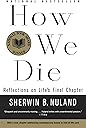

Desertcart purchases this item on your behalf and handles shipping, customs, and support to Austria.
NATIONAL BOOK AWARD WINNER • NATIONAL BESTSELLER • The definitive resource on perhaps the single most universal human concern: death. Even more relevant than when it was first published, this edition addresses contemporary issues in end-of-life care and includes an all-embracing and incisive afterword that examines the state of health care and our relationship with life as it approaches its terminus. How We Die also discusses how we can take control of our own final days and those of our loved ones. "Nuland's work acknowledges, with unmatched clarity, the harsh realities of how life departs… There is compassion, and often wisdom, in every page." — San Francisco Examiner Review: For everyone expecting another to be approaching death. - And for your own preparations, too. A classic work, lays out what we want to know but do not wish to look out. Respectful and almost reverent. The packaging was astonishingly good-- rather like desertcart's in the mid-1990s. Book was slipped into a crisp plastic sleeve; documents folded and wrapped around the lower edge; set into a cardboard 3/4 sleeve; snugged into a waterproof envelope with a hand-written thank you from the seller. Thank You. I live in a rural area with no postal delivery, and the postal workers tend to roll or fold books to fit them in the P.O. boxes. No chance of that here, and no bent/banged corners. Review: Very Good Book - "How We Die" comprises individual stories taken from a physician's close looks at and through the dying process. Especially enjoyable is that it described the illnesses and pathologies in layman but partly technical language. Much of the book's value was in the frank descriptions of the diseases. In an early chapter Dr. Nuland is still a third-year medical student taking a patient's history, when the patient suffers a severe cardiac event. The thriller begins -- Nuland steps through rapid-fire, inexperienced, yet probably good decisions, and immediately cuts through the breastbone. Holding the man's defibrillated heart in his hands, he tries to massage it back into sync. Nuland explains how a phone call from the patient's spoiled, college-age daughter had set off an effect on his constricted arteries, which, combined with his life-style choices (exercise, diet, substance-intake) genetics, and age, caused a breaking off of plaque, creating a blood clot (ischemia) and finally the heart's starvation of the blood's oxygen-carrying hemoglobin. Perhaps an unintended result was that I learned, in a socio-economic context, how 18th Century English society routinely allowed young, poor, meagerly-paid boys to be hired to climb inside of chimneys to clean them -- and about the horrific scrotum cancers and visceral diseases they contracted. The section on Alzheimer's Disease covers its physiological impact, level-by-level, and was an eye-opener for me. Nuland has been deeply touched by his experiences and conveys this well. This is an amazing look inside a physician's head, the sort of detached, frank, professionalism that lurks there, and the full panoply of empathy and human feeling. One chapter is on an AIDS patient's downward spiraling journey, mixed with a sort of chronology or history of HIV. This is a seven-page history of the discovery of AIDS, and related pharmacology and forensics. Reading San Francisco newspapers my whole life has kept me informed of this insidious disease's past so I would have actually appreciated an even more detailed accounting. Missing is a detailed accounting of the fascinating race in isolating the AIDS retrovirus between the CDC and Pasteur Institute in Paris. Along with his experiences, Nuland also expresses opinions and a philosophy revolving around his work, which also gives this book value. He presents both sides of the euthanasia issue, only going as far as to criticize a particularly questionable case. He talks about the value of the family doctor, death with dignity, death by "old age" (though a doctor never can write this on the death certificate, says Nuland), suicide, and euthanasia. It is on death itself where Nuland may be his most eloquent. This book is excellent as a gift to someone who's lost a loved one to the ravages of long-enduring, punishing, terminal diseases. Someone gave me a copy of this book after I'd lost my close grandfather to a debilitating suite of diseases. It was very soothing to read Nuland's book after his death. I plan to buy several more copies. Had this book been longer and more detailed I would have given it 4-1/2 or 5 stars, instead of 4.


| Best Sellers Rank | #40,527 in Books ( See Top 100 in Books ) #59 in Death #85 in Anatomy (Books) #164 in Grief & Bereavement |
| Customer Reviews | 4.4 out of 5 stars 1,611 Reviews |
C**U
For everyone expecting another to be approaching death.
And for your own preparations, too. A classic work, lays out what we want to know but do not wish to look out. Respectful and almost reverent. The packaging was astonishingly good-- rather like Amazon's in the mid-1990s. Book was slipped into a crisp plastic sleeve; documents folded and wrapped around the lower edge; set into a cardboard 3/4 sleeve; snugged into a waterproof envelope with a hand-written thank you from the seller. Thank You. I live in a rural area with no postal delivery, and the postal workers tend to roll or fold books to fit them in the P.O. boxes. No chance of that here, and no bent/banged corners.
L**D
Very Good Book
"How We Die" comprises individual stories taken from a physician's close looks at and through the dying process. Especially enjoyable is that it described the illnesses and pathologies in layman but partly technical language. Much of the book's value was in the frank descriptions of the diseases. In an early chapter Dr. Nuland is still a third-year medical student taking a patient's history, when the patient suffers a severe cardiac event. The thriller begins -- Nuland steps through rapid-fire, inexperienced, yet probably good decisions, and immediately cuts through the breastbone. Holding the man's defibrillated heart in his hands, he tries to massage it back into sync. Nuland explains how a phone call from the patient's spoiled, college-age daughter had set off an effect on his constricted arteries, which, combined with his life-style choices (exercise, diet, substance-intake) genetics, and age, caused a breaking off of plaque, creating a blood clot (ischemia) and finally the heart's starvation of the blood's oxygen-carrying hemoglobin. Perhaps an unintended result was that I learned, in a socio-economic context, how 18th Century English society routinely allowed young, poor, meagerly-paid boys to be hired to climb inside of chimneys to clean them -- and about the horrific scrotum cancers and visceral diseases they contracted. The section on Alzheimer's Disease covers its physiological impact, level-by-level, and was an eye-opener for me. Nuland has been deeply touched by his experiences and conveys this well. This is an amazing look inside a physician's head, the sort of detached, frank, professionalism that lurks there, and the full panoply of empathy and human feeling. One chapter is on an AIDS patient's downward spiraling journey, mixed with a sort of chronology or history of HIV. This is a seven-page history of the discovery of AIDS, and related pharmacology and forensics. Reading San Francisco newspapers my whole life has kept me informed of this insidious disease's past so I would have actually appreciated an even more detailed accounting. Missing is a detailed accounting of the fascinating race in isolating the AIDS retrovirus between the CDC and Pasteur Institute in Paris. Along with his experiences, Nuland also expresses opinions and a philosophy revolving around his work, which also gives this book value. He presents both sides of the euthanasia issue, only going as far as to criticize a particularly questionable case. He talks about the value of the family doctor, death with dignity, death by "old age" (though a doctor never can write this on the death certificate, says Nuland), suicide, and euthanasia. It is on death itself where Nuland may be his most eloquent. This book is excellent as a gift to someone who's lost a loved one to the ravages of long-enduring, punishing, terminal diseases. Someone gave me a copy of this book after I'd lost my close grandfather to a debilitating suite of diseases. It was very soothing to read Nuland's book after his death. I plan to buy several more copies. Had this book been longer and more detailed I would have given it 4-1/2 or 5 stars, instead of 4.
S**H
Great read; very interesting and thought provoking
The language is superb! Dr. Nuland writes about the scientific medical truths in such an artistic and beautiful language. I like the way he starts off a serious subject with such drama and fiction (so it seems); but then tapers it to the serious facts of life. He draws us from a fiction to nonfiction with interest and enthusiasm. He makes the facts of death so real and natural that it takes the fear of death out of us; it becomes quite acceptable. His language really is beautiful. The way death consumes each and every one of us, whether we are healthy or sick, is so fascinatingly put. He has explained how he saw his grandmother pass away; this has shed a lot of light on the facts about death for me. The analogy with which he described the cancer cell to young unruly adolescent has a touch of humor and at the same time describes the truth about the malignant cells. It is so beautifully written. For someone who is not a doctor or someone who is more a dreamer in the fiction world, this book (which is a nonfiction-medicine) is never boring from beginning to the end. He has caught my attention from the beginning to the end. His language captivated my attention; I have never read a nonfiction book with such enthusiasm and interest before. I am able to face the facts of death more logically now. This book was an excellent read. I would recommend this book to anyone who wants to accept death as a natural phenomenon and to make peace with yourself and with your loved ones at the time of death.
H**J
The medicalization of death from a physician's viewpoint, we may fear death, let's accept it on our own terms
Love this book, and love how the author wrote from his heart. He started the book saying it was written as a "conversation" and I did feel that. I felt like he was sharing himself with me. His personal thoughts, feelings, his humanity. His feelings as a physician but also his personal feelings as an observer of people. It's quite interesting he wrote the book in 1994, then added in a short chapter in 2010 and he died in 2013 at home, at 83 years of age. So it was interesting to hear it from his perspective from years and years of experience. He talks about "ars moriendi" the art of dying the good death... "is nowadays made difficult by the very fact of our attempts at concealing and sanitizing, and especially preventing, which result in the kind of deathbed scenes that occur in such specialized hiding places as intensive care units"... "the patient dies alone among strangers: well-meaning, empathetic, determinedly committed to sustaining his life, but strangers nonetheless. There is no dignity here" He makes an amazing point "Nowadays, the style is to hide death from view".... "death is therefore to be secluded and to occur in sequestered places.... began discreetly in the 1930's and 1940's and became widespread after 1950.... Our senses can no longer tolerate the sights and smells in the early nineteenth century that were part of daily life, along with suffering and illness. The psychological effects have passed from daily life to the aseptic world of hygiene, medicine and morality. The perfect manifestation of this world is the hospital, with it's cellular discipline. Although it is not always admitted, the hospital has offered families a place where they can hide the unseemly invalid whom neither the world nor they can endure.... 80% of American deaths now occur in the hospital (written in 1994) the figure has gradually risen since 1949 when it was 50%, in 1958 it reached 61% and in 1977 it was 70%."... Update from 2010 section "at the present time, 40% of Americans die in acute care hospitals" ..."dropped to as low as 20% in relatively rural areas and 50% to more desely populated areas, which no doubt reflects the growing influence of outpatient palliative care and the autonomy, driven insistence on dying at home".... "we have YET FAILED to DE-medicalize death" (all caps mine) "Nowadays, the style is to hide death from view"
R**E
Could be trimmed down by 1/2 and still get all the points across
The author does deliver in detailing some of the ways most people tend to die, which is good information for anyone unaware of what actually is likely to happen. Being a retired RN of almost 4 decades and having spent much time in both ICU and home hospice work, I agree with the author that death is very rarely what we hope it will be. It is however much better the further you stay away from conventional medicine and remain close to comfort care only. Staying away from the last ditch techno efforts is a great decision in virtually every case. What I didn't appreciate was the extensive use of unnecessary words to make his point and the overuse of words not typical in most people's conversations. This gave the impression of some snobbishness. He also tends to see himself as above or special in humanity due to his profession as a surgeon. Yes, it gives him a unique perspective (all of us have a unique perspective), but it doesn't make him better morally or ethically. He does seem to have trouble connecting his ideals and his behavior. The book is worth the read, although it is sometimes difficult to tolerate the excessive word usage.
V**S
An Important Book With Lasting Value
An excellent book... I wish I could thank the author for writing it, but he himself passed away from prostate cancer. I found the book very helpful as I try to heal from the death of my mother. From Nuland's detailed descriptions, I realized that it was not possible to treat her with medication, and that it would not have been possible to save her life.
S**D
Depressing to say the least
Information wise this was a very good book. Very informative although a bit outdated now. However the more I read, the more depressed I became. This book will do that to you. To be told all the ways your body can (and will) betray you and eventually your breakdown into usually (according to this book) a long slow process of suffering and dying, is just depressing and unsettling. Yes, we all know we die eventually, but as the book states in the beginning, we all hope and believe that we will skip the long suffering and pain part and just die in our sleep quickly and painlessly. Most of us do labor under that belief, and I think that is what lends to sanity in most of us, for if we knew for sure that it would be otherwise we would live each day in fear and distress waiting for the pain and suffering to begin that will burden our family, destroy our life as we know it and end miserably. Again, the book itself is chock full of informative processes of the body and exactly what and how these processes go awry to kill us off, so kudos for that. But be warned, you will not feel warm and fuzzy after reading this.
S**Y
How We Die Helps
I started How We Die because I wanted the facts and got so much more. I recommend this book to anyone whether or not they are facing the imment death of a loved one, like I am. Dr. Nuland writes beautifully, and discusses a whole range of issues we face both living and dying. He gave words to some of my feelings in ways that are both compassionate yet realistic. For example, he discusses the use of medical technology not to cure but to prolong life as heartbreaking to the individual and the family and as "breaking the purse of society" so that we are less able to care for those whose time has not yet come. He writes about hope and the need to identify hope that acknowledges that none of get out of this alive forever. He uses a mixture of stories about individuals along with facutal descriptions and his philosophy in a way that kept me reading. The book was published in 1993 and so the chapters on Alzeihmer's Disease and AIDs are probably (fortunately) out of date. I would have wished that Dr. Nuland could have up-dated these chapters, but unfortunately he died in March of this year. I hope that he died as he hoped he would. I know he contributed to my understanding and ability to cope with inevitable death of loved ones.
Z**M
very nice
great book to read!
V**H
A must read for everyone as everyone has to encounter death.
I started reading this book when my grandmother passed away. This book has comforted me beyond words and has given a completely new and I will say necessary perspective to death. It not only helps with closure to whatever extent it is possible, but also prepares one for the future times where we will be taking life-death decisions either for ourselves or our loved ones.
O**O
Brilliant, just brilliant. A must-read for any human being.
A life-changer (or should I say death changer) for anyone that ever wondered how do we cease to exist. The truth is as blunt as blunt can be and keeps your death expectations at bay.
P**S
How We Die is a book that stays with you
It’s thought-provoking, unsettling, and strangely enlightening all at once. Death is final. But getting there is far more complicated than most of us realise. The book looks closely at the illnesses that most often lead to death and explains what actually happens to the body. Reading it can be frightening at times, but it also removes a lot of mystery. You come away understanding that dying is usually a process, not a single moment. What really stood out to me was how clearly it shows the impact on everyone involved. Not just the patient and their family, but the doctors and nurses too. Medicine can make people seem hardened, yet this book shows how exposed and vulnerable medical staff can feel when faced with death over and over again. This is not a cheerful read. It can be depressing, and at times uncomfortable. But death doesn’t become easier by ignoring it and it will happen to everyone Overall, it’s a powerful and honest book. Difficult, yes. But worth reading.
J**N
Still reading it
This delightful man is so very interesting in how he compiles words thoughts ideas brilliance intelligence together. The language is quite understandable, as I have just retired from a career in nursing. The most interesting, is how we come away with the concept that we must stop the death denying and death defying ways we have been so locked in to.
Trustpilot
3 days ago
1 month ago