

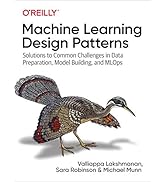
Machine Learning Design Patterns: Solutions to Common Challenges in Data Preparation, Model Building, and MLOps
Product ID: 226318419
Buy anything from 5,000+ international stores. One checkout price. No surprise fees. Join 2M+ shoppers on Desertcart.
Desertcart purchases this item on your behalf and handles shipping, customs, and support to Austria.
The design patterns in this book capture best practices and solutions to recurring problems in machine learning. The authors, three Google engineers, catalog proven methods to help data scientists tackle common problems throughout the ML process. These design patterns codify the experience of hundreds of experts into straightforward, approachable advice. In this book, you will find detailed explanations of 30 patterns for data and problem representation, operationalization, repeatability, reproducibility, flexibility, explainability, and fairness. Each pattern includes a description of the problem, a variety of potential solutions, and recommendations for choosing the best technique for your situation. You'll learn how to: Identify and mitigate common challenges when training, evaluating, and deploying ML models Represent data for different ML model types, including embeddings, feature crosses, and more Choose the right model type for specific problems Build a robust training loop that uses checkpoints, distribution strategy, and hyperparameter tuning Deploy scalable ML systems that you can retrain and update to reflect new data Interpret model predictions for stakeholders and ensure models are treating users fairly Review: A useful book for a n00b like me with a background in programming - My background: I'm an expert software engineer (C++, Java, etc) and proud n00b at machine learning. I've read the O'Reilly "AI and Machine Learning for Coders" book and many online articles. I have a background in trading/financial software, which exposed me to many statistical terms in this book. In the past, PhD level physics/math quants would typically handle those topics and this book has helped me realize some gaps in my knowledge and fill them (sometimes via online search). I can now at least reason about those concepts better even if I don't yet understand the details. I'm 1/3 into the book (so maybe premature for 5 stars) and it's been a dense but interesting read so far. There have been times where I have to lookup terms but the material has still been approachable. The language in the first couple chapters could probably be simplified some but it was sufficient for me with a lot of coffee. I expect to still have very incomplete knowledge after finishing this book due to lack of practical experience. However, my goal is to build a large scaffolding of knowledge/concepts on ML that I can use as a foundation for future learning and broaden my toolbox before I start hacking code. When I was learning C++, I found the Gang of Four book "Design Patterns" accomplished a similar goal to help bridge the gap between academic knowledge and practical software engineering. Much like with the GoF book I suspect I may be re-reading parts of this book in the future when my knowledge has matured. Some may prefer doing a lot of ML coding before reading this book, but I like to have a lot of background knowledge/tools before tackling code - personal preference I guess. I seem to have discovered an error/typo regarding "precision" vs "recall" in chapter 3: Page 135 paragraph 2: "If we care more that our model is correct whenever it makes a positive class prediction we'd optimize our prediction threshold for recall". I think the last word in that sentence should be "precision". The terms are defined on page 124 paragraph 2. Review: Good to fill gaps in knowledge and become aware of many things that are done subconsciously - I thought this was a great book for providing people with an understanding of the toolkit that ML engineers need to know when making Machine Learning models. As a side note, I bought this to be better prepared for ML architecture and design interviews. If you are in a hurry, I think the content in Chapters 2, 3, and 4 are great. 5 was somewhat relevant for me and Chapters 6, and 7 are not really relevant until you are actually neck-deep in the models, so they did not really apply to me. Chapter 8 was fantastic since it had a Common Patterns by Use Case and Data Type section, and enumerated many different types of problems and the tools that one might use to tackle them. I am satisfied with what I got from this book.





| Best Sellers Rank | #682,497 in Books ( See Top 100 in Books ) #91 in Machine Theory (Books) #132 in Business Intelligence Tools #1,231 in Artificial Intelligence & Semantics |
| Customer Reviews | 4.6 out of 5 stars 411 Reviews |
J**O
A useful book for a n00b like me with a background in programming
My background: I'm an expert software engineer (C++, Java, etc) and proud n00b at machine learning. I've read the O'Reilly "AI and Machine Learning for Coders" book and many online articles. I have a background in trading/financial software, which exposed me to many statistical terms in this book. In the past, PhD level physics/math quants would typically handle those topics and this book has helped me realize some gaps in my knowledge and fill them (sometimes via online search). I can now at least reason about those concepts better even if I don't yet understand the details. I'm 1/3 into the book (so maybe premature for 5 stars) and it's been a dense but interesting read so far. There have been times where I have to lookup terms but the material has still been approachable. The language in the first couple chapters could probably be simplified some but it was sufficient for me with a lot of coffee. I expect to still have very incomplete knowledge after finishing this book due to lack of practical experience. However, my goal is to build a large scaffolding of knowledge/concepts on ML that I can use as a foundation for future learning and broaden my toolbox before I start hacking code. When I was learning C++, I found the Gang of Four book "Design Patterns" accomplished a similar goal to help bridge the gap between academic knowledge and practical software engineering. Much like with the GoF book I suspect I may be re-reading parts of this book in the future when my knowledge has matured. Some may prefer doing a lot of ML coding before reading this book, but I like to have a lot of background knowledge/tools before tackling code - personal preference I guess. I seem to have discovered an error/typo regarding "precision" vs "recall" in chapter 3: Page 135 paragraph 2: "If we care more that our model is correct whenever it makes a positive class prediction we'd optimize our prediction threshold for recall". I think the last word in that sentence should be "precision". The terms are defined on page 124 paragraph 2.
E**E
Good to fill gaps in knowledge and become aware of many things that are done subconsciously
I thought this was a great book for providing people with an understanding of the toolkit that ML engineers need to know when making Machine Learning models. As a side note, I bought this to be better prepared for ML architecture and design interviews. If you are in a hurry, I think the content in Chapters 2, 3, and 4 are great. 5 was somewhat relevant for me and Chapters 6, and 7 are not really relevant until you are actually neck-deep in the models, so they did not really apply to me. Chapter 8 was fantastic since it had a Common Patterns by Use Case and Data Type section, and enumerated many different types of problems and the tools that one might use to tackle them. I am satisfied with what I got from this book.
S**U
Has some helpful uses
The books is mostly from a computer science prospective. I am from an engineering background so my review may be biased. It covers design patters for data treatment, model design to MLOPs. I like the first two sections and my review is based on them. It provides alternative design patterns that I did not know before and they are purely practical. No theories involved
J**C
Must read for serious machine learning developers
This is a must-read for scientists and practitioners looking to apply machine learning theory to real life problems. I foresee this book becoming a classical of the discipline’s literature. Very well written and comprehensive description of concepts and applications of design patterns.
E**O
Must have as Data Scientist
This book contains a lot of good practices in a easy to read way, so you don't have to digest all the white papers online. I'd love to have the e-book version so I could read some hints while I run the Jupyter Notebooks, but seems that the publisher doesn't allows you to get the e-book with the book so you must buy both.
J**R
Excellent and well-written book on design patterns for ML
The book does a great job in explaining the design pattern with good examples.
R**.
Excellent
This is well written with fabulous examples throughout. It was reassuring to me to see patterns that I use in practice are documented here and there were plenty of inspirational ideas, too.
X**U
The Long-awaited ML design patterns book
Got to know this book from a LinkedIn book review and thought it would fill in the gap of practical ML design patterns. Finished 4/5 of the book and expect to keep it close to my desk. Highly recommended.
M**R
Very interetsed book for Machine Learning users
The book is written in a very good way making you go through the chapters without any difficulties. Not suitable for very beginners which do not have any ML background. The book doesn't discuss the ML basic.
S**A
It should be read, instead as, ML Best Practices Cookbook
"ML Design Patterns" is a misleading title. I was very excited to read it cover-to-cover after checking the title, and that the authors drew parallels to Design Patterns in Software Engineering. Their patterns looked more like hacks/tricks than Design Patterns. I still am not sure what/how exactly Design Pattern should be -- but certainly they should go beyond proving tips and tricks. For example, I was more interested in "problem abstractions" and then provide a map to a "solution template". Lot of techniques that exist in the wild today can be mapped to simple problem types, and as a results, same technique can be applied, and avoid reinventing the wheel -- think of "canonical" forms in the optimisation literature. Similar things exists in Statistics literature also. From models persepctive, the likes of Linear Models, Generalized Linear Models, Structural Equation Models, Seemingly Unrelated Regressions, Measurement-Error-in-Predcictors etc. There are quite a many. While it is impossible to create a taxonomy out of it, at least, I hoped some exercise in that direction would have taken place. What I was looking for in Design Patterns is: <IF> your response is binary (0/1), both features are categorical, objective is to predict responses at the unobserved combinations. <Then> Solution template The above problem is a "pattern" -- Collaborative Filtering, Netflix movie type, Item Response Theory, Logistic Regression -- all are different names they go with, depending on the reader's familiarity/ domain knowledge. The above is simply the "model" dimension. They are are other dimensions concerned with data, pre-processing, evaluation etc. In summary, I think that Design Patterns is a too strong word they used and probably they have not done justice to it. Instead, someone should read it as a cookbook of ML Best Practices, and things to watch out for, while implementing (not so much of a design). From that perspective, this book does justice.
J**A
現場で機械学習を実践する人には是非お勧めしたい本
本書は実際にプロダクトに組込んで、本番環境にデプロイされる機械学習モデルを開発する機械学習エンジニアのためのデザインパターン集です。 Google Cloud に従事する著者達が、現実の課題に機械学習を適用する際に用いているパターンを、なぜそれらが有効なのかという根拠と共に解説してくれています。 本の冒頭でも触れられていますが、大学や企業のラボで機械学習の研究を生業としている人にとっては、本書から有益な情報はあまり得られないかもしれません。 各パターンは (パターン本によくあるように) 課題と解決策、それからトレードオフと代替手法で構成されています。 ほぼ全てのパターンに TensorFlow と Keras、または BigQuery によるサンプルコードが掲載されており、これらは GitHub からダウンロードできます。 基本的にはそのパターンを「どう実現するか」ではなく、「なぜそれが有効か」にフォーカスがあたっているため、PyTorch などその他の機械学習フレームワークを普段使っている方にとっても有益な本だと思います。 どの章もとても示唆に富んでいますが、全パターンを総括している最終章が特に印象的でした。 最終章では、機械学習モデルのライフサイクルに触れ、まず最初にビジネスサイド含めた各ステークホルダとメトリクスに関して合意を取った上で、後続のライフサイクルでも常にそのメトリクスを念頭に置いておくこと、それからモデルの構築に利用できるデータはどんな種類のものなのかーそもそも手に入るのか?機密情報を含んだものなのか?などーについて、やはり各ステークホルダとちゃんと会話をしておくことなどを強調した上で、引き続くモデルの構築や評価、本番環境へのデプロイ、そして継続的なモデルの評価 (concept / data drift でモデルが劣化していないか?) に、本書で紹介されているパターンをどう適用していくか解説されており、本書の立ち位置を顕著に表した章になっています。 現時点では、実際にプロダクトに組込んで本番環境にデプロイされる機械学習モデルのテクニックを紹介した本はあまり目にしません。しかも本書のようにそれらが何故有効なのか解説し、各パターンの関連についても詳解している本はとても希少と思われるので、現場で機械学習を実践する人には是非お勧めしたい本だと思います。
C**T
Great inspiration to solve machine learning problems!
A really nice book that goes through various scenarios in machine learning and outlines possible solutions. I've implemented one or two of these ideas directly, but more so this book gives you really good inspiration on how to solve various machine learning problems. I read it cover to cover and would recommend it to anyone who works in the field.
Y**O
Great book! Really interesting to see how the industry develops ML best practices
This book was inspirational. It is very well structured and provides clear explanation on when a pattern is useful and the alternative you have as an ML practitioner. The book is biased more towards Google Cloud offering and Tenserflow. They sometimes offer alternatives on AWS/Azure and PyTorch -- but not very often.
Trustpilot
2 weeks ago
1 month ago