Desertcart purchases this item on your behalf and handles shipping, customs, and support to Austria.
โก Stay Shock-Safe & Ahead of the Curve with Sperryโs Adjustable Voltage Sensor!
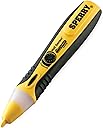
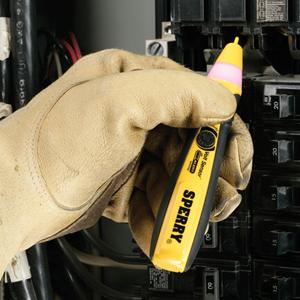
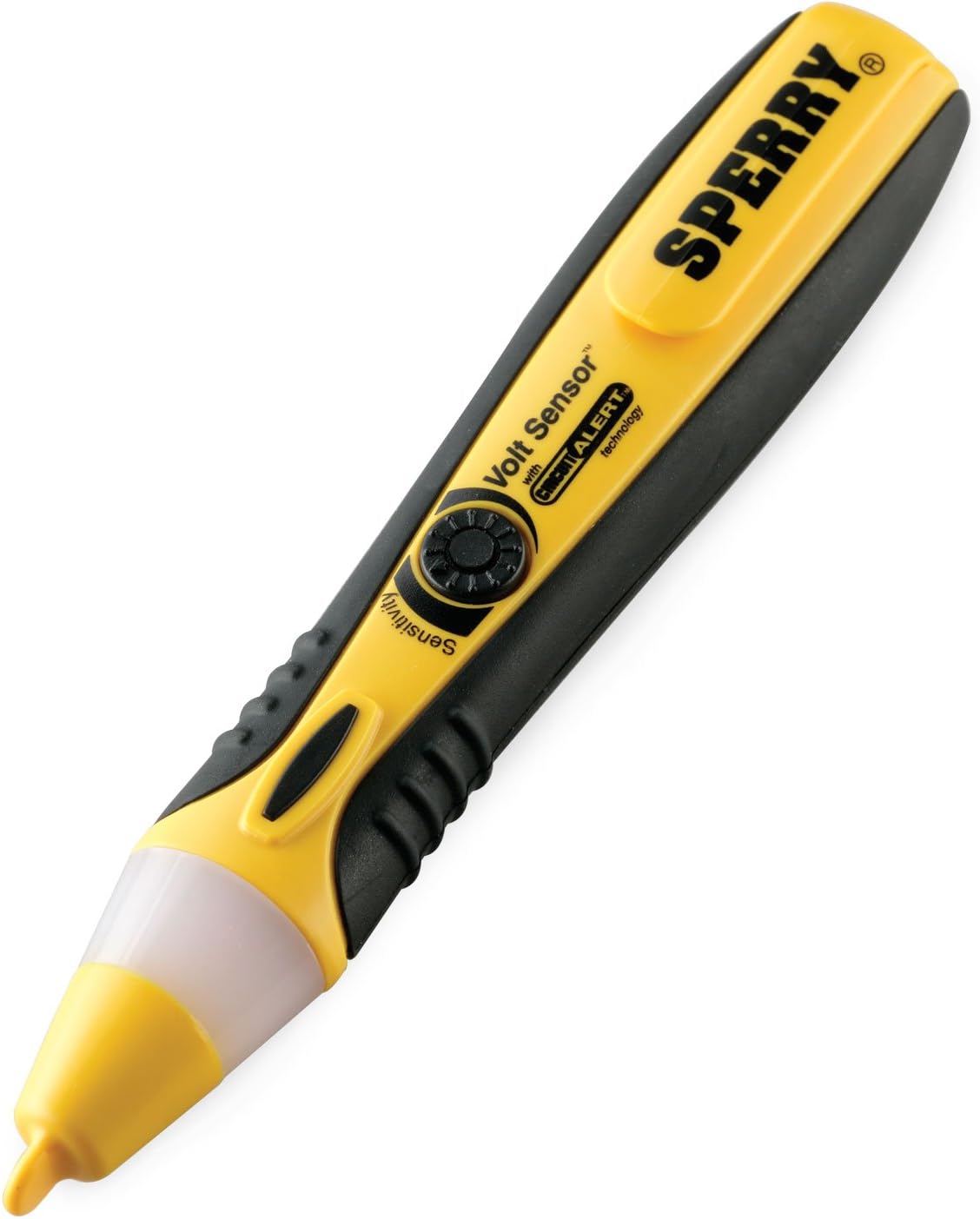
The Sperry Instruments VD6505 is a professional-grade, adjustable non-contact voltage sensor designed to detect AC voltages from 12 to 1000 volts. Featuring a rugged, impact-resistant ABS housing with rubber grips, it offers 360ยฐ visual and audible alerts for live voltage detection. Its adjustable sensitivity dial allows precise identification of live wires even in complex or bundled wiring scenarios. Rated CAT III 1000V and CAT IV 600V, this compact, pocket-friendly tool ensures maximum safety and reliability on any electrical job site.


| ASIN | B000GLAC5G |
| Best Sellers Rank | #138,210 in Tools & Home Improvement ( See Top 100 in Tools & Home Improvement ) #198 in Multi Testers |
| Brand | Sperry Instruments |
| Brand Name | Sperry Instruments |
| Color | Red |
| Customer Reviews | 4.3 out of 5 stars 988 Reviews |
| Global Trade Identification Number | 00035632064793, 50035632064798 |
| Item Dimensions | 2 x 3 x 4.75 inches |
| Item Type Name | Adjustable Non-Contact Voltage Sensor |
| Item Weight | 0.27 g |
| Item dimensions L x W x H | 2 x 3 x 4.75 inches |
| Manufacturer | Sperry Instruments, INC. |
| Measurement Type | Voltmeter |
| Minimum Operating Voltage | 12 volts_of_alternating_current |
| Model | VD6505 |
| Number of Items | 1 |
| Part Number | VD6505 |
| Power Source | Battery Powered |
| Specification Met | Cat Iii 1000v/Iv 600v |
| Style | Adjustable Non-Contact Volt Tester |
| Style Name | Adjustable Non-Contact Volt Tester |
| UPC | 666116005669 077344278402 705554427654 035632064793 003563064793 |
| Unit Count | 1 Count |
W**K
Well-made, very versatile, indispensable
I've used it for several jobs and haven't even started my major wiring projects. Wanted to install a strong, reliable grab bar in my tub/shower exactly where I wanted it. Didn't want to be limited by the location of the wall studs. Before cutting out the sheetrock in the next room so I could add bracing between the studs I had to 1) locate the wiring precisely so I didn't cut it and 2) make sure it was dead while I was cutting. The sensitivity dial helped me pinpoint the location and route of the wiring. To start, I set it sensitive enough so that I could detect live wiring behind the sheetrock from about a foot away. I continued to dial the sensitivity back so that I had to be within an inch or two of the wiring for the sensor to respond (with a red blinking light and loud chirping sound). Then by moving the sensor along the wall, I could very precisely trace the run of the wiring, marking it with blue painter's tape. Before cutting into the sheetrock I flipped off what I was fairly sure was the correct breaker. To make sure, I dialed up the sensitivity of the sensor and swept it all over the wall where my painter's tape was. No response from the sensor indicated that I did flip the correct breaker, so it was safe to cut into the sheetrock. (In this situation you can hold the sensor near a lamp to make certain it will respond to current.) Silliest use I've made of the sensor was to make sure my crockpot was on. I'm going to upgrade my kitchen circuits. In the meantime the few kitchen receptacles are on one circuit, the electric range is on it's own. The range has a standard "convenience" outlet for temporarily plugging in an appliance, but it's old and "iffy". I started the crockpot on the regular kitchen circuit but had to move it and plug it into the range's convenience outlet. The crockpot doesn't have a power light, so I wasn't sure it was getting electricity. Maybe the plug needed a jiggle? Got my Sperry adjustable volt sensor out and sure enough, there was power in the crockpot power cord. Dinner was saved. The adjustability is what makes this so versatile. I've fiddled with the sensitivity dial and gotten it so that I could tell the hot from the neutral side of the power cord on a table fan. Touch the sensor to one side of the cord, no response. Touch it to the other side, flashing and chirping. Take a close look at the cord, and the no-response side has the telltale "neutral" ridge. It's a well-made and useful tool. Could save your life, could save your wiring. Could save your dinner.
A**E
High quality tool, highest recommendation.
A rugged well made tool that works very well. Same hi vis yellow plastic and black rubber grips as Dewalt Tools. I really like the adjustability of it. At full sensitivity, I get it within a few feet of a circuit or fluorescent light and it starts buzzing. All the way down and it does not detect anything, so the range of adjustment is fantastic. I can dial it in so precisely that I can hold it on one side of an insulated wire and it will not go off, but when I move it to the other side of the wire (where the hot conductor is) it goes off. That's accuracy to a few millimeters. Best way to use it is to calibrate it ahead of time. Stick it in the hot side of an outlet, on a wire or conduit, hover it over a wall switch or outlet that you know is hot and adjust the knob until it buzzes, now it's ready to test the unknown circuit. I live in a 60+ year old house with plaster and chicken wire lathe wall construction. At a little more than 1/2 sensitivity it detects the wires inside the wall, inside of metal conduit. By moving it back and forth and seeing where the buzzing starts and stops, I can trace exactly where that wire is in the wall between the studs. Makes it easy to trace or detect wiring in the walls before I cut or drill through. If you will only use one of these to stick into outlets or against wires to see if they are hot then the adjustability feature may be overkill, but to get a lot of varied use, I'l glad I chose this one.
C**O
Useable, if imperfect
Tracing wires in walls is difficult. Check out all the devices sold on Amazon for that purpose. Some are very expensive and the reviews indicate that the process is difficult still in 2012. This Gardner Bender (actually it seems to be a Sperry) not only checks for voltage by actually touching a wire, but can sense it in a wall and help you locate hidden wires. Also, you can put it near switches, outlets and devices and immediately know if power is on there. An aluminum laptop really lights the thing up, as do lamps, bulbs and appliances. What makes this device work is that it has a tiny little rotating dial allowing the sensitivity to be turned up or down. Quite a wide range actually, from almost off to sensing from a distance. If there is a live wire in a wall and you turn up the dial, the device will surely detect it and will in fact make it seem that there are wires everywhere in the wall. You have to turn the sensitivity down or move the device back from the wall to narrow it down. I found that you have to wave it back and forth, constantly changing the sensitivity and distance as you go along. You have to retrace your findings, see if you can get consistent results. Eventually you will get it down pretty good It is a slow process with a lot of manipulation and still you can only get to within maybe six inches or so of some wires, but that is usually close enough. If I did this for a living where time was money I would investigate a more expensive device. What I do not like is that the dial is very small and has no markings or tactile feeling so you really don't know where you are on the sensitivity scale. It is also easy to move it inadvertently. This really is annoying. A thumbwheel or simply a bigger dial with markings or clicks would be good, best being a digital readout. This sensor is cheap and it works. Kind of a 3.5 stars really, but very useful still. Hecho en China.
T**N
Excellent tool - but requires some level of training to PROPERLY USE the adjustability feature
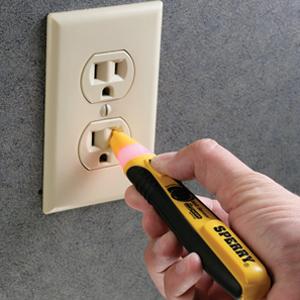
Whereas I agree if you are an untrained electrician that this tool could actually be misleading/confusing when "sniffing" voltage, but for a professional that is trying to differentiate which wire is the hot and which one is the neutral on ancient wiring- it is a godsend. I regularly come across knob and tube wiring, and I have successfully used this tool for almost 10 years. As a service electrician, I end up pulling it out of my bag about once a week. It is a very reliable tool and has it's place. In contrast, using a regular voltage sensor that doesn't have adjustable sensitivity, the magnetic field of the hot wire can induce a false reading on the unenergized wire. But for this tool to be used properly, you realistically just have to ensure it is calibrated each time you use it. Just stick it in an active receptacle. You can quickly find the "sweet spot" by adjusting the thumbwheel so that it beeps when you insert it in the right slot of a LIVE receptacle and it doesn't beep when you insert it in the left (neutral) slot of the receptacle. Then it is ready to differentiate which conductors are live and which ones are not.
T**S
The adjustablity is a great feature
This is a very good, useful tool. I can hold it next to a box and see if anything is live and if so reduce the sensitivity and identify which wire(s) is hot. I'd recommend finding a good default point on the sensitivity dial and always be sure it is set there before you start testing so it's not turned too low to get a reading on a live wire. I guess my one complaint is you have to be holding the button constantly in order for it to work. I miss the old "always on" testers. Also, these babies are not 100% accurate, none of the non contact testers are. I'm willing to bet a $12 pair of strippers on it, but not my life. So if it's a big deal test with a multimeter or even ground the wire out before touching it (expect sparks). It's better than a hard hit. Overall I really like it and carry it on my tool belt. I would recommend it.
B**.
Can be indispensible at times
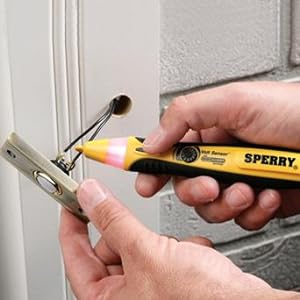
Excellent tool. Response is very good; just takes a little getting used to for approximating position of indicator on dial for a given job, along with a judicious bit of 'touch and go' tweaking. For example, sensitivity can be adjusted to facilitate reliable detection of an individual hot wire in a box with several wires in close proximity of each other โ and will enable detection of hot and neutral slots of receptacles to verify correct/incorrect wiring. At max sensitivity setting, a signal can be detected at an approximate distance of 12" to 18" thereby permitting a rough idea of hot wiring behind drywall. The only potential drawback would be attempting to use while wearing gloves, the 'feel' of the dial will be very difficult. The switch near the front must be depressed while in use which may be a bit annoying to some, however, one can guarantee that one will definitely not forget to turn it off (is the glass half full or half empty? It all depends upon your point of view).
K**I
Too sensitive or not sensitive enough and not in-between
Generally I love Sperry products. They are well engineered and work well. And I bought this because it was made by Sperry! I wanted a voltage detector that had an adjustable sensitivity. But the sensitivity on this is bad. It was either too sensitive and beeped at wires with no power or when you turn the sensitivity down slightly, it didn't beep at all for wires that had voltage running. Ultimately I had no confidence in what this voltage detector was saying. I could not trust that a wire had or didn't have power. What good is it??? Sperry you are a great company. Fix this product! But if you are buying this to confidently know that a wire has power, don't.
R**N
Pass.
My Sperry VD6505 voltage sensor has been spotty - sometimes oversensitive, sometimes not registering at all. It frequently would mark several wires in a receptacle as 'hot' when they were close together; I would have to separate the wires by an inch or more to find the real live wire. I spent a lot of time adjusting the sensitivity and rechecking my results for false positives and false negatives. When it worked, it worked but a number of times I would borrow someone else's tester which would give me the answer without the hassle. And, needing to push the small black button to get a reading confused some first-time users; they were used to just pointing their sensor at the wire and having it chirp and light up. I am keeping it - it is paid for and it is useful - but I would recommend that you look elsewhere for a live-wire sensor.
M**N
... an electrician and have found the sensitivity adjustment very useful - it will react at quite a distance with ...
I use this at work as an electrician and have found the sensitivity adjustment very useful - it will react at quite a distance with new batteries, which are lasting well, and can be set to pick up lower voltages/closer to cable to identify live conductors I generally don't trust cheap electrical testers but this one has so far proved to be very good. It has limitations in regard to clarity of the voltage it picks up, it won't tell you what the voltage is - just that there is voltage present. Otherwise - I was so impressed I bought another for a work mate ....
R**L
Voltage Tester
This is a must have tool for any DIY guy doing electrical work around the home. Works great and save time tracing live wires. You can regulate it to check from 14 volts DC to 600 Volts AC. The seller was fast in shipping the product and was received the same way as advertise by the seller. I have no hesitation in recommending this seller to anyone who may be thinking of purchasing this item.
K**A
Nice
Nice product.
C**M
5 big stars
This thing works really great. If you have any question if the circuit is on or off this will tell. Anywhere a electrical current is moving, this will alert the person. Worked wonderful when I rebuilt my garage.
W**1
Excellent Non Contact Voltage Detector
Very good price for a non contact voltage tester with adjustable control for sensitivity.
Trustpilot
1 month ago
1 month ago