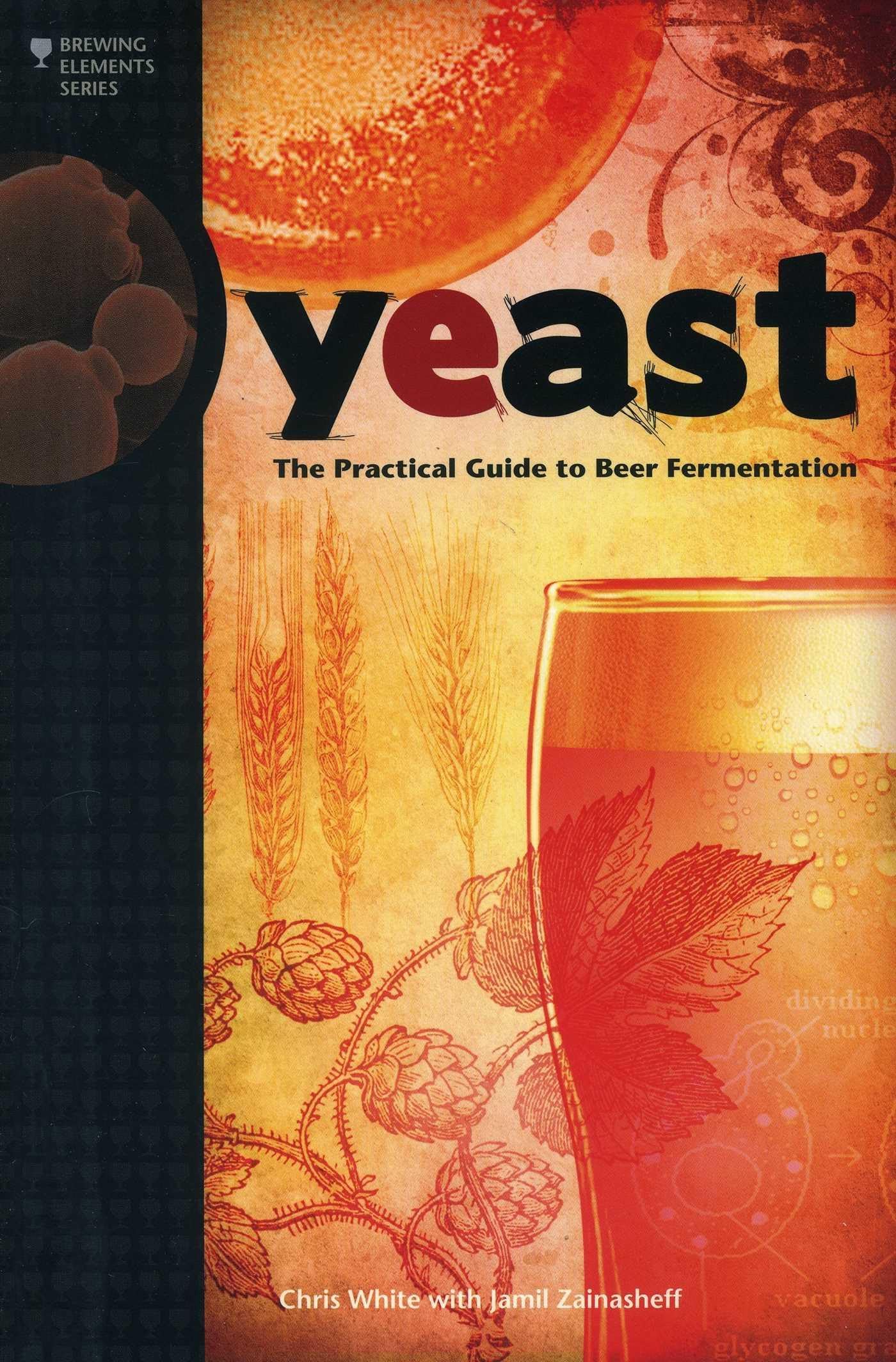
Yeast: The Practical Guide to Beer Fermentation (Brewing Elements)
Product ID: 235212
Buy anything from 5,000+ international stores. One checkout price. No surprise fees. Join 2M+ shoppers on Desertcart.
Desertcart purchases this item on your behalf and handles shipping, customs, and support to Austria.
Yeast: The Practical Guide to Beer Fermentation is a resource for brewers of all experience levels. The authors adeptly cover yeast selection, storage and handling of yeast cultures, how to culture yeast and the art of rinsing/washing yeast cultures. Sections on how to set up a yeast lab, the basics of fermentation science and how it affects your beer, plus step by step procedures, equipment lists and a guide to troubleshooting are included.


| Dimensions | 6.1 x 0.75 x 9.02 inches |
| Edition | 9/16/10 |
| Isbn 10 | 0937381969 |
| Isbn 13 | 978-0937381960 |
| Item Weight | 2.31 pounds |
| Language | English |
| Print Length | 300 pages |
| Publication Date | October 16, 2010 |
| Publisher | Brewers Publications |
User
Written for homebrewers
After reading the other reviews I was a little unsure if purchasing this book would apply to homebrewers. After reading this book extensively I believe that this is an excellent starting point for homebrewers who want to learn how to culture and store their own yeast. The other reviews are correct, there are a few basic introduction chapters in the beginning but the vast majority of the book is an extensive guide on yeast culturing practices from start to finish. The author(s) do an excellent job explaining concepts and procedures in a clear way giving the reader a step-by-step guide, with some photographs.The authors give examples of how commercial breweries grow up their yeast to pitchable rates, but the vast majority of this book is written for homebrewers who are working in 5 and 10 gallon batches. Everything is covered in detail, from washing and rinsing yeast harvested from a primary fermentation vessel, pitching rates, yeast starters, harvesting yeast, storing yeast, preparing slants and petri dishes and streak plating yeast cells to grow and isolate different colonies. For those homebrewers who think that yeast culturing is way too much of a headache and prefer to purchase a new vial of yeast from the store for every batch, please give this book a chance and see how easy it is to culture and isolate your own yeast. The author(s) do an excellent job of describing how complex a brewery laboratory can be, but they do an even better job of teaching the homebrewer to use the exact same techniques at home using nothing more than a pressure cooker, agar, dry malt extract and a wire inoculation loop.If you are a homebrewer who is just starting out and are using extract and partial mash recipes then perhaps yeast culturing is too large of a next step. However, for all-grain brewers who are looking to take their recipes to the next level and begin culturing their own strains and producing strains that are unique to their recipes then this book will be an excellent starting point. The author(s) teach the reader how to streak yeast onto a petri dish and isolate individual colonies as well as how to select the healthiest colonies as well as how to step up these colonies to a pitchable size for a 5 gallon fermentation.All of the other reviews for this book are fairly accurate and each has their own degree of truth, but by all means to not let the negative reviews for this book sway your decision. It does not matter if you are a homebrewer or a full size commercial brewery, if you have considered culturing your own yeast to save money or to create new and unique yeast strains, please give this book a chance.
User
Excellent Reference to "Cold Side" of Homebrewing
I was put off by some of the early reviewers of this book, who didn't find it as useful as they had hoped. And, perhaps partly because they had lowered my expectations--but mostly because of what I read in this book--I am overjoyed with what I found.This book divides brewing into two parts: the brew day, which it calls the "hot side" (which it does not really cover), and what happens after you boil your wort, which it calls the "cold side." This is what the book focuses on. It's about yeast, sure: what they are, how they work, what happens to them under various conditions. But it's really about fermentation, this cold side: the way we control those various conditions to get yeast to do something we want them to do: make great beer.And in its focus, White and Zainasheff hammer home the need for repeatability--same amount of yeast, same temperature, etc.I think they are on to something. And if you suspect that your beer could stand some time and attention spent on this cold side of brewing, there is a wealth of knowledge here. For example, if you had to brew all your beers with just one yeast, what would it be? Two? Three? etc. How many yeast varieties should you try to maintain (based on how often you brew)?This book treats the reader seriously. That means whether you are doing 5 gallons at a time with malt extract or running a microbrewery, the assumption is you want to make the best beer possible--and that fermentation control is key. I did have to smile at the chapter title "Your Own Yeast Lab Made Easy." And yet, for all the high-tech possibilities mentioned that might make your head spin and your wallet empty, there were many simple, free approaches to controlling and measuring your beer. And I think that chapter title captures the spirit of the book--first, to encourage you to think more scientifically about your beer (by which I mean "systemically," where you brew with intention)--which can be a bit off-putting if you think of yourself as a free spirit, creative type; second, that it is as "easy" as you want it to be. Take notes. Sniff. Taste. Do it again.Do you need this book to brew award-winning beer? No. You just need a way to put the right amount of yeast in your wort and hold it at the right temperature(s) for the duration of fermentation--every time. If you are convinced, put this money toward a few flasks and a stir plate, a temperature controller, a fermentation chamber, and a way to heat or cool your beer as it ferments--and hold it to within 1 degree F of your target. But if you aren't convinced, this book might give you the information and knowledge, and allow you to benefit from the experience of these gentlemen.
User
Essential Knowledge For Intermediate/Advanced Brewers
This is a fantastic booking for home brewers or smaller breweries owners looking to learn more about the contributions yeast play in the fermentation of beer, how improve your fermentation with better yeast handling and pitching, and coverage on how to setup your own lab for propagation and testing of yeast. The book is well written and easy to understand for somebody that does not have a background in microbiology.I found this book to be much more informative than the Hops book and much easier to follow then the Water book.
User
A good introduction to yeast
Without yeast there would be no beer. Author and homebrewer Chris White has a doctorate in biochemistry and founded White Labs, a major provider of yeast to home and professional brewers. Homebrewer, biochemist and author Jamil Zainasheff collaborated with John Palmer on the well-received book Brewing Classical Styles. Many Brewer’s Publications books address both the needs of the serious brewer and the hard core beer fan and sometimes fail to fully satisfy either. While providing useful information that can expand the understanding of the beer enthusiast, this book more directly addresses the needs of the home and small craft brewer. Less than 10% of this book deals with the history of yeast. Slightly more than 15% discusses how yeast works clearly and concisely in a way that most readers should be able to follow. Another 10% digs into how to choose the right yeast. The rest of the book tunnels into important issues for brewers, explaining the fermentation process, growing, handling and storing yeast, and finishes with an important section on trouble shooting. Despite being written by the founder of White Labs, this book is not written for the professional zymologist or biochemist. It’s written for lay readers – amateur and professional brewers and for a subset of beer aficionados who want to burrow deeper into the subject. To reach their intended audience at times they sacrifice depth for clarity. That said, for what they intended to write they did a good job and I thoroughly enjoyed the book.
User
Everything a brewer needs to know know about yeast
First thing's first, this is neither a brewing how-to book nor a yeast biochemistry textbook. This is, as the authors intended, the book equivalent of a practicum. I say that it is "everything a brewer needs to know about yeast" because, while it doesn't delve into the exact biochemical pathways yeast use or why homebrewers should make a vorlauf recirculation a standard part of their mash schedule, it does explain in great detail the what, why, and how of yeast. What it is and how it works, why problems arise, how to propagate and set up a proper lab, everything.If you're a brewer you owe it to yourself to buy this book. As they say, the yeast controls 80-90% of the final result. This book right here is a major step in teaching you how to control it.
User
Everything I hoped for and more!
I ordered this book because I needed a resource for yeast-ranching that was easy to follow. I did not want a general microbiology book for my purposes. This book came through with more than flying colors. It's very easy to follow and grasp some more technical information. It's also reassuring knowing that the information is being presented by one of the founders of a major yeast supplier in the US and an experienced "DIY-er" and excellent writer.Pros: Easy to read. Highly detailed and compartmentalized sections making it easy to jump around. Equipment lists and "How to's"Cons: Not entry level information (Though it's possible to follow, it's recommended for people with some knowledge in brewing.)
User
Comprehensive book about brewer's yeast and fermentation
An in-depth introduction to yeast in general and to choosing the right yeast for your brew and caring for it. Written by (among others) Chris White of White Labs. Not an easy read if you haven't got a biology/chemistry background I can imagine, but the nerdiest parts can be skipped with little impact on the usefulness of this book. I rated it five stars because it's a great book, and the paper edition is well deserving of five stars. The Kindle edition not so much. There are some useful tables and diagrams that are badly represented in the Kindle edition, even when you zoom in. Maybe it works better on a newer Kindle, I don't know. The Kindle edition gets four stars because of this.
User
Perfect guidebook for brewers
Such an excellent and knowledgeable book. If you are looking for a book thoroughly discussing the intricacies of yeast in general, this isn't for you; but if you're looking for an extensive guide on propagating, storing and pitching brewer's yeast, this is the perfect reference book. It offers a wide range of information and is especially useful for homebrewers and nanobrewers. Of particular interest is the comprehensive chart detailing the ratio of yeast cells to dry malt extract needed to make the most efficient starter. Great read!
User
Gran bel libro
Prodotto conforme, nulla da segnalare, spedizione ok, descrizione ok.Il libro è davvero molto molto bello ed interessante, essendo in Inglese faccio un po' fatica, ma è un problema mio!Davvero una lettura utile per chiunque sia intenzionato a perfezionare conoscenze e tecniche in merito a questo particolare "spicchio" della produzione brassicola.
User
Magnifico, buena información avanzada
Para avanzados, profesionales y motivados por conocer bien los procesos de fermentación. Desde una bioquímica básica bien entendida y explicada aplicada a la elaboración únicamente, a procesos y materiales para uno mismo montarse su pequeño laboratorio casero, o al menos para intentarlo.Me parece básico para el homebrewer que se mete a hacer starters, cultivos y más cacharreos.
User
Livro maravilhoso sobre fermento
Ótimo livro. Acho que já tem versão traduzida.
User
Love this book. Well written
Not done reading but I love it so far
User
Très très bien!
Une excellente bière s’est fait uniquement avec la maîtrise de la fermentation et par conséquent de la levure. C’est livre est un guide complet pour tous les brasseurs qui veulent aller plus loin dans da recherche de l’excellence!
Trustpilot
2 weeks ago
5 days ago