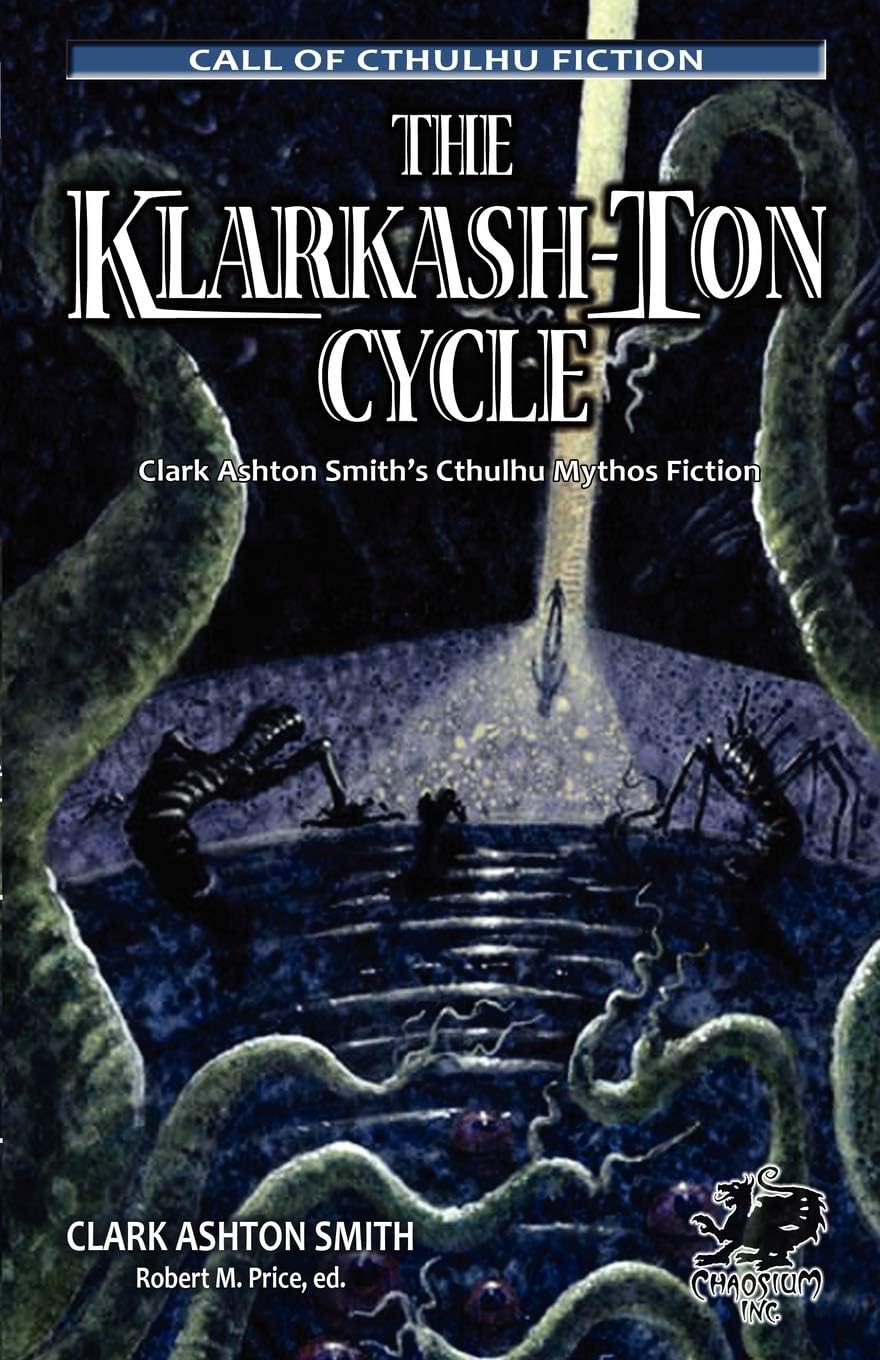
The Klarkash-Ton Cycle: The Lovecraftian Fiction of Clark Ashton Smith (Chaosium Fiction) (Call of Cthulhu Fiction)
Product ID: 23948926
Here is a collection of Clark Aston Smith's Cthulhu Mythos fiction, collected and arranged by Robert M. Price, with commentary for each of the stories. Included here are "The Ghoul", "A Rendering from the Arabic", "Ubbo-Sathla", "The Werewolf of Averoigne", and others. Review: The ORIGINAL versions - First off, there are typos. I was forewarned, so they didn't bother me. Kinda funny to spot them, actually. The end notes are pretty fascinating. Many of the included stories were modified and re-titled when they were originally published. This compilation has the author's original versions and titles. Some of the stories weren't Cthulhu mythos. That's the only negative. They were well written, so at least enjoyable. Review: Ghoulfriend in a Coma - The Klarkash-Ton Cycle: Clark Ashton Smith's Cthulhu Mythos Fiction: edited and with notes by Robert M. Price (Collected 2008): Chaosium reprints the Cthulhu Mythos-related short stories of Clark Ashton Smith in three volumes, with this being the one containing stories that aren't set in the distant past when the Book of Eibon was being composed nor those Smith stories that focus on his quasi-tricksterish god Tsathoggua. Despite the availability of Smith's work in multiple editions, this text is valuable because it reprints several variant versions of Smith's stories that aren't available that easily, along with a long story fragment -- "The Infernal Star" -- that is otherwise out of print. 'Klarkash-Ton' was the nickname H.P. Lovecraft gave Smith in their correspondence in the 1930's. The stories range from straightforward horror to science fiction to science-fiction horror, while Smith's prose style ranges from the relatively plain to the poetically baroque, almost arcane diction that one really either loves or hates. I love it, in part because there's clearly a sense of humour at work behind the occasionally loopy word choices. One caveat: the stories have been proofread and copy-edited with mind-boggling ineptitude. You may want to grab a pen and correct all the errors for the next person who reads the collection. Think of it as a fun game! "The Ghoul" (1934): Smith's ghoul isn't as idiosyncratic as Lovecraft's ghouls, though it sure loves to eat dead people. "A Rendering from the Arabic" (Variant of "The Return of the Sorcerer" [1931]): Slightly different version of the oft-reprinted "The Return of the Sorcerer." Lovecraftian references abound in a story about the walking, shuffling dead. "The Hunters from Beyond" (1932): One of those Smith stories that plays with his own multi-talented career as a painter and sculptor as well as a writer of prose and poetry. It does seem a bit derivative of both HPL's "Pickman's Model" and Frank Belknap Long's "The Hounds of Tindalos." "The Vaults of Abomi" (Variant of "The Vaults of Yoh-Vombis" [1932/1989]): A few hundred words flesh out the beginning of one of Smith's two or three finest works of science-fictional horror, set on his version of Mars and possessed of imagery and situations that anticipate such later horrors as Alien, The Thing, and The Puppet Masters. "The Nameless Offspring" (1932): Well, we get the offstage rape of a woman in a coma by a ghoul, followed by the resultant offspring. One of Smith's most obliquely disturbing works. "Ubbo-Sathla (1933)": Much-reprinted reincarnational horror story. "The Werewolf of Averoigne" (Variant of "The Beast of Averoigne") [1931/1984]): The variant is superior to the standard version, preserving as it does Smith's original multi-viewpoint epistolary format. "The Eidolon of the Blind" (Variant of "The Dweller in the Gulf" [1933]): Another creepy science-fiction horror story set on Smith's version of Mars, which makes most other early 20th-century writers' versions of Mars seem like a goddam Disneyworld. "Vulthoom" (1935): Another Mars story, much lighter on horror and, as Price comments in the notes, not that different from many other contemporary interplanetary stories involving humans and decadent, Orientalist civilizations. "The Treader of the Dust" (1935): Excellent, concise horror story with a strikingly creepy evil god or demigod or whatever you want to call it. "The Infernal Star" (Fragment) (1935/1989): Fascinating, long fragment of what was to be a novella-length dark fantasy involving reincarnation, atomic 'memory,' and a Sun made, basically, of Evil. In all: highly recommended, though I do wish for an edition with better copy editing.


| Best Sellers Rank | #4,346,575 in Books ( See Top 100 in Books ) #81,767 in Horror Literature & Fiction |
| Customer Reviews | 4.4 out of 5 stars 43 Reviews |
A**B
The ORIGINAL versions
First off, there are typos. I was forewarned, so they didn't bother me. Kinda funny to spot them, actually. The end notes are pretty fascinating. Many of the included stories were modified and re-titled when they were originally published. This compilation has the author's original versions and titles. Some of the stories weren't Cthulhu mythos. That's the only negative. They were well written, so at least enjoyable.
J**R
Ghoulfriend in a Coma
The Klarkash-Ton Cycle: Clark Ashton Smith's Cthulhu Mythos Fiction: edited and with notes by Robert M. Price (Collected 2008): Chaosium reprints the Cthulhu Mythos-related short stories of Clark Ashton Smith in three volumes, with this being the one containing stories that aren't set in the distant past when the Book of Eibon was being composed nor those Smith stories that focus on his quasi-tricksterish god Tsathoggua. Despite the availability of Smith's work in multiple editions, this text is valuable because it reprints several variant versions of Smith's stories that aren't available that easily, along with a long story fragment -- "The Infernal Star" -- that is otherwise out of print. 'Klarkash-Ton' was the nickname H.P. Lovecraft gave Smith in their correspondence in the 1930's. The stories range from straightforward horror to science fiction to science-fiction horror, while Smith's prose style ranges from the relatively plain to the poetically baroque, almost arcane diction that one really either loves or hates. I love it, in part because there's clearly a sense of humour at work behind the occasionally loopy word choices. One caveat: the stories have been proofread and copy-edited with mind-boggling ineptitude. You may want to grab a pen and correct all the errors for the next person who reads the collection. Think of it as a fun game! "The Ghoul" (1934): Smith's ghoul isn't as idiosyncratic as Lovecraft's ghouls, though it sure loves to eat dead people. "A Rendering from the Arabic" (Variant of "The Return of the Sorcerer" [1931]): Slightly different version of the oft-reprinted "The Return of the Sorcerer." Lovecraftian references abound in a story about the walking, shuffling dead. "The Hunters from Beyond" (1932): One of those Smith stories that plays with his own multi-talented career as a painter and sculptor as well as a writer of prose and poetry. It does seem a bit derivative of both HPL's "Pickman's Model" and Frank Belknap Long's "The Hounds of Tindalos." "The Vaults of Abomi" (Variant of "The Vaults of Yoh-Vombis" [1932/1989]): A few hundred words flesh out the beginning of one of Smith's two or three finest works of science-fictional horror, set on his version of Mars and possessed of imagery and situations that anticipate such later horrors as Alien, The Thing, and The Puppet Masters. "The Nameless Offspring" (1932): Well, we get the offstage rape of a woman in a coma by a ghoul, followed by the resultant offspring. One of Smith's most obliquely disturbing works. "Ubbo-Sathla (1933)": Much-reprinted reincarnational horror story. "The Werewolf of Averoigne" (Variant of "The Beast of Averoigne") [1931/1984]): The variant is superior to the standard version, preserving as it does Smith's original multi-viewpoint epistolary format. "The Eidolon of the Blind" (Variant of "The Dweller in the Gulf" [1933]): Another creepy science-fiction horror story set on Smith's version of Mars, which makes most other early 20th-century writers' versions of Mars seem like a goddam Disneyworld. "Vulthoom" (1935): Another Mars story, much lighter on horror and, as Price comments in the notes, not that different from many other contemporary interplanetary stories involving humans and decadent, Orientalist civilizations. "The Treader of the Dust" (1935): Excellent, concise horror story with a strikingly creepy evil god or demigod or whatever you want to call it. "The Infernal Star" (Fragment) (1935/1989): Fascinating, long fragment of what was to be a novella-length dark fantasy involving reincarnation, atomic 'memory,' and a Sun made, basically, of Evil. In all: highly recommended, though I do wish for an edition with better copy editing.
A**N
A Flawed But Great Sampling of Clark Ashton Smith's Cthulhu Mythos Stories
As someone who had only read a handful of Clark Ashton Smith's contributions to H.P. Lovecraft's Cthulhu Mythos, I was pretty excited to pick up this book. Unfortunately there were some unexpected problems with this collection. Don't get me wrong, this collection features some pretty great stories by Smith, such as "The Hunters from Beyond". It also includes another story of Smith's I had wanted to read for a while, "The Return of the Sorcerer". Of course in this collection Return of the Sorcerer is presented here with the alternate title, "A Rendering from the Arabic". The reason for the alternate title is because the story is presented with an alternate ending. According to the story's intro (seen at the back of the book), the ending in this version is from Smith's surviving first draft of the story. The reason for the use of the story's alternate title (apparently a working title Smith had used originally) was to avoid bibliographic confusion according to the collection's editor, Robert M. Price. And this is one of the two big flaws with this collection. About half of the stories in this collection are the unrevised versions of Smith's stories rather than the versions which were originally published. In some cases this is both a good and a bad thing. For instance with the story, "The Eidolon of the Blind", the editor of Weird Tales apparently found the story so grotesque he refused to publish it at all (this is all according to the story's intro). Smith eventually tried selling the tale to a publication called Wonder Stories under the title "The Dweller in the Gulf", but the editor of that publication demanded certain revisions to it be made. It seems even after Smith conceded to these demands and made the changes the editor wanted, Wonder Stories published it under the title "The Dweller in Martian Depths" and had someone from the secretarial staff make further changes to the story. So in the case of "Eidolon of the Blind", it's a real treat for us readers to have it presented in this collection in its original form, because I doubt that the butchered published version was really any good from the sound of it. The original version would be gruesome by even today's standards, and I can kind of see why a publisher of a magazine that operated during the early 1900s wouldn't want to touch it. Even so, there are a few of these "director's cut" versions of Smith's stories that shouldn't have been bothered with at all. The best example from this collection is the director's cut of the story, "The Beast of Averoigne", which is presented in this collection under the first draft title "The Werewolf of Averoigne". This version is presented with a section that had been cut entirely from the published version, and it was good it had been cut because it's kind of a spoiler for the "beast's" identity. Of course the overall problem with using these director's cut versions of Smith stories is that it makes it a bad collection for someone like myself who hadn't read much of Smith's work in the first place. In short, this is probably not the best book to use for introducing a friend to the work of Clark Ashton Smith. The other big problem with this collection is that it's riddled with typos! I found at least two or three typos in almost every story in this book. I don't know if the proofreader Chaosium Inc. was using was nearsighted or just being lazy. These typos don't make the book impossible to read, but they are very annoying. To sum it up, this book is a decent collection, but only for someone who's well versed in the works of Clark Ashton Smith and is enough of a fan to want to read the original versions of his work...and doesn't mind too many typos.
M**R
Good for certain fans of the inimitable CAS
I agree with the previous reviewer about the typographical errors, and I was not going to write my own review, but then I thought there was some additional information a potential buyer might want to know. The Klarkashton Cycle is a decent trade paperback in the Chaosium cycle series, edited, as are most, by Robert Price. Mr. Price's introduction is pretty good but his notes on the stories at the end are priceless. I would not read them, however, until you read the stories, to avoid potential spoilers. The cover art by Stephen Gilberts is better than that on most cycle books, although not as good as some of his other covers in this genre. As I see it, there are three groups of fans who might want this book. Some are collecting all the cycle books, come heck or high water, and they already bought it. Some are Smith completists. There is a definite reason for them to get this book. Others, however, are new to the wonders of CAS and are considering this as an initial collection. In this book, there was no effort made to include just top drawer Smith; rather, the editor has included those stories he would categorize as Lovecraftian or Cthulhu mythos. This could lead to endless debate as to whether anything Smith wrote is Lovecraftian or is best not categorized as anything other than wholly original. I'm not persuaded that this is a good basic Smith collection for new devotees. Arkham House still has in print the hardcover A Rendezvous in Averoigne which has most of the Smith stories included in the three Chaosium books devoted to CAS' creations, as well as many others. However, there is not complete overlap. Also, the Arkham House book, while I highly recommend it, is dated 1988. CAS scholarship has accelerated in recent years and some of the stories are now seen in different forms. Annoyingly enough, at least for me, Mr. Price changed the titles of some of these stories (see below) to Smith's previous working titles, to avoid confusion with the more well known versions. Well this confused the heck out of me, because I thought I would be seeing something new. I was, but only different versions, enjoyable on their own merits, sort of like the different editions of Bruckner's symphonies. Buyers need to know that The Infernal Star is only a fragment (alas CAS never finished it). Oh, well, Price's notes explained everything. Absolute Smith completists are probably following the series from Nightshade Books in expensive, handsome hard covers. Otherwise I still would suggest A Rendezvous in Averoigne as a single basic Smith collection. The Tsathoggua Cycle is worth getting for the CAS stories, and also the other stories about Tsathoggua by different authors. The Book of Eibon is something else, mainly by Lin Carter, who attempts to write the actual Book of Eibon. I'm afraid I have not read it yet. I love Smith's prose but you must decide for yourself if the Klarkashton Cycle is the book to introduce it to you. What follows are the contents of the Smith stories in each of the Chaosium and Arkham House books. The Klarkashton Cycle (Chaosium) The Ghoul A Rendering from the Arabic (alternate version of The Return of the Sorcerer) The Hunters from Beyond The Vaults of Abomi (alternate version of The Vaults of Yoh-Vombis) The Nameless Offspring Ubbo-Sathla The Werewolf of Averoigne (alternate version of The Beast of Averoigne) The Eidolon of the Blind (alternate version of The Dweller in the Gulf) Vulthoom The Treader of the Dust The Infernal Star The Book of Eibon (Chaosium - note only a few titles by Smith) The Coming of the White Worm: History of Evagh the Warlock The Light from the Pole: History of Pharazyn the Enchanter, by Lin Carter and Clark Ashton Smith The Door to Saturn The Tsathoggua Cycle (Chaosium, has stories by authors other than Smith) From the Parchment of Pnom The Seven Geases The Testament of Athammaus The Tale of Satampra Zeiros The Theft of the Thirty-Nine Girdles A Rendezvous in Averoigne (Arkham House hardcover, used copies are cheaper) The Holiness of Azédarac The Colossus of Ylourgne The End of the Story A Rendezvous in Averoigne The Last Incantation The Death of Malygris A Voyage to Sfanomoë The Weird of Avoosl Wuthoqquan The Seven Geases The Tale of Satampra Zeiros The Coming of the White Worm The City of the Singing Flame The Dweller in the Gulf ["Dweller in Martian Depths"] The Chain of Aforgomon Genius Loci * The Maze of Maal Dweb The Vaults of Yoh-Vombis The Uncharted Isle The Planet of the Dead Master of the Asteroid The Empire of the Necromancers The Charnel God Xeethra The Dark Eidolon The Death of Ilalotha The Last Hieroglyph Necromancy in Naat The Garden of Adompha The Isle of the Torturers Morthylla
D**E
so many typos its almost unreadable
While CAS writing is, as always, amazing, this release includes so many typos it really makes reading it a chore. I will not buy any more books from Chaosium ever again anticipating this. Very unhappy :(
J**T
A SLIM BUT DECENT SAMPLING
I think a review for this book could go in one of two directions, to fans of Clark Ashton Smith looking for a decent sampling of his many stories (in this case those deemed most Lovecraftian by the editor), and to people unfamiliar with him who are looking for an introduction to his work (or simply in search of a collection of classic weird tales). To the first group, yes, there are some proof-reading mistakes but if you're willing to overlook them you will have acquired exactly what you were looking for. While mirroring H.P. Lovecraft's bleak vision of a strange and hostile cosmos, these tales are purely Smith's own. There is nothing derivative about them. Smith didn't need to borrow or steal. He had an invented mythology of his own. To the second group...ditto. This slim volume doesn't begin to address Smith's vast body of work. It is, however, a good starting point for someone discovering Smith for the first time. James Pratt, author of 'Cthelvis and Others'
R**L
Right cover, wrong book inside...
when I received the book it had an entirely different book between the covers, "Season of the Rose" by Amy Flynn Boucher...not sure what happened there, maybe there was a run of incorrect books placed between the cover of the Klarkash-Ton Cycle books, I contacted the seller, hopefully I'll get it resolved...was looking forward to getting this, now I'm a bit disappointed because of the odd mix-up
A**R
What's with all the typos?
If you're charging this much for a book, why have you not hired a proofreader? Bringing the book back to the store.
A**H
Chroniken des fremdartigen Universums
Clark Ashton Smiths Universum ist fremdartiger, als der Mensch verkraften kann. Unerklärliche Mächte, Lovecrafts "Grossen Alten" nicht unähnlich, trachten danach, die Erde und den Menschen zu versklaven, oder wenigstens durch ihr Erscheinen Schrecken und Terror zu verbreiten ("The Werewolf of Averoigne", "The Nameless Offspring"). Smiths Protagonisten sind hochintelligente Einzelgänger, die, dem Okkulten nicht abgeneigt, durch die Mächte vernichtet werden, die sie herbeiriefen ("The Treader of the Dust", "A Rendering from the Arabic", "The Ghoul") oder eine monströse Transformation erfahren ("Ubbo-Sathla", "The Infernal Star"). Gut und Böse verschwimmen dabei als Kategorien, übrig bleibt ein überaus seltsames und unergründliches Universum, dem der Mensch hilflos ausgesetzt ist-Thomas Ligotti wird dieses Thema später noch meisterhaft verarbeiten. Clark Ashton Smith (oder "Klarkash-Ton", je nach Präferenz) ist wohl einer der ersten Autoren, die ultramundane Welten- in seinem Fall die des Mars-in ihrer ganzen Andersartigkeit beschreiben. Mögen seine Ideen über Raumfahrt und die Atmosphäre des "Roten Planeten" etwas naiv sein-die fieberhaft-morbide Atmosphäre seiner Erzählungen ist es nicht. Ob es sich um die Beschreibung einer "Marshölle" handelt ("The Eidolon of the Blind"), oder um die Übernahme des Mars durch eine Macht außerhalb aller Dimensionen ("Vulthoom", mein Favorit des Bandes, der in dem Aufbau einer morbid-dekadenten Atmosphäre seinesgleichen sucht-H.R.Giger grüßt schon mal), oder "bloß" um die Invasion einer fremdem Lebensform ("The Vaults of Abomi"-unwillkürlich fühlt man sich an spätere "Alien"-Filme erinnert)-Smith zieht in der Beschreibung der Mars-Abenteuer alle Register seines Könnens. Die Gratwanderung des Horror-Autors zwischen Realität und Fiktion wird schließlich brillant in"The Hunters from Beyond" illustriert, wo ein Künstler seinem eigenen Wahnsinn ungewollt Leben einhaucht und von diesem fast vernichtet wird. Lovecraft-Leser werden sich gewiß an "Pickmans Model" oder "The Case of Charles Dexter Ward" erinnern. Es ist sicherlich hilfreich, Lovecrafts Werk zu kennen, um Clark Ashton Smith einschätzen zu können-ein Muß ist es nicht. Dafür spricht der Autor mit einer unüberhörbar eigenen Stimme. Freunde intensiven Horrors und fantastischer Dimensionen werden an diesem Band ihre Freude haben. Daher fünf Punkte-und bei Eibons Bart, greift zu!
Trustpilot
2 weeks ago
5 days ago