
Desertcart purchases this item on your behalf and handles shipping, customs, and support to Austria.
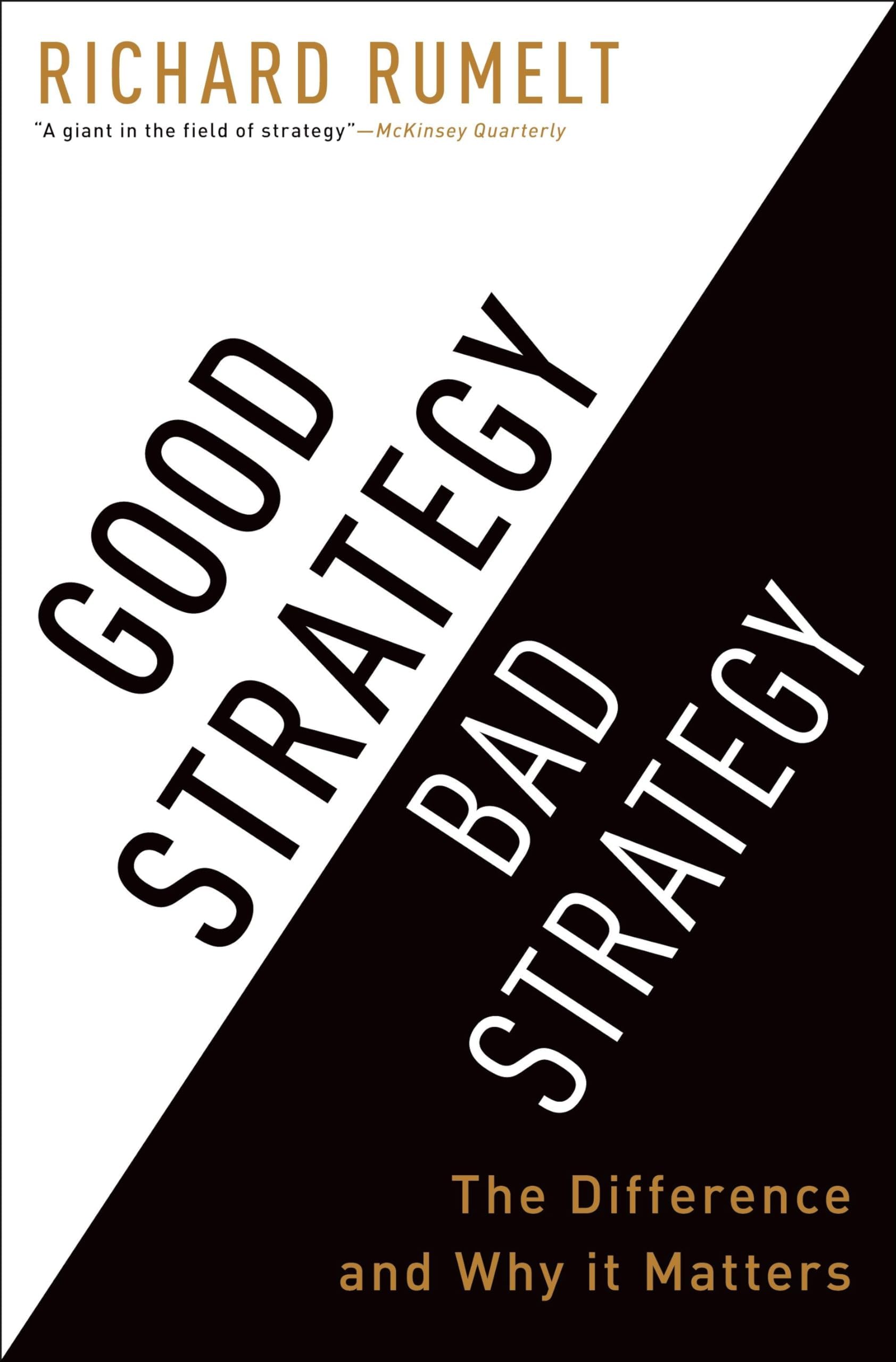
Good Strategy/Bad Strategy clarifies the muddled thinking underlying too many strategies and provides a clear way to create and implement a powerful action-oriented strategy for the real world. Developing and implementing a strategy is the central task of a leader. A good strategy is a specific and coherent response toโand approach forโovercoming the obstacles to progress. A good strategy works by harnessing and applying power where it will have the greatest effect. Yet, Rumelt shows that there has been a growing and unfortunate tendency to equate Mom-and-apple-pie values, fluffy packages of buzzwords, motivational slogans, and financial goals with โstrategy.โ In Good Strategy/Bad Strategy , he debunks these elements of โbad strategyโ and awakens an understanding of the power of a โgood strategy.โ He introduces nine sources of powerโranging from using leverage to effectively focusing on growthโthat are eye-opening yet pragmatic tools that can easily be put to work on Monday morning , and uses fascinating examples from business, nonprofit, and military affairs to bring its original and pragmatic ideas to life. The detailed examples range from Apple to General Motors, from the two Iraq wars to Afghanistan, from a small local market to Wal-Mart, from Nvidia to Silicon Graphics, from the Getty Trust to the Los Angeles Unified School District, from Cisco Systems to Paccar, and from Global Crossing to the 2007โ08 financial crisis. Reflecting an astonishing grasp and integration of economics, finance, technology, history, and the brilliance and foibles of the human character, Good Strategy/Bad Strategy stems from Rumeltโs decades of digging beyond the superficial to address hard questions with honesty and integrity. Review: A roadmap for creating good strategy and how to spot and avoid bad strategy - I thought I remembered my friend Art Petty saying that he liked Good Strategy Bad Strategy: The Difference and Why It Matters by Richard Rumelt. So, I emailed him and asked if that was true. Hereโs his reply. โLike is an understatement. Rumeltโs kernel of Strategy is the most powerful, supple approach for creating clarity and coherence on strategy Iโve yet encountered.โ Artโs no novice. Heโs been an effective executive and an effective consultant for decades. He works with clients on strategy. And, guess what? The book lived up to Artโs recommendation and then some. The kernel of Strategy that Art referred to is a great reason to read the book, even if thatโs all you get out of it. Hereโs Rumeltโs description of the kernel. โA good strategy has an essential logical structure that I call the kernel. The kernel of a strategy contains three elements: a diagnosis, a guiding policy, and coherent action. The guiding policy specifies the approach to dealing with the obstacles called out in the diagnosis. It is like a signpost, marking the direction forward but not defining the details of the trip. Coherent actions are feasible coordinated policies, resource commitments, and actions designed to carry out the guiding policyโ. The kernel isnโt a magic formula. Itโs a guide to the most important hard work you will do to create a strategy. If youโre a consultant, itโs a quick way to help you figure out if your client has a strategy or not. As Rumelt points out in the book, a lot of things masquerade as strategy. Plans and slogans and goals can look like strategy until you analyze them with a tool like the kernel. What makes creating a great strategy hard is that it involves choices, and we donโt like choices. We also donโt like hard work, so we skip the hard parts and just do the parts that are fun. In my experience, an awful lot of companies spend a day or so developing their strategy. They substitute discussion for diagnosis. Talk replaces analysis. Then they trot out some fine-sounding generalities instead of taking time to craft guiding principles. Biz-speak often replaces clear language here. Thereโs a lot of talk about what to do, but precious little about how to coordinate activities. Most of those companies spend most of their time on what theyโre going to do, after skipping the hard parts of diagnosis and guiding principles. Art says that, since reading Rumelt, he spends more time on the strategy process. He spends half of the time on diagnosis, another 40 percent on what Rumelt calls the guiding philosophy, and 10 percent on coherent actions. Itโs much harder to do it that way than it is to go off to an offsite and whip up some generalities that sound good but donโt have much impact on day-to-day work life. Hereโs what it comes down to. The kernel is the way you develop a good strategy. The kernel is also the way that you identify bad strategy, whether itโs yours or someone elseโs. Now that Iโve read this book, I wonโt think about doing strategy the same way ever again. Rumelt has helped me know some danger signals to watch for. And heโs given me a language for guiding the process of creating and evaluating a strategy. The kernel is reason enough to buy and read this book, but there are lots of other goodies here, too. Thereโs analysis of many business situations that I found both absorbing and compelling. Thereโs one other thing you can take away from this book. Even when you do the work to create and execute a good strategy, you can still not succeed. You can make bad choices, even with a good process. Luck still plays a role. Unforeseen events play a role. The competition plays a role. This book was written in 2006. Rumelt makes several predictions about how some things will play out in the years ahead. He gets some of them right, some of them wrong, and some of them a mix of both. Thatโs a good thing because it demonstrates whatโs true in real life. There are times when you can do everything wrong and have things turn out right. And there are times when you can do everything right and still go down in flames. One of my favorite quotes about life is from the American writer and horseplayer, Damon Runyon. It goes like this: โThe race may not always be to the swift, nor victory to the strong, but thatโs the way you bet.โ Developing a good strategy is the hard work of figuring out how to bet. In A Nutshell Good Strategy Bad Strategy: The Difference and Why It Matters by Richard Rumelt gives you a roadmap that will help you develop better strategy. Ironically, that will make your work harder. Thankfully, it will also increase your odds of success. Review: An experienced practitioners thoughtful reflections - There are two things we often notice when helping a company craft their strategic story: 1) the strategic story process helps executives clarify what they really think the strategy should be; and 2) way too many executives can't actually tell you their company's strategy without reaching for a document. It's only since reading Richard Rumelt's new book, Good Strategy Bad Strategy, that I can see both observations are symptoms of not having a story to tell about the company's strategy. The second point came quickly to us because we know stories are memorable and therefore if your strategy was a story then you have a better chance of remembering it. Ipso facto (I'm not 100% sure of what this means but it felt right to put it here). The first point, however, goes to the heart of Rumelt's thesis: good strategy comprises a kernel made from a diagnosis of what's happening that's causing a challenge; a guiding policy on how the company will overcome this challenge; and a coherent set of actions that will translate the strategy into reality. Most strategies are defined as a set of aspirational goals, which Rumelt argues is a big mistake that has resulted from the template view of strategy creation: create a vision, state a purpose, set some goals, bingo, you now have a strategy. An effective strategy is all about action, about getting something done, it's concrete, plausible and doable. These attributes are much the same for stories. So from a story perspective, the kernel consists of the story of what's happening, the story of what will be done, and then the unfolding stories that emerge from the actions. These stories then help leaders decide how they will adapt to the inherent complexity of business.This is not just Shawn's story-coloured glasses making this connection. Rumelt says himself that, "The diagnosis for the situation should replace the overwhelming complexity of reality with a simpler story, a story that calls attention to its crucial aspects. This simplified model of reality allows one to make sense of the situation and engage in further problem solving." (p. 81) Rumelt's book is divided into three parts. Part 1, Good & Bad Strategy, describes the differences between what makes a good'ne and what makes a stinker. Part 2, Sources of Power, describes a series of approaches the strategist can adopt to improve their strategy. It includes topics such as focus, leverage, advantage and growth. This section finishes with a chapter on putting it all together that examines the graphics chip maker NVIDIA and their strategy, which incorporates many of Rumelt's sources of power. As suggested by Rumelt, I skipped to the NVIDIA chapter before reading each source of power in detail. The last part, Thinking Like a Strategist, has three chapters which explore what is mean to reflect on how you think about strategy. The book is very Gladwellesque in the way Rumelt tells stories. Each chapter is full of personal anecdotes, stories from history and Rumelt does a lovely job of telling stories that include analogies which he links to important strategy concepts. For example he tells the story of meeting a friend in Baja California who was a combat helicopter pilot. In some musing over a beer Richard (I bet he is know to his friends as Dick) says it would be better to be in a helicopter than a plane if the engines died because the rotors would keep turning and act like a parachute. He friend chuckled and said "only if the right actions are done within a second of losing power and, most importantly, without thinking about it." Rumelt uses this analogy to discuss how companies have intuitive capabilities gained from experience which allows them to do things other companies just can't. One type of competitive advantage. GS/BS is full of these interesting analogies. Just a note on book architecture. I love endnotes. I'm always following those suckers to find out the original references and other tidbits hidden behind those superscripted numbers. But here's the thing: if your end notes are arranged by chapter with a new set of endnote numbers then you need to have the chapter number/name on each page of your book otherwise I have to thumb back through the chapter to the chapter title page just to work out where the hell I am. This is not just a criticism of Rumelt's book, this is most business books out there. Publishers and book designers, please note. OK, rant over. This book is a bloody ripper. It has a really practical feel without getting dot pointy. The stories carry the book and keep it interesting and because many of the stories are personal anecdotes you develop a deep admiration for Rumelt's character and experience. Well worth getting yourself a copy.


| Best Sellers Rank | #8,797 in Books ( See Top 100 in Books ) #9 in Strategy & Competition #15 in Strategic Business Planning #20 in Systems & Planning |
| Customer Reviews | 4.5 out of 5 stars 5,714 Reviews |
W**K
A roadmap for creating good strategy and how to spot and avoid bad strategy
I thought I remembered my friend Art Petty saying that he liked Good Strategy Bad Strategy: The Difference and Why It Matters by Richard Rumelt. So, I emailed him and asked if that was true. Hereโs his reply. โLike is an understatement. Rumeltโs kernel of Strategy is the most powerful, supple approach for creating clarity and coherence on strategy Iโve yet encountered.โ Artโs no novice. Heโs been an effective executive and an effective consultant for decades. He works with clients on strategy. And, guess what? The book lived up to Artโs recommendation and then some. The kernel of Strategy that Art referred to is a great reason to read the book, even if thatโs all you get out of it. Hereโs Rumeltโs description of the kernel. โA good strategy has an essential logical structure that I call the kernel. The kernel of a strategy contains three elements: a diagnosis, a guiding policy, and coherent action. The guiding policy specifies the approach to dealing with the obstacles called out in the diagnosis. It is like a signpost, marking the direction forward but not defining the details of the trip. Coherent actions are feasible coordinated policies, resource commitments, and actions designed to carry out the guiding policyโ. The kernel isnโt a magic formula. Itโs a guide to the most important hard work you will do to create a strategy. If youโre a consultant, itโs a quick way to help you figure out if your client has a strategy or not. As Rumelt points out in the book, a lot of things masquerade as strategy. Plans and slogans and goals can look like strategy until you analyze them with a tool like the kernel. What makes creating a great strategy hard is that it involves choices, and we donโt like choices. We also donโt like hard work, so we skip the hard parts and just do the parts that are fun. In my experience, an awful lot of companies spend a day or so developing their strategy. They substitute discussion for diagnosis. Talk replaces analysis. Then they trot out some fine-sounding generalities instead of taking time to craft guiding principles. Biz-speak often replaces clear language here. Thereโs a lot of talk about what to do, but precious little about how to coordinate activities. Most of those companies spend most of their time on what theyโre going to do, after skipping the hard parts of diagnosis and guiding principles. Art says that, since reading Rumelt, he spends more time on the strategy process. He spends half of the time on diagnosis, another 40 percent on what Rumelt calls the guiding philosophy, and 10 percent on coherent actions. Itโs much harder to do it that way than it is to go off to an offsite and whip up some generalities that sound good but donโt have much impact on day-to-day work life. Hereโs what it comes down to. The kernel is the way you develop a good strategy. The kernel is also the way that you identify bad strategy, whether itโs yours or someone elseโs. Now that Iโve read this book, I wonโt think about doing strategy the same way ever again. Rumelt has helped me know some danger signals to watch for. And heโs given me a language for guiding the process of creating and evaluating a strategy. The kernel is reason enough to buy and read this book, but there are lots of other goodies here, too. Thereโs analysis of many business situations that I found both absorbing and compelling. Thereโs one other thing you can take away from this book. Even when you do the work to create and execute a good strategy, you can still not succeed. You can make bad choices, even with a good process. Luck still plays a role. Unforeseen events play a role. The competition plays a role. This book was written in 2006. Rumelt makes several predictions about how some things will play out in the years ahead. He gets some of them right, some of them wrong, and some of them a mix of both. Thatโs a good thing because it demonstrates whatโs true in real life. There are times when you can do everything wrong and have things turn out right. And there are times when you can do everything right and still go down in flames. One of my favorite quotes about life is from the American writer and horseplayer, Damon Runyon. It goes like this: โThe race may not always be to the swift, nor victory to the strong, but thatโs the way you bet.โ Developing a good strategy is the hard work of figuring out how to bet. In A Nutshell Good Strategy Bad Strategy: The Difference and Why It Matters by Richard Rumelt gives you a roadmap that will help you develop better strategy. Ironically, that will make your work harder. Thankfully, it will also increase your odds of success.
S**N
An experienced practitioners thoughtful reflections
There are two things we often notice when helping a company craft their strategic story: 1) the strategic story process helps executives clarify what they really think the strategy should be; and 2) way too many executives can't actually tell you their company's strategy without reaching for a document. It's only since reading Richard Rumelt's new book, Good Strategy Bad Strategy, that I can see both observations are symptoms of not having a story to tell about the company's strategy. The second point came quickly to us because we know stories are memorable and therefore if your strategy was a story then you have a better chance of remembering it. Ipso facto (I'm not 100% sure of what this means but it felt right to put it here). The first point, however, goes to the heart of Rumelt's thesis: good strategy comprises a kernel made from a diagnosis of what's happening that's causing a challenge; a guiding policy on how the company will overcome this challenge; and a coherent set of actions that will translate the strategy into reality. Most strategies are defined as a set of aspirational goals, which Rumelt argues is a big mistake that has resulted from the template view of strategy creation: create a vision, state a purpose, set some goals, bingo, you now have a strategy. An effective strategy is all about action, about getting something done, it's concrete, plausible and doable. These attributes are much the same for stories. So from a story perspective, the kernel consists of the story of what's happening, the story of what will be done, and then the unfolding stories that emerge from the actions. These stories then help leaders decide how they will adapt to the inherent complexity of business.This is not just Shawn's story-coloured glasses making this connection. Rumelt says himself that, "The diagnosis for the situation should replace the overwhelming complexity of reality with a simpler story, a story that calls attention to its crucial aspects. This simplified model of reality allows one to make sense of the situation and engage in further problem solving." (p. 81) Rumelt's book is divided into three parts. Part 1, Good & Bad Strategy, describes the differences between what makes a good'ne and what makes a stinker. Part 2, Sources of Power, describes a series of approaches the strategist can adopt to improve their strategy. It includes topics such as focus, leverage, advantage and growth. This section finishes with a chapter on putting it all together that examines the graphics chip maker NVIDIA and their strategy, which incorporates many of Rumelt's sources of power. As suggested by Rumelt, I skipped to the NVIDIA chapter before reading each source of power in detail. The last part, Thinking Like a Strategist, has three chapters which explore what is mean to reflect on how you think about strategy. The book is very Gladwellesque in the way Rumelt tells stories. Each chapter is full of personal anecdotes, stories from history and Rumelt does a lovely job of telling stories that include analogies which he links to important strategy concepts. For example he tells the story of meeting a friend in Baja California who was a combat helicopter pilot. In some musing over a beer Richard (I bet he is know to his friends as Dick) says it would be better to be in a helicopter than a plane if the engines died because the rotors would keep turning and act like a parachute. He friend chuckled and said "only if the right actions are done within a second of losing power and, most importantly, without thinking about it." Rumelt uses this analogy to discuss how companies have intuitive capabilities gained from experience which allows them to do things other companies just can't. One type of competitive advantage. GS/BS is full of these interesting analogies. Just a note on book architecture. I love endnotes. I'm always following those suckers to find out the original references and other tidbits hidden behind those superscripted numbers. But here's the thing: if your end notes are arranged by chapter with a new set of endnote numbers then you need to have the chapter number/name on each page of your book otherwise I have to thumb back through the chapter to the chapter title page just to work out where the hell I am. This is not just a criticism of Rumelt's book, this is most business books out there. Publishers and book designers, please note. OK, rant over. This book is a bloody ripper. It has a really practical feel without getting dot pointy. The stories carry the book and keep it interesting and because many of the stories are personal anecdotes you develop a deep admiration for Rumelt's character and experience. Well worth getting yourself a copy.
H**D
A Mixed Bag Review
Rumelt's `Good Strategy Bad Strategy' provides a refreshing, straight-forward take on business strategy basics. Written in an informal tone, the reader can immediately connect with the author. The book demonstrates strategies from large corporations and his personal anecdotes. Rumelt cuts through the common strategy jargon and differentiates real strategy from misguided goal setting. The book follows this pattern, through Chapter 6, at least. Then somewhat unexpectedly, the book turns from `straight-shooting' business strategy to theoretical concepts and meandering stories, leaving the reader wondering, `where exactly this book is headed'. On the positive side, the book is worth its purchase price for the clarity Rumelt offers on how to create good strategy. He uses the `kernel' method emphasizing the need to identify the structure of a current business challenge, choosing a `guiding policy' for dealing with the challenge, and lastly designing a series of actions or resource allocations in order to implement the `guiding policy'. With his solid advice and focus on action items as the underlying mechanism for effective business strategy, it begs the question in today's market, `how can so many of today's corporations issue strategies that are `fluff' and no action. Rumelt hits the nail on the head with the majority of the examples he uses, one of which, after peeling away the layers of a corporate bank's `strategy' the core message is a bank exists to be a bank. Rumelt uses the bank example to show what strategy is not. Strategy is not a goal setting, is not a budget and is not a laundry list of lofty desirable outcomes. Good strategy is specific and action-oriented. In the same vein, another positive point for the `Good Strategy Bad Strategy' content is that Rumelt identifies the core element to initiating a good strategy: "discovering the critical factors in a situation" and creating a set of actions to deal with the situation. The emphasis on taking action is a key component of the book. It is often missing in the cultural jargon and `fluff' that other strategic books espouse. In this book, strategy is not disguised as a company's mission and/or values. Additionally, Rumelt highlights that a coherent strategy does not consist of companies with too many objectives; as this ultimately results in a loss of focus. On the other side of the coin, after Chapter 6 the reader will need to have patience to work through the concepts and examples Rumelt presents. It would be most beneficial if the reader is already well-versed in management strategy and/or has years of on the job experience in order to best apply and thoroughly understand his examples on proximate objectives, chain-link systems and inertia and entropy. The examples come more from his personal consulting experiences and the demonstrative stories are not as direct and to the point as the examples in his first few chapters. The overarching concepts are relevant to strategy, but again unless the reader is well-versed in management strategy the application or replication of these concepts may prove difficult. Overall, `Good Strategy Bad Strategy' is a recommended read for those interested in business strategy. The no-nonsense approach is refreshing and there are definite `pearls' of strategic wisdom in the book. There are a myriad of examples from history and business cases in which Rumelt's strategic advice draws upon. However, the reader should keep in mind that the later sections of the book are lackluster compared to the first few chapters. With that said, the book should still be given a chance and is worth its investment. All in all, the book is a `mixed bag', but take a chance and see for yourself.
D**N
Corporate examples
Better than a standard text book written by a college professor. Examples of good and bad strategies are from the professorโs consulting practice.
M**E
Excellent Book! Top 50!
"Good Strategy Bad Strategy: The Difference and Why It Matters" is a must-read for anyone seeking to understand the core principles of effective strategy. Richard Rumelt's book does an exceptional job of outlining the key components of good strategy, highlighting the importance of clear and coherent plans to achieve specific goals. Rumelt's insights are thought-provoking, and his examples of good and bad strategies from real-world scenarios offer valuable lessons. He emphasizes the significance of identifying the critical challenges and opportunities, rather than falling into the trap of generic goals and wishful thinking. The book's practical approach and clear writing style make it accessible to both business professionals and individuals interested in strategic thinking. It provides readers with a framework to evaluate and craft effective strategies in any field. I couldn't agree more with its recognition as a top 50 business book. "Good Strategy Bad Strategy" is an enlightening read that will undoubtedly enhance your understanding of strategy and its crucial role in achieving success.
S**I
I really liked the main idea
I thought this book produced a very interesting and concrete perspective on strategy. The central idea of the kernel was great. However I thought it was way too long winded. Could have been half as long.
J**N
Think you know what good strategy is? Think again.
Good Strategy Bad Strategy: The Difference and Why It Matters Richard P. Rumelt Book review by: Giovanni Casanova, Kimberly David, Nicholas Ley, John Partain, Sam Sweilem, and Margaret Tryche Think you know what good strategy is? Think again. It is easy to believe that a company puts forth a good strategy when it presents goals, vision, and values, however Richard P. Rumelt handedly points out that this is not the case in most instances. In this stimulating, well-written book, Rumelt expounds that a good strategy states a problem, explains it, and offers a solution. He dispels the notion that the average list of goals a company creates is an actual strategy. Whether the reader is an MBA student just beginning to delve into the world of business strategy, a mid-level manager tasked with putting business strategy into operational use, or a business executive who has been navigating business strategy for years, this book provides wise insight and a new approach to spotting bad strategy, along with solutions to avoid it. Good Strategy Bad Strategy: The Difference and Why It Matters reads like a novel rather than a stuffy guide, using a cornucopia of real world examples of both good and bad strategy, not only in the subject of business, but in many different applications of strategy such as war and national or political disasters. The anecdotes are relatable and enlightening, and the advice is sage, all with delightful humor and tongue-in-cheek sarcasm sprinkled in. Rumeltโs main focus is the fact that a good strategy needs what he refers to as the โkernel,โ which is made up of a diagnosis, a guiding policy, and coherent action. Many bad strategies donโt take these steps into account, often focusing on too-broad ideas and fruitless fluff rather than action plans. The reader will learn that bad strategy is the avoidance of hard work and tendency to skip over details. A good strategy is not necessarily something a company wants to do, itโs how the company plans and sets tasks that lead to the end result. A bad strategy is all goals with no action. This thought-provoking book allows the reader to question their own experiences with strategy formation. It gives helpful resources to become a better business person. Highlighting common mistakes companies make in forming strategies and then correcting said mistakes takes the normal guide book a step further in comparing good versus bad. Rumelt does a stellar job of challenging his audience to dig deeper, create and implement plans that will support targets, know their competitive advantage, and never be afraid to alter the course if it helps to navigate the waters of success. The reader might not become a strategy expert by the end of the book, but he or she will gain valuable insight on how to spot bad strategy, and will be equipped with the tools to create good strategy.
A**.
โIt needs a strategy, not a set of slogans.โ
From a storied career of academic studies, Richard Rumelt coalesces his experiences with notable figures, such as Steve Jobs of Apple and Andy Marshall of the U.S. Department of Defense, and misguided characters, such as a headstrong CEO of a no-name graphics arts company, to form Good Strategy Bad Strategy by explaining how to avoid disordered strategic thinking and formulate real strategies. Rumeltโs own strategy in this guide is to juxtapose cases that display good strategy with those that fall short, resulting in the discovery of many commonalities of bad strategy. Through scathing narratives of entities that believe โfluffโ and goals are real strategies, Rumelt argues that strategy must have a basis in action instead of a superfluous claim or set of goals. Rumeltโs guide to correcting an organizationโs โset of slogansโ starts with asking โwhatโs going on here,โ builds by developing โwhat has to happen,โ and often ends with transformational decisions such as Intelโs 1980s exit from its DRAM business. He puts forth his kernel of strategy as a blueprint to developing a good strategy. This kernel involves a diagnosis of the problem, a guiding policy that focuses on the criticalities, and a subsequent set of coherent and coordinated actions. Bad strategy is justly characterized as an absence of these three elements, leaving the culprit with a misunderstanding of the facts which leads to vacuous statements about sustainability and desired rates of return. Many of Rumeltโs examples point to a bad strategist actively avoiding the difficult decisions while sidestepping the actions the kernel of strategy requires. The kernel seems obvious when viewed theoretically. Actually implementing it requires tremendous forethought, insightful analysis of an organizationโs current and future states, and a willingness to act. Rumelt does not introduce the kernel of good strategy until chapter five. It would benefit the reader to briefly survey the kernel prior to commencing the earlier chapters so as to have an objective frame of reference when reviewing introductory examples in the book. As a professor at UCLA, Professor Rumelt structures portions of his argument through case studies he has conducted via lecture. While narrating prior class interactions and case discovery, Rumelt discusses how Wal-Mart was able to obtain and maintain an advantage over Kmart. Unfortunately, Rumelt loses a portion of his impact as the anticipated revelation is reliant on a classroom setting, and he is unable to translate a โSusy saidโฆโ and โJoe retortedโฆโ cadence into a structured thought process. The writing in the classroom style segments feels belabored. However, there are valuable lessons buried in this format. Those include a discussion on TiVo in which Rumelt challenged students to push past their initial solution to a strategic challenge. Rumelt redeems himself in the case of Nvidia and other straightforward examples. He abandons the class narrative and subsequently describes a succinct and manageable implementation of the kernel of good strategy. From Rumeltโs work, one can easily come to the conclusion that good strategy is uncommon and significantly lacking from most businesses and politicians today. Rumelt provides a basis for understanding strategy in its simplest form - good versus bad. He expands upon this through his kernel of strategy and by reviewing many notable examples of bad strategy, with a few illustrations of good strategy interspersed between. Rumelt utilizes his classroom as a setting to cultivate the conversation of good versus bad strategy and again, heavily relies on the cases. While the book tends to seem primarily focused on examples, they actually provide the easiest medium for understanding what strategy truly entails and how the details are the difference between good and bad.
B**E
LโArme Secrรจte du Bon Stratรจge
Commenรงons par รฉliminer tout effet de surprise inutile : Good Strategy / Bad Strategy est un excellent bouquin, qui sโadresse ร une population bien plus vaste que le cercle restreint des ยซ รฉlus ยป, ยซ managers ยป et autres ยซ leaders ยป dโentreprises. Cela dit, il mโa quand mรชme fallu quelques jours de digestion avant de rรฉellement comprendre pourquoi. Le but de cette review est de vous armer de mes conclusions en amont de lโachat, pour que vous puissiez profiter pleinement du voyage et surtout, pour que vous sachiez exactement oรน vous mettez les pieds. Car GSBS est spรฉcial. Sans le bon รฉtat esprit, vous risquez de vous y perdre. Et croyez-moi, ce serait dommage. Premiรจre chose, lโouvrage ressemble davantage ร un recueil de mรฉmoires quโau traditionnel textbook dโรฉcole de commerce. Si vous cherchez une mise ร niveau sur le SWOT et les modรจles de Porter, vous รชtes clairement au mauvais endroit. Choisir GSBS, cโest se prรฉparer ร passer 350 pages avec un gars qui a vouรฉ sa vie ร la stratรฉgie. Une vie quโil a pris soin de documenter au fil des annรฉes sous la forme de cas et dโanecdotes, qui sโรฉtendent du monde de lโentreprise au domaine militaire en passant par la finance, lโรฉconomie ou encore la politique. Le rรฉcit de cette vie trรจs riche, prestigieuse - et esclave dโaucun domaine - sert ร la fois de trame au bouquin, et de socle ร la description pas ร pas de la ยซ pensรฉe stratรฉgique ยป que Mr Rumelt se propose de vous transmettre. Oui, je parle bien de ยซ pensรฉe stratรฉgique ยป et non de boรฎte ร outils tout terrain. Cโest probablement pourquoi certains reprocheront ร la trame de manquer dโorganisation, de pรฉdagogie ou de pragmatisme. Il est vrai que, si lโauteur prรฉsente un certain nombre dโoutils et de mรฉcanismes, il ne leur collera presque jamais de dรฉfinitions claires et figรฉes. Cโest justement lร son parti-pris. Vous aider ร comprendre ces outils par vous-mรชme en vous montrant comment ils peuvent รชtre sรฉlectionnรฉs et utilisรฉs dans un monde complexe et dynamique, oรน rien nโest jamais ยซ clair et figรฉ ยป. Le temps que vous passerez avec GSBS se rapprochera donc plus dโun dรฉbat animรฉ que dโun cours magistral. Pas de tout repos donc, mais autrement plus efficace. Et puis, qui a dit que le travail de la stratรฉgie รฉtait une promenade de santรฉ ? En revanche, quel que soit le niveau dโinvestissement que vous mettrez dans cette lecture, vous en sortirez quoi quโil arrive avec plusieurs grands enseignements clรฉs. Le premier doit vous sembler quasi-รฉvident ร ce stade. Si Richard Rumelt vous laissera construire votre propre dรฉfinition ยซ pragmatique ยป de ce quโest la stratรฉgie, vous serez rapidement dโaccord avec moi sur le fait quโil sโagit avant tout dโun รฉtat dโesprit. Une dรฉmarche intellectuelle qui permet dโaborder un problรจme fondamental [quel que soit son contexte ou son origine] efficacement. Les outils que lโon nous apprend ร lโรฉcole ne sont en fait que de maigres facilitateurs dans la construction trรจs personnelle de cette dรฉmarche, qui repose principalement sur un regard ouvert et curieux sur le monde, le courage dโassumer ses intuitions et bien sรปr, les annรฉes dโexpรฉrience. Tout cela, lโauteur ne peut pas le bรขtir ร votre place. Il vous proposera nรฉanmoins une mรฉthode de travail - le ยซ Kernel ยป - qui guidera vos pas dans la recherche, le diagnostic et la rรฉsolution des problรจmes fondamentaux de votre organisation, ainsi que dans la communication de vos solutions au reste des collaborateurs. Si une partie de GSBS est concrรจte et pragmatique, cโest bien celle-lร . Ca nโen fait pas pour autant la plus dรฉterminante ร mon sens. Lโenseignement le plus solide - qui est aussi le troisiรจme et dernier que jโรฉvoquerai ici - reste la prise de conscience de la valeur dโune vraie dรฉmarche stratรฉgique. A lโaide de ses nombreux cas et anecdotes, Rumelt vous fera toucher du doigt les opportunitรฉs - souvent invisibles ร lโลil profane - quโune bonne stratรฉgie est capable de rรฉvรฉler et dโexploiter. Mais surtout, il exposera les ravages que son double malรฉfique - la mauvaise stratรฉgie - peut faire sur son passage [je pense entre autres ร son analyse de la crise des subprimes, qui ร elle seule, mรฉrite lโachat du bouquin]. Ce volet critique, il le mรจne avec une condescendance si tranchante et experte quโil vaccinerait nโimporte qui contre la tentation du bullshit et de lโimposture [souvent forte, ร lโรจre du web]. Si jโai bien fait mon boulot, vous aurez donc bientรดt entre les mains un bouquin ร la fois optimiste et motivant. Optimiste car il prouve que la stratรฉgie - bien loin dโune fonction honorifique rรฉservรฉe aux ยซ leaders ยป - est avant tout un รฉtat dโesprit qui certes, se travaille et s'aiguise, mais comporte รฉgalement une part dโinnรฉ. Ce qui signifie que le bon stratรจge nโarrive pas toujours dโoรน on lโattend. Et motivant car le niveau de finesse que Mr Rumelt atteint dans ses analyses est trรจs trรจs au-dessus de ce que lโon a lโhabitude de voir [et bien sรปr, de pondre :-]. Mais au lieu dโรฉcraser son lecteur, il lui donne envie de travailler plus, de creuser plus, dโassumer encore plus de choixโฆ en lui montrant avec รฉlรฉgance que la stratรฉgie est, avant tout, un Art.
S**C
Good, but very repetitive and not concise.
The book is good, but it could be more concise and some of the examples better analyzed. Especially when given example of good strategies, one has to wonder why was it different for similar companies in the same industry and time.
V**O
Well structured and intensive
Quite intensive with actual theory and examples of practice
U**U
Val
Amazing
A**S
MUST READ
MUST READ
Trustpilot
1 day ago
5 days ago