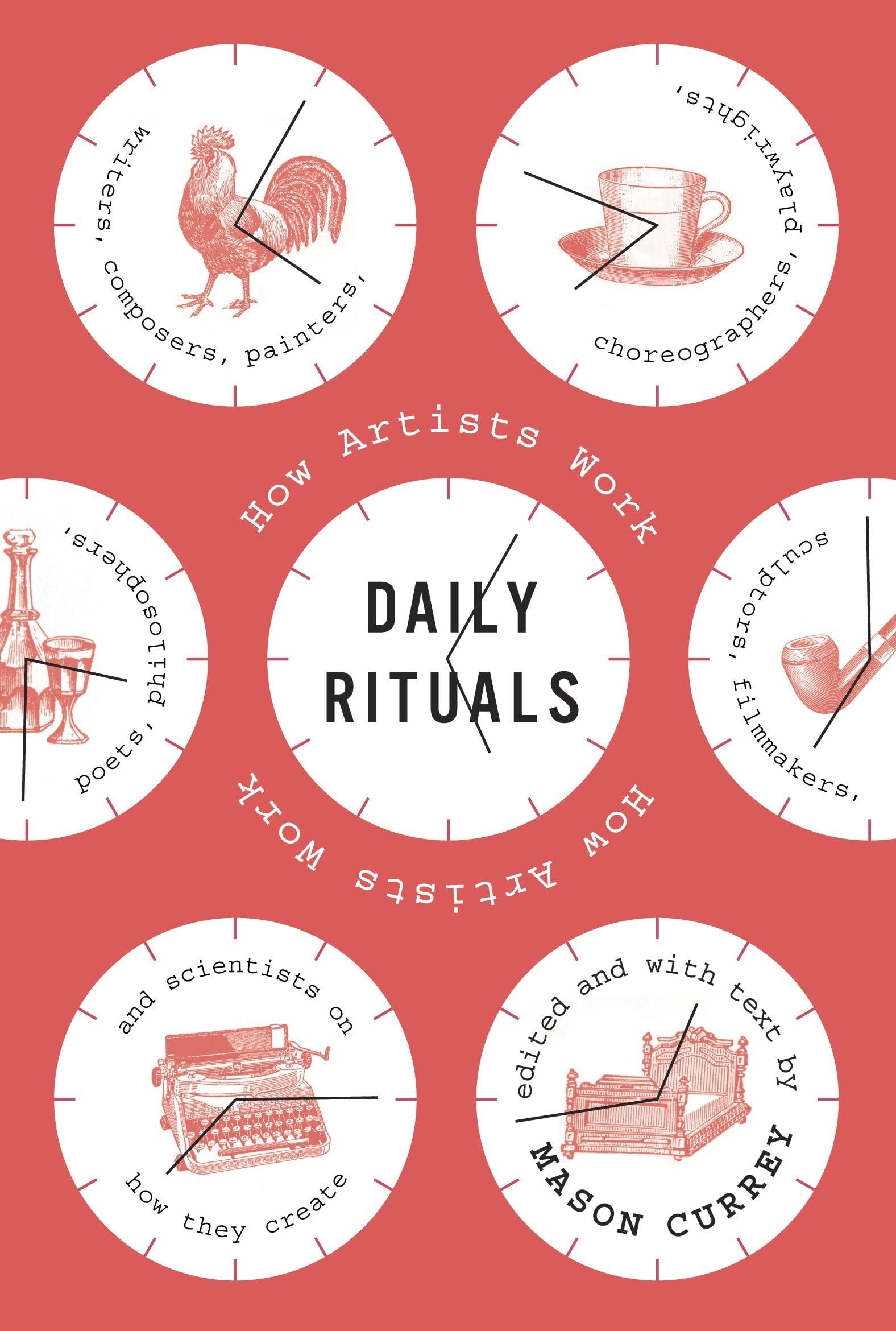
Daily Rituals: How Artists Work
Product ID: 245047
Desertcart purchases this item on your behalf and handles shipping, customs, and support to Austria.
More than 150 inspired—and inspiring—novelists, poets, playwrights, painters, philosophers, scientists, and mathematicians on how they subtly maneuver the many (self-inflicted) obstacles and (self-imposed) daily rituals to get done the work they love to do. Franz Kafka, frustrated with his living quarters and day job, wrote in a letter to Felice Bauer in 1912, “time is short, my strength is limited, the office is a horror, the apartment is noisy, and if a pleasant, straightforward life is not possible then one must try to wriggle through by subtle maneuvers.” Kafka is one of 161 minds who describe their daily rituals to get their work done, whether by waking early or staying up late; whether by self-medicating with doughnuts or bathing, drinking vast quantities of coffee, or taking long daily walks. Thomas Wolfe wrote standing up in the kitchen, the top of the refrigerator as his desk, dreamily fondling his “male configurations”.... Jean-Paul Sartre chewed on Corydrane tablets (a mix of amphetamine and aspirin), ingesting ten times the recommended dose each day ... Descartes liked to linger in bed, his mind wandering in sleep through woods, gardens, and enchanted palaces where he experienced “every pleasure imaginable.” Here are: Anthony Trollope, who demanded of himself that each morning he write three thousand words (250 words every fifteen minutes for three hours) before going off to his job at the postal service, which he kept for thirty-three years during the writing of more than two dozen books ... Karl Marx ... Woody Allen ... Agatha Christie ... George Balanchine, who did most of his work while ironing ... Leo Tolstoy ... Charles Dickens ... Pablo Picasso ... George Gershwin, who, said his brother Ira, worked for twelve hours a day from late morning to midnight, composing at the piano in pajamas, bathrobe, and slippers.... Here also are the daily rituals of Charles Darwin, Andy Warhol, John Updike, Twyla Tharp, Benjamin Franklin, William Faulkner, Jane Austen, Anne Rice, and Igor Stravinsky (he was never able to compose unless he was sure no one could hear him and, when blocked, stood on his head to “clear the brain”). Review: Such an enjoyable read! - I'm ashamed to admit that prior to the last couple of years, I was not a reader. Now, I'm reading three books at once! This is one of them. As I've picked up the habit, I've started reading a lot about habits - the science behind them, how to maintain them, and how to get rid of them. This was such a nice treat! It really complements the other books I have been reading as it takes you through the daily habits of those whom many think wouldn't have any. Good or bad, the habits they had made them into some of the most recognized and admired artists of all time. You see many shared habits between them, which you could attribute some of their success to, and may even want to incorporate into your own life. I've also never had a huge interest in history (I know, I was a terrible student - math was more my thing), but I found myself intrigued with the simplicities of daily life in the 1700s, 1800s and early 1900s. It's such an easy read and hard to put down! It's informative, inspiring, and introduces you to new artists whose work you may fall in love with. I can't bear to part with it as it's definitely one to reread, so I will be purchasing more copies for my loved ones! Review: An interesting read for anyone interested in the arts - I read Daily Rituals: How Artists Work for a book study I am doing with the Emerge Arts Ministry group. It was a very interesting read. Basically the author/editor researched the work habits of about 150 artists, mostly from the fields of literature and visual arts, though artists from other disciplines were also included to a lesser degree. The book yielded some fascinating insights. Of course the artists sampled are anything but a monolithic group and their working habits ran the gamut. There were of course some destructive traits that showed up quite frequently including addictive behaviors and some of the random weirdness that is often associated with my fellow artists. On the other hand there were other artists with whom I really resonated, including something I am most passionate about. Many of the artists sampled derided the idea of sitting around waiting on inspiration. Rather they showed up every day and pursued inspiration by sitting down and doing the work. This is a trait that I believe all artistic people should aspire to. I really enjoyed this book and learned something from most every artist featured. Some showed me things I wanted to emulate, while others showed me the kind of artist I do not want to be. Both of those things can be helpful. This book is a worthwhile read. It is composed of very short essay style chapters, so the reader can digest the book in small bites if desired.

| Best Sellers Rank | #27,345 in Books ( See Top 100 in Books ) #30 in Biographies of Artists, Architects & Photographers (Books) #36 in Popular Psychology Creativity & Genius #44 in Trivia & Fun Facts (Books) |
| Customer Reviews | 4.3 out of 5 stars 1,651 Reviews |
E**B
Such an enjoyable read!
I'm ashamed to admit that prior to the last couple of years, I was not a reader. Now, I'm reading three books at once! This is one of them. As I've picked up the habit, I've started reading a lot about habits - the science behind them, how to maintain them, and how to get rid of them. This was such a nice treat! It really complements the other books I have been reading as it takes you through the daily habits of those whom many think wouldn't have any. Good or bad, the habits they had made them into some of the most recognized and admired artists of all time. You see many shared habits between them, which you could attribute some of their success to, and may even want to incorporate into your own life. I've also never had a huge interest in history (I know, I was a terrible student - math was more my thing), but I found myself intrigued with the simplicities of daily life in the 1700s, 1800s and early 1900s. It's such an easy read and hard to put down! It's informative, inspiring, and introduces you to new artists whose work you may fall in love with. I can't bear to part with it as it's definitely one to reread, so I will be purchasing more copies for my loved ones!
A**S
An interesting read for anyone interested in the arts
I read Daily Rituals: How Artists Work for a book study I am doing with the Emerge Arts Ministry group. It was a very interesting read. Basically the author/editor researched the work habits of about 150 artists, mostly from the fields of literature and visual arts, though artists from other disciplines were also included to a lesser degree. The book yielded some fascinating insights. Of course the artists sampled are anything but a monolithic group and their working habits ran the gamut. There were of course some destructive traits that showed up quite frequently including addictive behaviors and some of the random weirdness that is often associated with my fellow artists. On the other hand there were other artists with whom I really resonated, including something I am most passionate about. Many of the artists sampled derided the idea of sitting around waiting on inspiration. Rather they showed up every day and pursued inspiration by sitting down and doing the work. This is a trait that I believe all artistic people should aspire to. I really enjoyed this book and learned something from most every artist featured. Some showed me things I wanted to emulate, while others showed me the kind of artist I do not want to be. Both of those things can be helpful. This book is a worthwhile read. It is composed of very short essay style chapters, so the reader can digest the book in small bites if desired.
C**D
Those who make things do not usually act like most people. This book helps you feel less weird.
Listen to Daily Rituals on Audible when you go walking for the next 2 weeks--it could change your life. Not many people write books and make millions with their intellectual properties. To accomplish that, you will not act like most people. I found it helpful to hear how very productive people structured their day: when did they eat, walk (most of them did), see patients, see family, make love, and sleep? Examine the daily rituals of people like Einstein, Sigmund Freud, Charles Dickens, Carl Jung, Steven King, Richard Feynman, Benjamin Franklin, Isaac Asimov, and many others. This book did two very important things for me: (1) It gave me ideas for how to structure my day to get things done, and (2) it made me feel less weird for living the way I do. Both of those are equally important, and you can do neither without the other. I have trouble reading this one, so I listen to it. Even though I keep the hard copy handy for reference, I have listened to it many times, several times a year, since I first bought it when it first came out.
F**E
Not a self coaching book, just and index of your favorite artists habits during their days.
This book points out a lot of the rules that thousands of artists have used even during the beginning or their lives. However I noticed I am just reading how they used their daily routine to achieve the best results. I was expecting this book to be more like a helpful goto guide to my favorite artists. That's not what this book is, just a giant index of their morning and afternoon lives, I found this book to be ok as a reference guide for your favorite composers however there isn't anymore context I can take from this other than just information thats collected and not buffered into a self coaching book. I find this book not very useful for someone looking to improve their lives.
K**N
I really enjoyed this book
I enjoyed this book and I wrote a complete review on my website. It's a bit lengthy to post here, but the following excerpt should be more enough to get my point across. Is your creativity driven by a looming deadline? Do you need four or five cups of Diet Pepsi or tea before you can even think of putting one word on the paper? Does the rest of the world need to be sleeping for you to hit your stride? Do you sometimes type the title of an article on the page just to see words on the page? Okay, well maybe I’m the only one that does those things. If not, join the ranks of many creatives that have rituals or behaviors that get their creative muscles warmed up and ready for the battle of the blank sheet or canvas. As a creative who grew up with other creatives, Daily Rituals piqued my interest and would hopefully feed my curious nature. Maybe this middle of the night creative could pick up a few tricks of the trade from some of the most successful artists in the world. Perhaps I could gain a little insight into how they became so successful and in some cases are still going strong. If nothing else, it would be fun to take a peek behind the curtain. And it was. I really enjoyed this book and I would recommend it to anyone looking for a quick, informative, enjoyable read.
A**.
An interesting, easy read.
I appreciate how many different artist the author includes here. It shows a wide range of talent at work and the vast amount of differences in what creative types do to get the work done. I enjoyed reading it, very short chapters, if you could even call them that, quick bio's that cut right to the routines. It was handy to have my iPad close as a few writers I was not familiar with and would have liked at least a mention of their most notable works. This info was included in some but not all of the essays. The artists included were also heavily stacked with writers, followed by composers. I would have preferred more visual artists but that is just a personal bias. I also would have liked to see more living artist included. The author relies mostly on diaries, biographers and oral second hand accounts for the information presented, interviews with living artists would be perhaps more relevant to our times. It's a bit discouraging how many prolific artist past had meals all prepared for them, maids and typists, etc. Maybe a sequel! Even with these wants I found the book enjoyable and fun to read.
H**N
Fun account of how artists work
Mason Currey has gathered together from a variety of sources accounts of how artists work. Most of the artists are writers, but he includes a number of painters and a smattering of choreographers, architects, and others. The entries are quite short; none is longer than a few pages and some are only a paragraph or two. The artists' approach to their work varies, but most seem to work for just a few hours per day, typically first thing in the morning. Most seem to stick to a schedule, although some seem to work sporadically -- or erratically! -- and so don't appear to actually have "daily rituals." Currey makes no attempt to draw conclusions from the material he has gathered, so the reader is left to take what he will from the entries. Because there is no particular organizational theme and because there are so many entries, this is a book best read in short bursts rather than cover-to-cover in a single sitting. Although I enjoyed the book, I have a couple of minor criticisms: First, Currey doesn't always make clear that for a substantial number of these artists the work schedule described applied to just a brief period in his or her career. To take one of many examples, George Orwell is described as writing on a schedule determined by his hours as a clerk in a used bookstore, but Orwell only held that job for a brief period. Second, the order of the entries appears random or nearly so. In a few cases, the entries for similar artists appear together, but that's rarely the case. Here, for example, are the last four entries in the book: Maira Kalman, Georges Simenon, Stephen Jay Gould, Bernard Malamud -- quite a mixed group (and should a writer of non-fiction like Gould have been labeled an "artist"?). It might have been more helpful to have grouped the artists by type and then chronologically within type. Doing so might have made it easier for readers to detect common approaches and consider how the approaches may have varied over time.
A**H
Manton Curry does an excellent job of introducing the daily rituals of artists in ...
This is no ordinary book! Daily rituals is one of the most interesting biographies I have read; it pries into famous artists everyday lives looking at the methods they employed to harness their creative juices. Daily rituals is a group biography that will allow you to learn more about the famous artists you know and introduce to ones you have never heard of. This is not a 'how to be productive book', nonetheless by looking at the radically different approaches that artists have used to harness their creativity could give you some ideas for your own creativity. Neither is this a regular book, with an intro, body conclusion or even a plot to follow. One can choose the biography of certain people or read it cover-to-cover (it does not matter which cover you start from). Manton Curry does an excellent job of introducing the daily rituals of artists in a humorous and intriguing manner, not placing too much weight on any single artist. Some biographies are a mere paragraph while others span a few pages nonetheless it is a well-balanced book. I highly reccomend this book, for a deeper knowledge of general history, and as the perfect companion for artists of any sort.
N**S
Insightful and Easy to Read
Daily Rituals: How Artists Work is a very insightful book that provides a glimpse into the daily routines and habits of various artists. It’s easy to read, making it a perfect daily read. I found it inspiring and motivational to see how different creators approach their work. Overall, a great book for anyone interested in creativity, productivity, or the lives of artists. Highly recommend it!
E**D
Delicioso
Me encantó el libro. Wonderful research, funny, delicioso
G**I
Bello
Bello
P**F
A Brilliantly conceived, Funny, Intriguing and Fascinating Collection. Endlessly stimulating.
This quite unusual 275 page book includes brief, well-written accounts of the 'daily rituals' practiced by 161 inspired and inspiring minds, from Tolstoy to Woody Allen to Dickens to Warhol to Picasso to Jane Austen to Beethoven ... Each delightful entry runs from 1 to 3 pages in length and all are remarkably well-researched. Easy to read, fun, jammed with insider anecdotes. From the jacket (and entirely accurate): "Writers, composers, painters, choreographers, playwrights, poets, philosophers, sculptors, filmmakers and scientists on how they create (and avoid creating) their creations." The book is a joy. Dip into it anywhere, for however long. I happen to be a bibliomaniac and this is my find of the year. ... It's physically small, therefore easy to carry also.
L**7
Amazing as I am trying to find my own routine
Really comprehensive and fascinating book on daily routines of over 150 amazing people that have made their mark in the world. It was inspiring and I read it in 2 days!
Trustpilot
3 weeks ago
2 months ago