
Desertcart purchases this item on your behalf and handles shipping, customs, and support to Austria.
🌀 Unlock your zen, one tangle at a time!
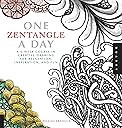
One Zentangle A Day is a bestselling 6-week guided course that teaches the meditative art of Zentangle through 42 daily exercises. Designed for all skill levels, it combines creative drawing with mindfulness, featuring expert artwork and practical tips to help reduce stress, boost focus, and inspire artistic growth.


| Best Sellers Rank | #18,569 in Books ( See Top 100 in Books ) #9 in Mixed Media (Books) #23 in Mandalas & Patterns Coloring Books for Grown-Ups #52 in Art Therapy & Relaxation |
| Customer Reviews | 4.6 out of 5 stars 2,639 Reviews |
C**R
For Those Who Like to Doddle, Doodle With A Purpose!
So far it's been a good learning experience. I really like doing these. Not sure if I'm exactly getting into the mediation mode that the author is hoping I'd attain, but I do consider what designs I want to use where. Ms. Krahula is good at trying to explain some of the drawing concepts such as shading, light placement, depth etc. There's also the use of words such as tanglenhancer, tangleation that I find bothersome but may in fact be normal words within the tangle community. The book is filled with step by step drawings for the patterns you're to learn. In the later lessons she starts to show you other ways to do tangles by adding color and how to apply tangles in other areas of art, jewelry, fabric, ornaments etc. There's also various art work from other artists that are beautiful to look at and can help you get ideas for your own work. Overall, I think this is a pretty good introduction to zentangles. It doesn't overwhelm you with material to learn. She does have a list of supplies, which I took as more of a suggestion. I didn't want to spend the money for special tiles, pens, markers etc. without knowing this was something I'd like or not. So I've just been doing these in a mixed media sketchbook. I did buy the Sakura micron pens, but they weren't that expensive. (update: Dec 2016, the sakura pens didn't last as long as I'd hoped. I ended up replacing them with Faber Castell Pitt artist pens. The tips on these are larger, (longer?), so it seems that they should last longer. They are very smooth and I haven't had any bleed through. They come in similar sizes as the microns so these are a good substitute IMO.) I'd say give this a try it's fun to do. Not very time consuming, unless you want it to be. A nice outlet for creativity and for those of us who like to doddle
A**R
Hours of good practice start-ups.
Excellent starter info.
C**U
Best Zentangle book
I own several books on Zentangle. This is the first one I got and the one that got me into it, and it is the best of the lot, but there is certainly room for improvement. First the pros: I like that it is organized as a series of daily lessons that build upon each other. This si the book's greatest strength. This encourages you to make Zentangle a daily practice, or at least a frequent/regular one. I did more than one lesson per day early on and later had to skip days or take longer to do some of them, partly due to my schedule, and partly because the projects became more time-consuming (and costly) later in the book. This also encourages you to try things--media and patterns and techniques that you might not otherwise try. The other books are not structured this way, but are more like random collections of stuff with a bunch of tangle step-outs (visual instructions for how to draw the patterns) appended. That said, there is generally something worthwhile in the random collections of stuff, but what is lacking is structure. This book takes the newbie or experienced tangler through various principles and techniques of art while introducing new tangles at a pace that makes it easy to integrate them into your practice. It also has you keeping a sketchbook as a place for practicing new patterns and techniques and working out ones of your own, another valuable art practice. The cons: As I mentioned earlier, the materials used in the projects get more costly as the book progresses. If you are buying everything recommended, it could get a bit pricey. That said, you will then have a nice collection of materials with which to continue your practice. I wish that the author had given some time to sustainable art materials. Some of the things she recommends, such as Gelatos and all those disposable markers and pens, are just grossly over packaged and lead to more plastic waste. There are various refillable technical (i.e. Rapidosketch, etc.) and fountain pens that use bottled inks and which are more affordable and less wasteful in the long run. And, as others have mentioned, the book would be better with better editing. Overall, this is the best introduction to Zentangle that I have seen and would give someone new to this practice a firm foundation in the discipline, and would fill in gaps and expand the horizons of someone who started tangling with a more random approach. To those critics who say that Zentangle is some evil, corporate patented form of doodling designed to profit those who founded it, I have this to say: that is nonsense--you can practice this art form without ever buying any Zentangle-branded merchandise--all you need are technical pens of the appropriate nib sizes, permanent black ink for them (and other colors as you see fit), ordinary graphite art pencils of any brand you want, a couple of stumps available at any art store, and quality paper. The branded Zentangle tiles are made from Fabriano Tiepolo paper, which is available at any real art store in big sheets that you can cut down to 3.5" squares for a lot less money, but most any quality printmaking paper (such as Stonehenge) or 90-140 pound watercolor paper cut to size will do. You can use a library card to borrow a book for free, or just visit any of the numerous websites now available (Tangle Patterns, for example), thus starving the alleged corporate beast. Or you could just keep complaining rather than trying out what may prove to be an accessible and enjoyable entry (or re-entry) point into the visual arts.
R**N
Zentangles can solve problems
The title grabbed my attention but the book did even more. I am an artist, have been for many years, but I have been struggling with an essential tremor in my dominant hand (the left) which has forced me to start training myself to use my right hand for things like eating soup or bringing a glass of water across the room without spilling it. My handwriting has suffered and I have almost stopped painting and drawing...until now. When I looked through "One Zentangle a Day" I had an inspiration... Instead of doing one Zentangle a day, I have been using my left hand for one Zentangle the first day, and the next day I do the same lesson (using the assigned pattern but not the same composition) but I use my right hand. I had never been able to draw or paint with my right hand. Following the suggestions in the book, working slowly and concentrating on what I am doing, my DRAWING WITH EACH HAND HAS IMPROVED! I did not buy the "tiles" offered in the book, I am using two sketch books - one for my left handed drawings, and the second for drawings done with my right hand. I date and label each drawing as is suggested in the book. have been working with Zentangles for three weeks and the improvement is surprising and very encouraging. The book is clearly written and well organized. The illustrations are self explanatory. Although it does require concentration and effort, the work is also relaxing. Sometimes a different approach will solve a problem. "One Zentangle a Day" has certainly helped me in my efforts to solve mine.
E**S
A Key to Unlock Creativity
I hadn’t drawn anything – even a straight line except in a doodle – since someone made me do so in art class in middle school decades ago. If it ever came up to draw anything at all I would completely freeze. Then a friend of mine, who is a therapist, was learning to provide art therapy for her patients and asked me if she could practice some of the lessons on me. That started me on a journey of art. She piqued my interest and wonder at this facet of life and the universe that I had never approached before. Then I told an artist friend of mine of this experience and that I didn't know where to begin this new exploration, and she recommended Zentangles. She said that it is the kind of art experience that quickly allows your creativity to blossom without things like knowledge of perspective, color, materials, etc., standing in your way. I looked on Amazon and quickly found the three things to get me going: pens, little cards, and this book. My artist friend was right about Zentangles. It was a great first step, it allowed a skill-less-couldn’t-draw-a-circle-me to quickly become creative and joyful about art I had created. And I felt something I had never felt before: the meditative feeling of becoming absorbed in an art project. Each little project can take only 15 minutes or so, or longer if you like. This experience opened up a journey in which I started looking behind other doors for art experiences. I found a couple of other art books helped me on my next art-exploration steps, that I plan to write reviews on, but, in case I don’t, here are the names of two “How To” books that helped me tremendously: a book on drawing called You Can Draw in 30 days by Mark Kistler, and a book on painting called “Daily Painting” by Carol Marine. One more thing (sorry this is so long!) I didn't do "one Zentangle a day." You can see that doing one a day seems to be a thing with art books (see the titles of the other two books I just recommended.) Go at your own pace and do what works for you, this is your journey! I repeated the first few Zentangle exercises for a couple of weeks and then slowly worked my way through other exercises, sometimes skipping the ones I didn't care to do.
J**E
Love This Book!
I purchased this book last week prior to embarking on a cross country trip. I scanned it from beginning to end and then started doing the lessons from the beginning (although I have been skipping around a little when I'm doing my daily zentangle just to add an extra pattern or two. It is easy, fun and definitely increases my focus. The instructions are clear and easy to follow, and I really appreciate the diagrams on how to do each stroke. Even the most complicated patterns are easy to do by following the steps Beckah lays out in her diagrams. I'm amazed at the beauty of the five Zentangles I've produced so far. Even the very first one I did is lovely. I also appreciate the recommendations Beckah gives on materials. I'm looking forward to trying some of the exercises towards the back that demonstrate how to branch off from the standard black and white. I bought it in the Kindle edition because I was leaving the next day and didn't have time to wait for the mail. Normally with a book like this that has many illustrations, I would purchase a hard copy, but the Kindle version Is surprisingly easy to use and the nice thing about that is that I can have it with me wherever I go just in case I want to do a Zentangle while I'm waiting or practice some of the patterns. Thanks Beckah for giving me the tools and ideas to feel confident getting started right away! I highly recommend this book.
C**S
Broke the rules and really enjoyed this!
I bought this book over a year ago. Started by following the directions with white tile and micro pens...got bored after 2 drawings. Fast forward to me wanting to learn how to use a liner brush. Broke the 'rules' and just let myself play so I could learn brush control without these things being precious. Now I have a nice little stack of papers to do other things with or keep in my journal plus several patterns I will incorporate into mixed media work 😊 Thanks for a great boom!
I**G
Some Strengths, Some Weaknesses
I bought this book because I wanted a more organized approach to learning basic tangles than I had taken, which was to find a tangle I liked in the books I have (both of Bartholomew's, Time to Tangle with Color, and one more) and learn it. I also wanted some help on learning to use tangles so they overlap, interweave, and do all the cool things I see in many examples. This book has been somewhat helpful, but could have been far better with a bit of judicious editing. I have been following Krahula's daily regimen, and am indeed learning--and liking--tangles I had skipped over before. Her introduction has the best and most informative list of materials for tangling that I've seen. There are clear descriptions of the different kinds of pens, pencils, watercolors, papers, and so on. The daily schedule includes introductions to enhancements to tangles, shading, changes to tangles, working on dark and brightly colored paper, and more. She has thoughts about what makes an interesting Zentangle and tries to communicate them through examples of her own work, that of guest artists, and suggestions. I really wanted this part a lot. Unfortunately, her command of written English is poor enough that in several places I really didn't understand what she was trying to explain, including her suggestions for interesting Zentangles. In others, I was merely annoyed: she uses "transcend" when she means "transition" and calls established rules about what is a Zentangle "historic' or "traditional", which is a bit pretentious for an art less than ten years old. She makes a commendable attempt to convey quite a bit about color theory and about how to mix colors, which I really appreciate, but since she doesn't use the standard vocabulary of hue, value, saturation, and tone, she isn't clear enough to get her probably quite useful points across. In additon, the step-by-step illustrations of how to draw the tangles are quite poor. Several squoosh a couple of steps together, others are unclear as to which aspects of the example are basic to the tangle and which are just the artist's whimsy. Some tangles look quite different from their counterparts in other Zentangle books. Odd quirks in the book abound: art materials are described but not photographed; Step-by-step layouts include blank spaces for steps beyond the ones provided, and some step 3's, for instance, show a clearly different drawing from the one in step 2. I'm not just quibbling here; I was stopped and confused by each of these defects.Some editing by a good editor might have made this a first-rate book. Overall, I think the main benefit to me has been the structure of doing the tangles she assigns, every day, whether I'd have picked them for myself or not. I also like the opportunity to view her work, which is quite different from the other artists whose books I have, and which I like quite a bit. Her use of color is worth learning from, and the patterns she provides for Zendalas are lovely.
A**0
Bon livre
Livre en anglais - Très bien pour aborder le Zentangle
R**Y
Gran calidad
Muy bueno
D**O
Wunderbar für Anfänger, sehr entspannend
Das Buch hält, was es verspricht: in sechs Wochen lernt man nach und nach die Grundmuster der neuen Entspannungskunst Zentangle kennen. Leicht verwandt mit dem klassischen Formenzeichnen sind Zentangle zunächst in kleine Quadrate (im Buch werden 8x8 cm empfohlen) gemalte Muster, die "Schritt für Schritt"-Zeichenmethode führt dabei rasch zu Konzentration auf das Tun und damit zu geistiger Entspannung. Anders als bei Formenzeichnen haben die Muster also einen festen, kleinen Rahmen, was den Effekt hat, dass auch Zeichenanfänger nicht erst einmal wie geschockt vor einem großen weißen Blatt sitzen und Hemmungen überwinden müssen, ordentlich groß loszumalen. Die kleine Form erleichtert den Einstieg enorm. Jeden Tag lernt man zwei bis drei neue Muster kennen, zwischendurch wird das Erlernte vertieft, indem man z.B. Muster kombinieren oder Licht und Schatten einfügen soll. Auch bei völlig unbegabten Menschen (mancher kann einfach nicht frei zeichnen) entstehen so hübsche kleine Kunstwerke, man ist selbst verblüfft, mit welch simplen Mitteln man schöne Effekte erzielen kann. Am Ende gibt es noch interessante Erweiterungen wie selbsterstellte Mandalas, Buchstabenmuster und Malen auf schwarzem Papier. Man braucht dazu nicht die Menge an Materialien, die am Anfang des Buches dargestellt wird, eine Din-A 6 Kladde mit Blankoseiten, weiche Bleistifte und Buntstifte reichen völlig. Egal, ob am Abend nach der Arbeit (oder morgens im Zug auf dem Weg dahin), im Urlaub, am Wochenende oder sogar im Wartezimmer, hat man die Muster erstmal erlernt, kann man mit wenig Material und Aufwand jederzeit entspannend tätig werden.
P**À
Ottimo acquisto sia per se stessi che per regalo.
Ottimo acquisto, arrivato nei tempi previsti, ben imballato, senza danni o segni di usura. Ben illustrato e con spiegazioni esaurienti.
L**R
Makes Me Want To Create!
As a beginner Zentangler, I asked for suggestions on what books to start with. One Zentangle A Day was the most suggested and I'm so glad I listened. It is beautifully illustrated and well written with concise, easy to follow instructions on how to create beautiful patterns and tangles. I found it easy to follow and not overwhelming. Each chapter gives an outline of what is entailed and has a week long daily activity with a pattern or patterns to learn. It is meant to be covered in six weeks with six chapters, each with seven lessons per chapter, but can easily be adapted to your own pace and schedule. It starts with an introduction to Zentangle and gives a list of suggested supplies but many people start simply with paper and pen. Along with the book, I bought some Zentangle tiles and micron pens, but found that I wasn't ready to start creating on tiles yet and instead picked up a small sketchbook to practice in. The tiles are beautiful though to be able to create a finished Zentangle on. I'm so glad I bought this book. For me, it is not a book to be raced through in six weeks. I am going through it slowly, almost savouring everything I am learning and enjoying the time to slow down and immerse myself in the experience. It's a book I will return to over and over again.
Trustpilot
1 month ago
2 months ago