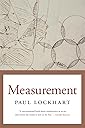
Harvard University Press Measurement
Product ID: 298808392
⭐4.6/5 star rating from 220 reviews
📈Ranked #25 in Science Experiments & Measurement
📚Top-tier academic press
📐 Elevate your math game with Harvard’s definitive take on measurement!
Harvard University Press Measurement by Paul Lockhart, published under the prestigious Belknap Press, is a highly acclaimed book ranked #25 in Science Experiments & Measurement and praised for its insightful approach to teaching mathematics. With a 4.6-star rating from over 220 readers, it’s a must-have for professionals and enthusiasts seeking a fresh perspective on mathematical measurement.
| Dimensions | 13.97 x 2.84 x 20.96 cm |
| Edition | Illustrated |
| Isbn 10 | 0674284380 |
| Isbn 13 | 978-0674284388 |
| Item Weight | 1.05 Kilograms |
| Language | English |
| Print Length | 416 pages |
| Publication Date | 12 May 2014 |
| Publisher | The Belknap Press |
User
Überschrift
Tolles Mathematikbuch.
User
Libro recomendado
A mi me ha ayudado a entender la geometria y estoy estudiando un grado de Matemáticas
User
Great book
Great maths bookRecommended
User
Best introduction book for mathematics
This is one of the best book to start mathematics. The visuals explanation on geometry are outstanding. It doesn’t sacrifice rigor for ease of understanding. It serves as a bridge for more complex mathematics. I highly recommend it.
User
Connections and Relationships! That's Mathematics in a Nutshell
All numbers _ all shapes and sizes _ time and space _ all are connected. Such relationships are everywhere at all times. Thus, patterns are created; some tangible; some not so much. Deciphering these connections, determining the general pattern, becomes the task of the mathematician. I discovered this concept when, some sixty plus years ago, my 6th grad teacher spent an entire morning detailing how common shapes (squares, rectangles, triangles, trapezoids, etc) were derived from one another by deriving their area formulas from a single equation. They were, in this way, shown to be all one and the same but simply stretched out into this or that shape or, geometrically, as viewed from various perspectives. This revelation came as a major eye-opener for me and changed my entire direction in life's pursuits. (Now that they 'teach to the test,' such revelations are generally and sadly absent from today's classrooms). Measurement as discussed in this wonderful book is not measurement in the classic sense of the word. In other words, one will not find a ruler with the sq rt of 2 on it. In this case, measurement represents a systematic assignment of a value to some subset of a system such that comparisons can be made between the elements of the system and between systems and (consequently) mathematical links between seemingly unrelated areas of the mathematical universe. The book is divided into two main sections. The first concerns what we used to refer to as "Synthetic" geometry. That is: to build up knowledge based on first principles. Numbers as such are conspicuously absent. Only pure reason is utilized much as it was in "ancient" times. In this manner, the author puts us directly into the mind of the mathematician; solving the riddle with nothing more the the one or two elements at hand. The ancient Greeks did this not so much because they lacked the so-called "brilliance" of the modern day Human but by choice, neglecting the more analytical approach. As such synthesis was more in keeping with their predominantly aesthetic view of nature. The second section adds the coordinate system (ala Descartes), thereby providing an Analytical approach and somewhat greater precision to the solutions (and consequently providing some deeper insights into the connections at large!). This is not a How-To book. It is an argument that is detailed and punctuated with an excellent choice of problems to challenge one's perspective. If the reader has no mathematical background, this book will pose a major challenge for sure. Additionally, if the reader lacks a fair background in both Trig. and The Calculus, this too will make forward motion along the line of comprehension rather tedious. That is not to say that one cannot follow the argument but it will be, at minimum, tough going, especially when the author reveals such links as between the Hyperbolic Integral area (dA = dw/w) and the Natural Log (ln). Calculus is, of course, simply a short cut to solving an infinite series of calculations in a few steps. It's use was initially implemented during the so-called "Kerala" Period in Southern India several centuries before Newton or Leibniz, both of whom systemized the science. It's rules are few but rather messy and often difficult (if not impossible) to apply without extensive practice and a good visual sense. Trig is stymied by its extensive use of the ever so transcendental Sin and Cos, etc. and also requires some fairly able visuals. The ability to convert from the geometric to algebraic represents a major breakthrough in extending Mathematics into further realms of exploration and therefore lends a helping hand to those less able to follow the visual signs so to speak. Again, 'measurement' represents only one area of the whole of Mathematics but this book will give anyone who wishes to tread through the mesmerizing tangle of Mathematical mystery an excellent sense of the Mathematical mind.
Trustpilot
1 day ago
1 week ago