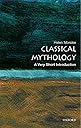
Classical Mythology: A Very Short Introduction
Product ID: 394011775
⚡Provocative, fresh myth interpretations
🌍Global cultural impact explored
📚Concise 144-page deep dive
Desertcart purchases this item on your behalf and handles shipping, customs, and support to Austria.
📖 Unlock the ancient secrets shaping your world today!
Classical Mythology: A Very Short Introduction by Oxford University Press offers a sharp, analytical exploration of Greek and Roman myths, revealing their enduring influence across art, culture, and psychology. This 144-page volume challenges traditional narratives with fresh interpretations, making it an essential, compact read for professionals eager to connect classical wisdom with modern life.

| Best Sellers Rank | #157,775 in Books ( See Top 100 in Books ) #289 in Archaeology #295 in Folklore & Mythology Studies #875 in Literary Movements & Periods |
| Customer Reviews | 4.5 out of 5 stars 150 Reviews |
J**S
Demystifying the myth
Emphatically not a narrative survey of Classical myths, this guide is firmly analytical. For Morales, 'Myth is a complex game of production and reception'. It is a game which invites reinvention and reinterpretation, selection and manipulation, and is one which is very much alive today. Her approach is radical and invigorating. One modern 'myth' tackled early on is that of Greek 'cultural purity'. Martin Bernal's controversial study, 'Black Athena', is discussed and found wanting, as one of its its central arguments about the value of myth in helping to reconstruct cultural origins is rejected. Morales references her points convincingly. Her argument about the malleability of myths, whose meanings depend on context, is illustated by examining the myth of Marsyas. To the Greeks, the myth can be interpreted as a warning that mortals 'know their place' and do not challenge the authority of the gods. To Romans of the Republic, however, Marsyas is a laudable figure, a freedom-fighter who resists the authority of the patrician class. In the myth's Roman guise, he is not killed by Apollo but rescued by Liber (god of liberation) and taken to Italy. As with Beard and Henderson's 'Classics' in the same series, every effort is made to present the subject in a lively and topical way. Some characters make it onto the A-list of mythological heroes (Theseus), while others, despite their positive qualities, do not (Lycurgus). Trying to find out why A-listers 'make it' (John Lennon) while others remain resolutely B-list (John Major) makes for an absorbing discussion. Morales is succinct and perceptive on the impact of Christianity, philosophy and psychology upon Classical myth (and vice versa), while her style is incisive, even provocative: the grand tradition of Western art, with its 'alibis' and its lascivious depiction of rape, has contributed to a view 'that ancient Greece and Rome were pornotopias.' By such means is a potentially dead(ly) subject brought vividly to life.
M**I
Five Stars
Mind blowing.
P**E
The meaning of myth
Two other entries in this Very Short Introduction series can be seen as companion volumes to the present one. They are Classics, by Mary Beard & John Henderson, and Myth by Robert A. Segal. I would recommend reading those two - in either order - and then this one, although they each stand very well alone. Morales discusses various interpretations of the role of myth in Western culture, its functions and significance. Although she distances herself from works that restrict themselves to narrations and summaries of the myths themselves, she does include a list of Classical deities and their attributes, unapologetically admitting, "I am having my cake and eating it by including this". But the focus throughout is very much on the nature and function of myth rather than its content. The chapter on Freudian psychoanalysis is particularly interesting. She writes very well, often with a light touch and with frequent popular culture references. The book concludes with a useful 5-page Timeline - from 800 BC, "Early Greece" to 2007, the publication of this book - a comprehensive Reference section, and a very useful Further Reading section. If you want an understanding of myth, how it evolves and how it continues to be relevant, you should read this book. [PeterReeve]
M**G
Great and quick guide to mythology
It was recommended to read as a great taster for a OU course i’m doing.
S**R
Changed My Idea of What Mythology Is
I read this book prior to beginning my studies as a Classics major since I did not have any real grounding in classical myth. I originally thought this book would relate what the various myths were and how they were important. Thankfully, this book helped reshape my idea of what "myth" was and is while offering helpful interpretive keys to better appreciate and contextualize Greek mythology. While I do not suggest someone buy this if they want to read a summary of every Greek myth, I would suggest anyone purchase this if they are interested in *what* mythology is and *how* the Greeks used it to help explain their world to themselves.
Trustpilot
2 weeks ago
1 month ago