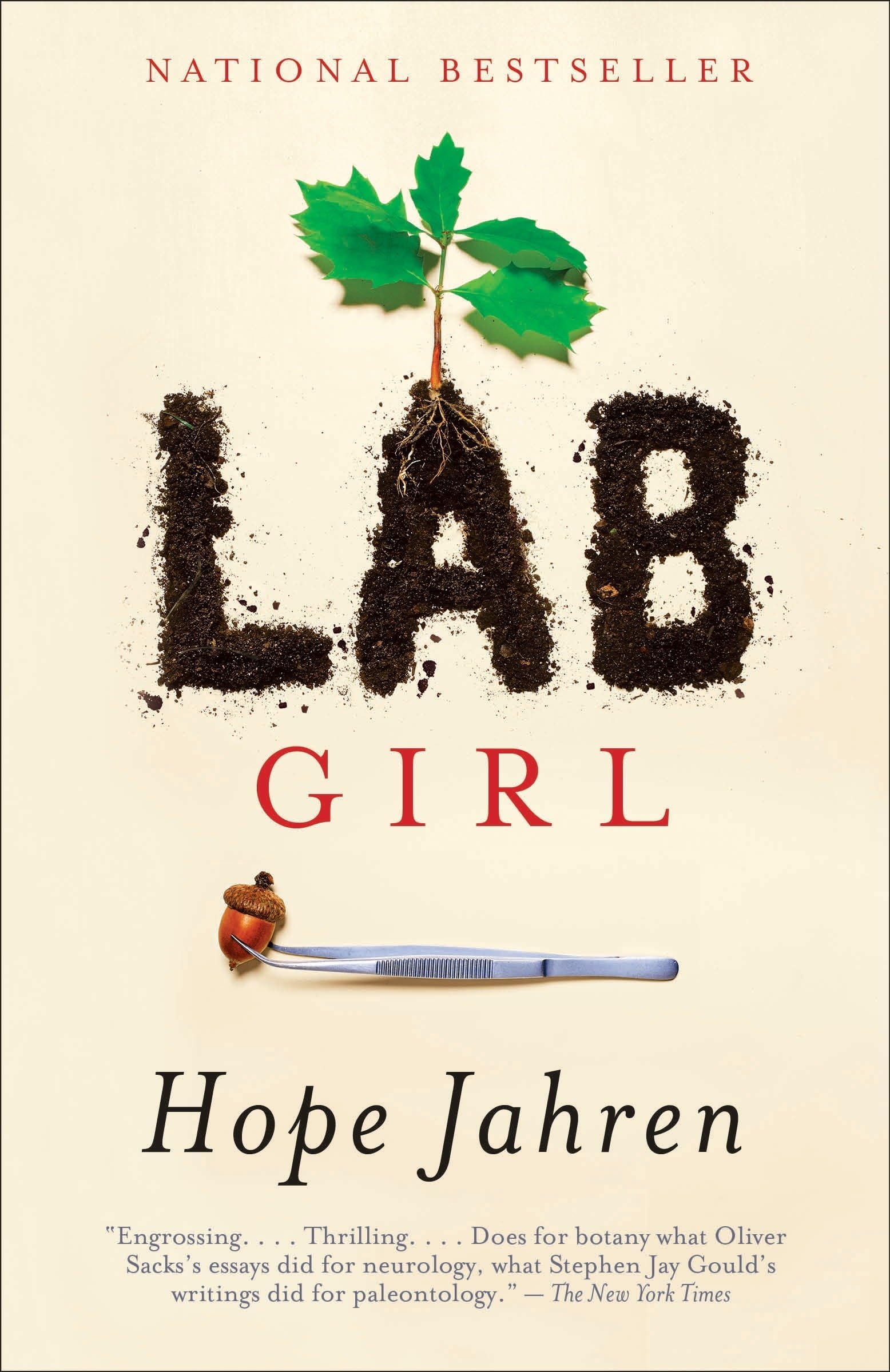
Lab Girl: A Memoir
Product ID: 39521023
Buy anything from 5,000+ international stores. One checkout price. No surprise fees. Join 2M+ shoppers on Desertcart.
Desertcart purchases this item on your behalf and handles shipping, customs, and support to Austria.
NATIONAL BOOK CRITICS CIRCLE AWARD WINNER • NATIONAL BESTSELLER • Geobiologist Hope Jahren has spent her life studying trees, flowers, seeds, and soil. Lab Girl is her revelatory treatise on plant life—but it is also a celebration of the lifelong curiosity, humility, and passion that drive every scientist. "Does for botany what Oliver Sacks’s essays did for neurology, what Stephen Jay Gould’s writings did for paleontology.” — The New York Times A Kirkus Reviews Best Nonfiction Book of the Century In these pages, Hope takes us back to her Minnesota childhood, where she spent hours in unfettered play in her father’s college laboratory. She tells us how she found a sanctuary in science, learning to perform lab work “with both the heart and the hands.” She introduces us to Bill, her brilliant, eccentric lab manager. And she extends the mantle of scientist to each one of her readers, inviting us to join her in observing and protecting our environment. Warm, luminous, compulsively readable, Lab Girl vividly demonstrates the mountains that we can move when love and work come together. Review: Truly enjoyable - Hope Jahren is a really fine writer. She interleaves tales of the death defying challenges and risks endured by a tree with tales of her own chaotic, driven life. Contrary to expectations, the life and studies of a botanist make for a gripping story. Inextricably interwoven with her life is her lab partner and life partner, Bill. Bill is the other half of a platonic love story. The reader is never sure of her age at any part of her career, but when they are probably in their 40’s, she has noticed that they are drawing apart. After all, by now she is married and with a child and living in Norway. She reflects that “…But deep down we knew the separation was good for us: We were getting older and I was raising a family. Convention and circumstance dictated that we should act more like colleagues and less like twelve-year-old fraternal twins.” It’s hard to believe the book is so compelling. Hope and Bill work constantly, studying plants and soil, teaching, building labs, applying for grants. Even their escapades are based around work, going to conventions to get noticed to improve their chances of getting an approved grant. This book reminds me of Elizabeth Gilbert’s “The Significance of all Things.” Gilbert has made the story of a repressed Dutch girl who becomes a world authority on mosses a fascinating and spellbinding novel. I am reluctant to compare an author or a book to another, because they may not find the comparison as complimentary as I do. But Jahren has made the real life struggles and victories of two dedicated scientists as exciting as the finest novel. And actually, I have to wonder how she found time to write this book. Review: Focuses on a two-decade-long symbiotic scientific partnership between the author and her lab assistant - I was drawn to this book after reading a short biographical sketch of Hope Jahren in Time magazine’s special edition of “The 100 Most Influential People.” I’d never heard of this prize-winning scientist before and wanted to know more about her. In the article, she was headlined as being “science’s great communicator.” That stunning phrase sold me: I just had to buy her book. There is nothing I love better than to read brilliant science authored by an accomplished academic who also writes eloquently. The book took me two days to finish and held my interest throughout. But in the end, the book was as equally fascinating as it was disappointing. It also left me frustrated. Let me explain. The memoir takes up perhaps two thirds of the text, but interspersed throughout are many small chapters, each illuminating some small facet of botany. Virtually every one of these life-science essays was exquisitely written and intellectually enchanting. I loved them! In many ways they reminded me of some of the best science writing of E. O. Wilson. I would definitely buy another book by Jahren that was focused on some popular aspect of geology, chemistry, or botany. These essays were five-star gems…but this book is not getting five stars because those essays only formed a minor part. As charmed as I was by the book’s botany essays, I was disenchanted (and frustrated) with the biographical chapters. In my view, all lives are fascinating if you scratch deep enough, and Jahren’s life was, indeed, very interesting. But what this author seemed to lack is any deep psychological perception about herself. In so many ways, Jahren seemed like a stranger to her own emotional and psychological landscape. I found that startlingly odd in a woman who was otherwise so incredibly brilliant. I always wanted her to take me deeper, but instead she generally just followed the action. Sometimes her vignettes were intriguing, sometimes amusing, sometimes downright silly (revealing youthful immaturity, lack of judgment, and inexperience)…and a few times, they were bit too technical for my general interest. Her memoir consisted of a disjointed grouping of chronological stories selected from her life. At the end, the author reveals that she had chosen most of the stories because she and her lab partner, Bill, often reminded each other about them and took great joy in talking about them. If these stories amused the two of them, she was sure they would amuse others…including the reading public. The stories come from the author’s day-to-day academic experience as a research geochemist and geobiologist. But taken together as a group, the stories actually celebrate the history of her extremely odd, two-decade-long relationship with her lab assistant, Bill. As a whole, the stories puzzled me more than they entertained or amused me…and by the end, the man and their relationship remained more of an enigma than anything else. “People still puzzle over the two of us, Bill and me. Are we siblings? Soul mates? Comrades? Novitiates? Accomplices? We eat almost every meal together, our finances are mixed, and we tell each other everything. We travel together, work together, finish each other’s sentences, and have risked our lives for each other.” In the end, I found the book incredibly frustrating. There was so much more I wanted to know, but the author never took me there…never revealed those aspects of her life…or those feelings in her heart! Was she guarding them or was she unaware of them? Frankly, I don’t know.


| Best Sellers Rank | #64,005 in Books ( See Top 100 in Books ) #93 in Scientist Biographies #297 in Women's Biographies #783 in Memoirs (Books) |
| Customer Reviews | 4.4 out of 5 stars 9,918 Reviews |
C**N
Truly enjoyable
Hope Jahren is a really fine writer. She interleaves tales of the death defying challenges and risks endured by a tree with tales of her own chaotic, driven life. Contrary to expectations, the life and studies of a botanist make for a gripping story. Inextricably interwoven with her life is her lab partner and life partner, Bill. Bill is the other half of a platonic love story. The reader is never sure of her age at any part of her career, but when they are probably in their 40’s, she has noticed that they are drawing apart. After all, by now she is married and with a child and living in Norway. She reflects that “…But deep down we knew the separation was good for us: We were getting older and I was raising a family. Convention and circumstance dictated that we should act more like colleagues and less like twelve-year-old fraternal twins.” It’s hard to believe the book is so compelling. Hope and Bill work constantly, studying plants and soil, teaching, building labs, applying for grants. Even their escapades are based around work, going to conventions to get noticed to improve their chances of getting an approved grant. This book reminds me of Elizabeth Gilbert’s “The Significance of all Things.” Gilbert has made the story of a repressed Dutch girl who becomes a world authority on mosses a fascinating and spellbinding novel. I am reluctant to compare an author or a book to another, because they may not find the comparison as complimentary as I do. But Jahren has made the real life struggles and victories of two dedicated scientists as exciting as the finest novel. And actually, I have to wonder how she found time to write this book.
B**E
Focuses on a two-decade-long symbiotic scientific partnership between the author and her lab assistant
I was drawn to this book after reading a short biographical sketch of Hope Jahren in Time magazine’s special edition of “The 100 Most Influential People.” I’d never heard of this prize-winning scientist before and wanted to know more about her. In the article, she was headlined as being “science’s great communicator.” That stunning phrase sold me: I just had to buy her book. There is nothing I love better than to read brilliant science authored by an accomplished academic who also writes eloquently. The book took me two days to finish and held my interest throughout. But in the end, the book was as equally fascinating as it was disappointing. It also left me frustrated. Let me explain. The memoir takes up perhaps two thirds of the text, but interspersed throughout are many small chapters, each illuminating some small facet of botany. Virtually every one of these life-science essays was exquisitely written and intellectually enchanting. I loved them! In many ways they reminded me of some of the best science writing of E. O. Wilson. I would definitely buy another book by Jahren that was focused on some popular aspect of geology, chemistry, or botany. These essays were five-star gems…but this book is not getting five stars because those essays only formed a minor part. As charmed as I was by the book’s botany essays, I was disenchanted (and frustrated) with the biographical chapters. In my view, all lives are fascinating if you scratch deep enough, and Jahren’s life was, indeed, very interesting. But what this author seemed to lack is any deep psychological perception about herself. In so many ways, Jahren seemed like a stranger to her own emotional and psychological landscape. I found that startlingly odd in a woman who was otherwise so incredibly brilliant. I always wanted her to take me deeper, but instead she generally just followed the action. Sometimes her vignettes were intriguing, sometimes amusing, sometimes downright silly (revealing youthful immaturity, lack of judgment, and inexperience)…and a few times, they were bit too technical for my general interest. Her memoir consisted of a disjointed grouping of chronological stories selected from her life. At the end, the author reveals that she had chosen most of the stories because she and her lab partner, Bill, often reminded each other about them and took great joy in talking about them. If these stories amused the two of them, she was sure they would amuse others…including the reading public. The stories come from the author’s day-to-day academic experience as a research geochemist and geobiologist. But taken together as a group, the stories actually celebrate the history of her extremely odd, two-decade-long relationship with her lab assistant, Bill. As a whole, the stories puzzled me more than they entertained or amused me…and by the end, the man and their relationship remained more of an enigma than anything else. “People still puzzle over the two of us, Bill and me. Are we siblings? Soul mates? Comrades? Novitiates? Accomplices? We eat almost every meal together, our finances are mixed, and we tell each other everything. We travel together, work together, finish each other’s sentences, and have risked our lives for each other.” In the end, I found the book incredibly frustrating. There was so much more I wanted to know, but the author never took me there…never revealed those aspects of her life…or those feelings in her heart! Was she guarding them or was she unaware of them? Frankly, I don’t know.
E**K
Obligation to Self v. Obligation to Community - Why I Appreciate this Book
I am almost finished reading Lab Girl - I just finished Part 3, Ch. 8. I don't know why I feel compelled now to review it, having not even finished it, but I guess I've been doing it along the way, anyway. I think I am mostly motivated by a particular review I stumbled upon while googling various things related to the book, as they came up - it was not a particularly good review - the reviewer was disappointed, no, she was really upset because the book didn't depict the real "struggle" facing women in the field, particularly facing Hope Jahren who has accomplished so much. I suppose because I was already several chapters into the book when I stumbled upon the review I had an enhanced reaction to it - like no way, you just don't get it. I really like this book - for everything it is and also for what it is not - it's honest, and Hope Jahren is a great writer. What's more, the book is reminiscent of what I loved about studying literature in college - I was an English major and I ended up concentrating on African-American literature, because only in that genre did I find that I could really follow the evolution of voice - from the slave narrative to popular fiction -- and with it the evolution from obligation to community to obligation to self -- at what point are we allowed to write for ourselves; as women, particularly women professionals, when do we get to tell our story without having to do it within the confines of our obligation to our community? Why does Jahren's book have to be dense in the struggles of academia or denser in science? Why can't it just be what it is - rich in details of a personal journey- her own struggle with herself, her insecurities, her intellect, her family, her emotional connections with others, her desire to be a great scientist, but also to have a husband and a family, her desire to impart her love of her field to others - and she does impart it as the best teachers always do - the best teachers are those who love their work - students are more apt to learn when the teacher is excited and fascinated about her subject, and Jahren is - the structure of the book is perfect for imparting the beauty of her work and setting it against or as prelude to its corresponding point of her personal life or development. I found the science parts wonderfully enriching - they ignited an interest in me to want to learn more (hence googling various topics as they came up). And, I felt a personal connection to the book - of course because I am a professional woman who has struggled in a male dominated field with some of the same issues that Jahren has faced, and it's the things she chooses to write about that are also the most significant in my life now. I also live in Baltimore, where she spent considerable time, and I know two of the scientists at SOEST in Hawaii, though I haven't spoken to either of them since Ralph Nader was running for President. Still, the book resonates for me on a number of levels. Mostly, I just wanted to give my 2 cents, for what they are worth. I'm looking forward to savoring the remaining chapters....
L**T
I don’t think there is another book I love more than Lab Girl
I don’t think there is another book I love more than Lab Girl. This is not a book about science or botany, but rather one woman’s journey with so many relatable moments. Usually when I read a book, I like to mark it up and I actually tear some pages to save specific places that I can open up to quickly. (Yes, I know what you're thinking, bibliophiles, but that’s just who I am. Don’t bother me about this.) Anyway, this book is now a mess, but I cannot help but flip through it, so soon after having finished it, and finding my favorite lines . . . which inhabit almost every page. “On some deep level, the realization that I could do good science was accompanied by the knowledge that I had formally and terminally missed my chance to become like any of the women that I had ever known.” Hope Jahren’s memoir captures who she is from a very young child and takes the reader to the present. She skillfully allows us to watch her behavior and deduce many of the facts that eventually come to light as the story progresses. The most delicious part of this book is Jahren’s use of intermittent chapters which describe plant life but is more of a vehicle for describing “life” in general. “It turns out that there is no ‘right’ or ‘wrong’ way to turn into a hundred-year-old tree: there are only ways that work and ways that do not.” She is brilliant! “Production of the new generation comes at a significant cost to the parent [plant], and you can see it in a cornfield, even from a distance.” Yes, yes, I nod in agreement as I read it and make my two little rips to bend back the page. This story is also a page-turner, one in which the readers want to know what happens next and become so invested in the characters we are brought to tears at times and silent cheers at others. I wholeheartedly recommend this book for anyone who enjoys a good read and a superbly written story!
S**R
When it's good, it's very, very good...
What was absolutely special about this book, and what made me happy to overlook its other flaws, were the wonderful descriptions of plants and trees the their various strategies for survival. If all scientists could write with such imagination and flair about their field of interest, the disconnect between academics and the public would vanish in a heartbeat. Those passages alone are worth the price of this book. Many of the autobiographical sections were, for me, a bit tedious and repetitive–and needed a good edit. Not all of them. She describes her bipolar episodes with eloquence and vitality. The account of her pregnancy and sojourn in the hospital was fascinating. And the discussion of the problems confronting a woman academic were enlightening. But... The endless, endless descriptions of Bill–his conversations, his habits, his eccentricities were wearying, to say the least. I found her absorption and extreme fascination with this one character...well, off putting. I would have appreciated more balance overall. Another thing. I almost hesitate to even mention it, but it just struck me as odd. She tells us that her son has spent 30 minutes each day for “years” (at least from the age of four) hitting a particular foxtail palm tree with a baseball bat. Years? Every day? I don’t want to make too much of this. But if I were a tree scientist obsessed with my work and my child was doing that, I’d pay attention. It’s hard to write a memoir. People not only judge your writing, they judge your life. In spite of my parsimonious three-star review, much of this book is outstanding. If you’re on the fence, buy it.
K**0
Love of trees, grant writing not so much
What a lovely book. It's been a long time since I was so captured by a writer's point of view that I couldn't put a book down. It's as achingly honest about her struggles with her desire to do science (although everyone knows that a woman in lab is nothing more that a distraction) as she is about her love for trees. She reminds me of a career day I once attended where every speaker was a woman scientist. They were all hopeful and positive except one older woman, a physicist, who spoke about the difficulties a woman scientist would face working in a lab, the prejudice she would face, the discounting of her work by the male scientists, and how her achievement would be taken by the male scientists. She ate lunch alone, while we all clustered around the young women scientists. One of my deepest regrets is that I chose not to eat lunch with her. That was some fifty years ago, and Hope Jahren tells me that things haven't changed that much. She does offer some hope, though, and shares her own experience maneuvering around the men in her chosen field, showing that it is possible for a woman to succeed. In spite of bipolar disorder, Hope is quite successful in her field and has been for years. Her relationship with Bill, her lab partner, matches her personality so exactly that one wonders at her luck in finding a partner so yin to her yang. She has been fortunate in her ability to find the funding she needs to keep herself and him both employed. I was amazed at how much time serious scientists have to spend on grant writing and trying to get funding so they can do the science they love. They are like freelance musicians, always looking for the next gig to pay the rent. When she writes about trees, leaves, and seed, the writing comes alive. I kept turning the corners of the pages of the library edition I had borrowed until I gave in and bought a Kindle copy for myself.
A**.
Gorgeously written science essays in alternating chapters make this a must-read
ScienceThrillers review: Lab Girl had a well-financed launch by the publisher (loads of “buzz”), and as soon as I heard about it, I knew I had to read it. The scientist-author of this memoir, Hope Jahren, is a woman about my age, who also grew up in rural southern Minnesota. I was eager to read her story about a life in science. What did I think of Lab Girl? I think it’s two different books inside a single cover. One of the books was mind-blowingly beautiful. The other, not so much. What makes this book definitely worth reading are the chapters that are essentially free-standing essays about plant science. As others reviewers have noted, read these and you will never look at trees the same way again. Jahren’s appreciation of the plant world is as rich and deep as Minnesota soil. She will bring you into a tree’s point of view, create drama in a tree’s slowly unfolding life story, show you the complexity you cannot see with your eyes. I absolutely savored each one of these literate, scientific interludes in the book. Jahren artfully constructs each essay as a kind of link or metaphor for the surrounding chapters–plant science as life story. And it works! Here are some openings from these chapters to give you a flavor: "No risk is more terrifying than that taken by the first root. A lucky root will eventually find water, but its first job is to anchor–to anchor an embryo and forever end its mobile phase, however passive that mobility was." "The American South is a plant’s idea of Eden. Summers are hot, but who cares, because the rain is generous and the sunshine predictable…The heavy humidity that chokes us is like nectar to a plant; it allows it to relax and open its pores, and to drink in the atmosphere, confident that evaporation will not interfere." "The life of a deciduous tree is ruled by its annual budget." These brief, glittering gems of science writing alternate with the “memoir” part of this book. Here’s the problem with reviewing a memoir: I find it impossible to separate the literary merits of the writing from the personality of the subject. In Lab Girl, the writing is unquestionably of high quality and the stories are interesting. Which is why I read the whole book, cover to cover, even though I felt a dislike for the author herself. Jahren rightfully complains about some aspects of a life in science, specifically, the endless, soul-sucking burden of trying to get funding for your lab. Another of her refrains felt to me more like a chip on her shoulder: that she was constantly disrespected because she was a woman. How “true” was her perception? I can’t say. But when it was revealed that the author suffers from severe bipolar disorder, I felt justified in taking some of her attitude with a grain of salt. The memoir sections are obviously about events in Jahren’s life and scientific career. Most of them revolve around an intense relationship she has with an unusual misfit of a man named Bill. The relationship defies categorization; at times it resembles mother-son; at others, brother-sister. Book clubs should have a field day discussing it. In summary, this critically acclaimed science memoir is beautifully written throughout. I highly recommend it for the essay chapters. If you read the memoir chapters and are turned off by the narrator, feel free to skip those parts.
H**R
Plants are not like us, yet we share a place to live with them. A fantastic and timely read.
"Lab Girl" is made up of short and seemingly only loosely connected narratives. However, the reader quickly finds out that the short chapters are connected in so many different ways. Some people want a more detailed memoir, but I like her dry sense of humor and irony, and I am glad she is not giving me every little detail of her life. The facts described are carefully chosen instead to provide the reader with food for thought. For me, the most interesting theme in the book concerns plants and our relation to them: they represent a form of life fundamentally different from how we live. They are so different (and Jahren does a good job of giving us some science without giving us too many details) that it is hard for us even to imagine what it is like being a plant. In order to imagine how a plant lives, we risk lending it too many human qualities and thus making the very difference disappear that we are trying to imagine. I think Jahren does a good job of explaining their difference yet trying to bring us closer to them, without making it seem too touchy-feely, without anthropomorphizing plants too much. Plants are so different from us (humans, animals), yet we share the same earth, which is hugely significant. Her book suggests that thinking about plants makes us rethink who we are, which I find a very original and richly compelling idea. The discussions of plant biology tie in nicely with the personal aspects of her narrative. I especially like the reflections on living on the brink of homelessness --both in the case of people (scientists) and plants (the kudzu). Today, we need to think more about the fact that our resources are limited--just as are those of trees and plants. On top of this, what she has to say about women in science, women's relationship to their bodies (which they can forget less easily than men can in our modern society) and, last but not least, living with mental illness are also pretty stimulating and timely.
R**N
Wonderful book
No need to be a scientist to enjoy this book. Moreover all the science is very accessible. But the book is not only about science. It is about a beautiful human person who chose the right way for her. I wish I could give six stars!
I**R
A wonderful combination of a science book and a deeply personal story
This is one of the best books I’ve read recently, it takes a deep love and knowledge of your subject to write an engaging book. Here there is a lot of love to humans, science and plants. Making it all work in a single book results in a fantastic reading. Also making you think where do you plant your own tree.
I**A
Lab Girl
Just like I do so often, I picked this book because of its cover and title, not reading it's description, and basically thinking I was going to read a fiction. I was surprised to discover it was a memoir. And, as someone who's never been really good with science, I thought I wouldn't be able to go through this book. Yet I did—and I absolutely loved it! Hape Jahren has a way of writing that is truly unique, and she makes the scientific parts of the book understandable (even for someone like me!) without making you feel like you're dumb. Somehow I appreciated that! - This book felt like an ode to nature, trees and plants, as well as friendship, motherhood, self-discovery. I loved how the chapters switched between each of these topics, as well as many others—such as Jahren's experiences as a female scientist, her bipolar disorder… - I was just so thrilled by this book. I laughed a lot, especially when reading her discussions with Bill; but it was also moving, touching, and thought-provoking. - It was quite a lovely surprise to discover this memoir, and I just recommend it enough!
J**S
Great book
"My lab is a place where my guilt over what i haven't done is supplanted by all of the things that i am getting done" - Hope Jahren :)
C**N
Vida de cientista
A vida de um cientista, que se dedica de corpo e alma e se traduz na descrição minuciosa do funcionamento das plantas.
Trustpilot
3 weeks ago
2 weeks ago