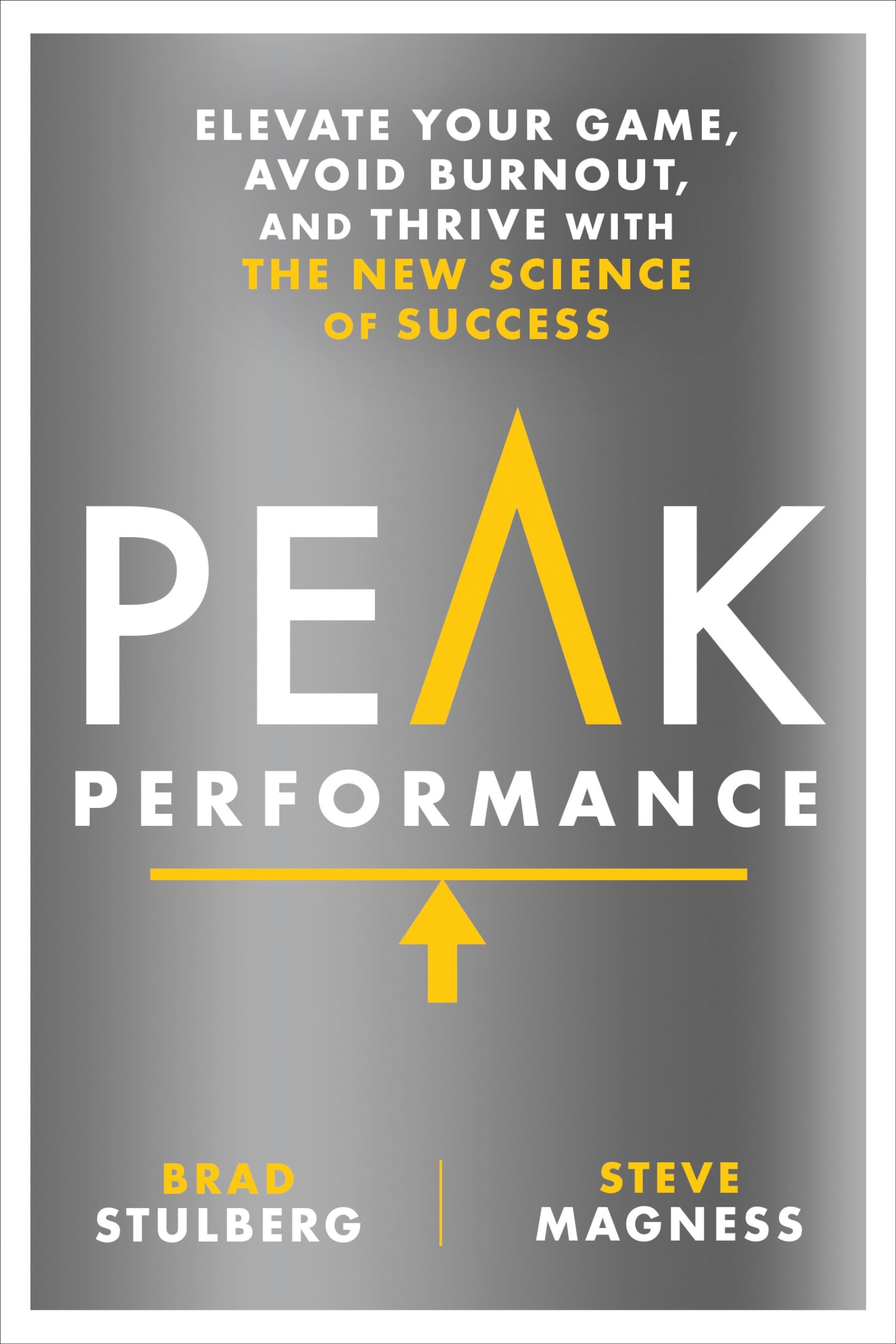
Peak Performance: Elevate Your Game, Avoid Burnout, and Thrive with the New Science of Success
Product ID: 42985162
Buy anything from 5,000+ international stores. One checkout price. No surprise fees. Join 2M+ shoppers on Desertcart.
Desertcart purchases this item on your behalf and handles shipping, customs, and support to Austria.
What does it take to go from good to great? Step up at work, in sports, and at home with this “transfixing book on how to sustain peak performance and avoid burnout” (Adam Grant). A few common principles drive performance, regardless of the field or the task at hand. Whether someone is trying to qualify for the Olympics, break ground in mathematical theory or craft an artistic masterpiece, many of the practices that lead to great success are the same. In Peak Performance, Brad Stulberg, a former McKinsey and Company consultant and writer who covers health and the science of human performance, and Steve Magness, a performance scientist and coach of Olympic athletes, team up to demystify these practices and demonstrate how you can achieve your best. The first book of its kind, Peak Performance combines the inspiring stories of top performers across a range of capabilities—from athletic to intellectual and artistic—with the latest scientific insights into the cognitive and neurochemical factors that drive performance in all domains. In doing so, Peak Performance uncovers new linkages that hold promise as performance enhancers but have been overlooked in our traditionally- siloed ways of thinking. The result is a life-changing book in which you can learn how to enhance your performance via myriad ways including: optimally alternating between periods of intense work and rest; priming the body and mind for enhanced productivity; and developing and harnessing the power of a self-transcending purpose. In revealing the science of great performance and the stories of great performers across a wide range of capabilities, Peak Performance uncovers the secrets of success, and coaches you on how to use them. If you want to take your game to the next level, whatever "your game" may be, Peak Performance will teach you how. Review: Peak Performance - Learning the Principles, Doing the work, and developing your path to success - This is a thoughtful, well-written and practical work on ways to improve your performance based on principles developed from both real-world examples (across many fields) and the latest science (across multiple disciplines). This is a "Do the work" book - if you are looking for the success and flourishing equivalent of a get rich quick scheme, then look elsewhere. If you are willing to do the work, try some new things (and/or stop doing some others), then this book will provide a wealth of ideas and information to help you on your journey. The book is broken into 3 sections based on their key principles of: * The Growth Equation (stress + rest = growth) * Priming - the power of developing optimal routines and designing your day * Purpose - to keep you focused and motivated There are many valuable ideas and insights in each chapter. My favorite feature of the book are the "performance practices" - these are callout boxes that distill key ideas into actions you can take right away to start to improve. I learned and was challenged throughout the book - my 2 favorite chapters are: * minimalist to be a maximalist - life is about choices and it is important to be highly focused in some areas and minimize the decisions and attention we give to other areas. I loved this quote from Michael Joyner - "You need to say no to a lot of things so that when it is time to say yes, you can do so with all your energy." The key is to be intentional and to make habits for the areas that are needed but not part of your focus. * transcend your "self". This chapter is on purpose and it challenges a lot of my thinking. I plan to work with some of the ideas mentioned here (and do the exercise on purpose that they recommend) and see how this works for me. I want to understand both the theory and practice in this area so I will be reading some of the works mentioned here in the near future. I am a strong believer in purpose but not "self-transcendence" and that is what I want to understand more. The book is truly action oriented and I have already starting using the ideas as I read the book over the last few days. I recommend the book highly and for those who are coaches or leaders, I would encourage you to share the ideas with your teams (and encourage them to read the book). Two additional thoughts - any critical thinker will find areas they disagree with in most books and this is no exception. The power of this book is that it is encouraging me to explore those areas in more detail. Additionally, most of us know that psychology and the social sciences have been plagued with a "reproduce-ability crisis" with many studies. While this work is very evidence based, it is important to remember that these ideas and findings will continue to evolve and change. For those with a growth mindset, that is just another piece of the puzzle in long-term learning and growth. I hope this book gets a wide audience and helps others in their personnel success and flourishing. Review: Science-Backed Strategies for Better Focus, Growth, and Performance - Peak Performance explores the science behind high achievement, breaking it down into key themes—stress as a growth driver, focus, flow, mindset, and motivation. The book makes a strong case against multitasking, backed by fMRI research, and highlights how our perception of stress shapes its physiological effects. One unexpected but useful topic: fatigue and recovery. For anyone new to these concepts, this is a solid introduction with plenty of actionable takeaways. That said, if you're already familiar with Csikszentmihalyi, Ericsson, and Carol Dweck’s work, much of this will feel like reinforcement rather than new insight. One practical shift for me is that while I already structure my days around deep work, I haven’t been intentional about priming rituals beforehand. Given the research on positive mood and cognitive performance, it makes sense to add a short check-in before deep work sessions—something I already do before coaching calls but hadn’t extended to focused solo work. Overall, a worthwhile read for those looking to optimize performance through science-backed strategies.


| Best Sellers Rank | #30,298 in Books ( See Top 100 in Books ) #39 in Popular Applied Psychology #212 in Personal Finance (Books) #387 in Success Self-Help |
| Customer Reviews | 4.6 out of 5 stars 2,236 Reviews |
M**S
Peak Performance - Learning the Principles, Doing the work, and developing your path to success
This is a thoughtful, well-written and practical work on ways to improve your performance based on principles developed from both real-world examples (across many fields) and the latest science (across multiple disciplines). This is a "Do the work" book - if you are looking for the success and flourishing equivalent of a get rich quick scheme, then look elsewhere. If you are willing to do the work, try some new things (and/or stop doing some others), then this book will provide a wealth of ideas and information to help you on your journey. The book is broken into 3 sections based on their key principles of: * The Growth Equation (stress + rest = growth) * Priming - the power of developing optimal routines and designing your day * Purpose - to keep you focused and motivated There are many valuable ideas and insights in each chapter. My favorite feature of the book are the "performance practices" - these are callout boxes that distill key ideas into actions you can take right away to start to improve. I learned and was challenged throughout the book - my 2 favorite chapters are: * minimalist to be a maximalist - life is about choices and it is important to be highly focused in some areas and minimize the decisions and attention we give to other areas. I loved this quote from Michael Joyner - "You need to say no to a lot of things so that when it is time to say yes, you can do so with all your energy." The key is to be intentional and to make habits for the areas that are needed but not part of your focus. * transcend your "self". This chapter is on purpose and it challenges a lot of my thinking. I plan to work with some of the ideas mentioned here (and do the exercise on purpose that they recommend) and see how this works for me. I want to understand both the theory and practice in this area so I will be reading some of the works mentioned here in the near future. I am a strong believer in purpose but not "self-transcendence" and that is what I want to understand more. The book is truly action oriented and I have already starting using the ideas as I read the book over the last few days. I recommend the book highly and for those who are coaches or leaders, I would encourage you to share the ideas with your teams (and encourage them to read the book). Two additional thoughts - any critical thinker will find areas they disagree with in most books and this is no exception. The power of this book is that it is encouraging me to explore those areas in more detail. Additionally, most of us know that psychology and the social sciences have been plagued with a "reproduce-ability crisis" with many studies. While this work is very evidence based, it is important to remember that these ideas and findings will continue to evolve and change. For those with a growth mindset, that is just another piece of the puzzle in long-term learning and growth. I hope this book gets a wide audience and helps others in their personnel success and flourishing.
S**S
Science-Backed Strategies for Better Focus, Growth, and Performance
Peak Performance explores the science behind high achievement, breaking it down into key themes—stress as a growth driver, focus, flow, mindset, and motivation. The book makes a strong case against multitasking, backed by fMRI research, and highlights how our perception of stress shapes its physiological effects. One unexpected but useful topic: fatigue and recovery. For anyone new to these concepts, this is a solid introduction with plenty of actionable takeaways. That said, if you're already familiar with Csikszentmihalyi, Ericsson, and Carol Dweck’s work, much of this will feel like reinforcement rather than new insight. One practical shift for me is that while I already structure my days around deep work, I haven’t been intentional about priming rituals beforehand. Given the research on positive mood and cognitive performance, it makes sense to add a short check-in before deep work sessions—something I already do before coaching calls but hadn’t extended to focused solo work. Overall, a worthwhile read for those looking to optimize performance through science-backed strategies.
W**K
Solid Advice for Improving Your Performance in a Healthy and Sustainable Way
I admit it. I’m a sucker for books on productivity and improving performance. Ever since I was a teenager, I’ve looked for ways to improve my own productivity and performance. I’m not an athlete. I’m an author, ghostwriter, and book writing coach. My purpose is to help other people discover and create great business books. That’s what I want to be fit for, and productive at. I don’t know how many books on improving performance and productivity I’ve read over the years, but I’m sure it’s over 100. As a result, when I read a new book, I’m not looking for some grand secret that no one has yet discovered. I’m looking for a fresh presentation of some things that I already know. I’m also looking for a tip or two about how I can change my behavior to do better. Peak Performance: Elevate Your Game, Avoid Burnout, and Thrive with The New Science of Success delivers on both of those. The authors introduce themselves and the book by telling the story of how they both achieved significant levels of performance and success early in life, then had that all come apart. They made their first connection online and shared their individual stories with each other. Here’s how they describe what happened next. “What started out as a two-person support group morphed into a close friendship, followed upon a shared interest in the science of performance. We became curious: Is healthy, sustainable peak performance possible? If so, how? What’s the secret? What, if any, are the principles underlying great performance? How can people like us – which is to say just about anyone – adopt them?” Here’s the core truth that this book builds on. “The key to strengthening your biceps – and, as we’ll learn, any muscle, be it physical, cognitive, or emotional – is balancing the right amount of stress with the right amount of rest. Stress + rest + growth. This equation holds true regardless of what it is that you’re trying to grow.” That’s not new. Jim Loehr and Tony Schwartz wrote an excellent book about that basic principle almost 20 years ago. The title is The Power of Full Engagement: Managing Energy, Not Time, Is the Key to High Performance and Personal Renewal. Stulberg and Magness build on that core truth in the three sections of their book. Section one is about the growth equation. Section two is what they call “priming” and discusses optimizing your routine. The third section is about developing and living out your purpose. What makes this book different is contained in one of the quotes above. The authors aren’t just after peak performance. Lots of people write books about that. They’re after “healthy, sustainable peak performance.” That difference from other books is important and significant and why I thought this was a great book. This is the kind of book that repays reading straight through. Sure, you can jump around from topic to topic, but the organization is perfect for a straight-through read. Every few pages, the authors summarize their key points in a section called “Performance Practices.” This is great for helpful review. They even go further by putting a recap of all the performance practices toward the end of the book. In A Nutshell If you’re looking for solid advice on improving your performance at anything in a healthy and sustainable way, Peak Performance: Elevate Your Game, Avoid Burnout, and Thrive with The New Science of Success is the book for you. It’s well-researched and well-written.
M**N
... reaching their full potential and consistently performing at their best. It's not a about bunch of "hacks" filled ...
This book can be a true game-changer for anybody interested in reaching their full potential and consistently performing at their best. It's not a about bunch of "hacks" filled with overpromise: it's about a few core principles backed by science that need to be adapted to the individual. For example, there is no one "ideal" daily or morning routine, but it is clear that having A routine that works for you is superior to having none at all. The examples in the book of how top performers from athletics, academics, business, and arts use these principles are really helpful, and makes it easy to see how these principles can be adapted for any scenario and type of person. Best of all, the conclusion of the book is a fantastic bullet point summary of all the principles discussed in the book, and I know that that part of the book is one I'll revisit time and time again as I embark on my journey of improving my performance by adhering to the stress + rest = growth equation, developing a purpose, creating routines, using mindfulness meditation, minimizing unnecessary decision-making and so on. Brad Stulberg and Steve Magness, thank you for bringing this wealth of knowledge to us readers!
E**.
"Adam Grant-level impact" after reading this book
I purchased this book because I like to keep abreast of books athletes I work with are likely to read (I'm a sport psychologist). I anticipated that this would be helpful in my work with them (it TOTALLY will be), but what I never intended was that it would be helpful for me, too. Given my background in sport and clinical psychology, it's a rare book that speaks to me on such a deep level. The last author that had this impact on me was Adam Grant, so we're talking "Adam Grant-level impact" here! I was familiar with 80% of the research the authors discussed, and they do a fantastic job of accurately discussing the findings in a practical manner. What I love most about this book is that the authors present the findings in such a way that it really begs the reader to question why he/she is approaching life, training, etc. in the manner they are and what can be done to IMPROVE that equation. They recognize this looks different for every athlete and challenge the reader to think about what the "stress + rest" equation looks like in his/her own life. They offer ideas of how to change things, but in a way that is still very individualized (i.e., not formulaic). This book is fantastic for anyone who wants to understand him/herself better or wants to encourage those with whom they work (e.g., athletes) to do the same. Reading this helped me take an HONEST look at my own life and tweak things to continue my own peak performance path. I really cannot say enough good things about this book, but to appreciate this, you'll need to read it for yourself! The only "negative" (and it's really not a negative, just a preference) is the "activity" the authors recommend completing at the end of the book because I REALLY do not like those activities in books. However, the authors comment that they, too, do not like these activities, which decreased my resistance :) I see value in the activity and intend to complete it for several domains of my life.
G**E
As a running enthusiast I've enjoyed Steve Magness' work
As a running enthusiast I've enjoyed Steve Magness' work. This book is no different. Had I known the book to have such a broad application I would have bought more books for friends. I've found the book pleasant to read, informative and motivating. It has a nice balance of scientific information and practical guides.
A**R
Comprehensive Book on Health and Human Performance
Stulberg and Magness' book dive deep into the topic of maximizing performance in your own life, whether in athletics, business, or any other endeavor. The author's use personal experiences, as well as a plethora of research findings in the field, to inform their discussions and provide context to the recommendations they proposes. The book divides into three sections: the growth equation, priming for performance, and finding a purpose. The growth equation is stress + rest = growth, and is commonly referred to by the authors as an essential ingredient in increasing performance over time. Referencing periodization common in exercise science, placing just manageable stress with subsequent rest periods allows for growth to occur in all areas of your life. Essentially, the authors emphasize pushing yourself to your limits in order to induce adaptations. The section discussing priming for performance depicts a number of famous, successful individuals who use planned warm ups to prime themselves for peak performance. Placing a warm up routine before activities, creating a place "of your own" to work, and designing your day to minimize distractions and maximize things that are important are all discussed. Finally, the concept of purpose is discussed in order to have individuals overcome their ego and enhance performance when encountering tasks that are challenging their limits. Without a purpose, the authors argue, then people would experience burnout quickly and may quit altogether. Thus, it is wise to have multiple, ever changing purposes for the most important tasks in your life in order to maintain drive.
M**U
A very practical, clear and down to earth book
This is a lovely read. I've read quite a lot of work on peak performance, including titles such as as execution, executive toughness, grit etc. This book draws on authors' own experience as elite achievers; and it distills decades of research on performance at elite level to offer very simple and practical approaches to peak performance. There are many nuggets in this book. Some of the ideas are insights I already knew but which I took for granted. These include the co-reinforcing relationship between stress and rest, the importance of sufficient sleep, defining purpose, drawing motivation through transcending yourself, the power of routine, the regenerative force of giving, and mindfulness. I must say since I started reading this book and listening to audiobook (which is well narated) I have seen noticeable changes in my wellbeing and performance. I am also inspired to give more. It is one of the top 3 books I've read in this area. I'd recommend it to executives, writers, creatives, and those in sports.
A**I
Eccezionale e pratico
Questo libro è pieno di spunti e fornisce delle idee prgamatiche per raggiungere il picco nelle performance in qualsiasi attività della vita.
S**Z
Good
Excelent to understand that to grow you need to rest,and for you to do this,you need fight against your brain
0**8
クオリティの高いビジネス書。
第5章のRest Like the Best は白眉。 以下の英文は含蓄があって良い。The irony is that resting hard often takes more guts than working hard.
S**K
More than anything, Sleep is the key.
A very great read. As an athelete this book has a lot to learn from. Especially the sleep part. In today's modern world we don't prioritise our sleep, this book has alot of information on the sleep and how it enhances one's performance.
R**A
Outstanding
It is a great book, with practical information about how you can increase your level of energy and get what you want in the different roles on your life. 100% good and applicable information.
Trustpilot
1 month ago
2 days ago