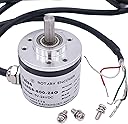
Taiss/Incremental Rotary Encoder DC 5-24v Wide Voltage Power Supply 6mm Shaft Optical AB 2 Phase Quadrature Encoder 600P/R
Product ID: 469020026
⚡Wide 5-24V DC power range
🔄600 pulses per revolution (PPR)
⏱️Max speed 6300 RPM
Desertcart purchases this item on your behalf and handles shipping, customs, and support to Austria.
🔧 Upgrade your control game with precision that never quits!
The Taiss Incremental Rotary Encoder delivers high-resolution 600 PPR feedback with a robust 6mm shaft, supporting a wide 5-24V DC power supply and speeds up to 6300 RPM. Featuring AB two-phase quadrature output and a compact 38x35.5mm design, it’s engineered for precise rotational measurement in industrial automation, robotics, and intelligent control systems—all backed by a 1-year quality assurance.

| ASIN | B07MX1SYXB |
| Are batteries included? | No |
| Best Sellers Rank | #137,807 in Industrial & Scientific ( See Top 100 in Industrial & Scientific ) #50 in Switch Encoders |
| Brand | Taiss |
| Colour | Black, Green, Red, White |
| Customer Reviews | 4.4 4.4 out of 5 stars (131) |
| Date First Available | 13 January 2020 |
| Item Weight | 139 g |
| Item model number | 600P/R |
| Manufacturer | Taiss |
| Model number | 600P/R |
| Number of Memory Sticks | 1 |
| Package Dimensions | 8.6 x 8.3 x 6.1 cm; 139 g |
| Resolution | 600 PPR |
R**T
These encoders work well.
For those that need assistance here is what you need to know: 1) they work best at 6v and up. This is only required to power the board and transmitting LEDs. If has nothing to do with the output. You can take apart and wire directly to the output of the 5v regulator and supply it 5V. But nothing lower. 2) these are open collector NPN. This means the signal wire is connected to the collector of an NPN transistor. So you can use it with 3.3v, 5v, etc for control logic but you need to either tell your microcontroller to use a PULL UP resistor, or install your own pull up resistor that connects from the control voltage say 3.3V to the control/pulse wire. Then connect the grounds together and hook the control wire to the microcontroller input pin. I'm not certain the minimum voltage for the control transistor but I would guess anything over 1.5v would probably be fine. I use them on an esp32 and use the internal pull up on the input pins. The esp32 has a built-in counter up to 80Mhz that can be used for this purpose. These are smooth rotation, no exact stop points. So they work well for free spinning applications like motor control. They are not great for a knob because there are no detents. But if you wanted those there are other options. I put a pulley on it with GT2 belts to the wheels of my robot and they work perfect for that task. I hope this helps inform future customers.
T**Y
Well priced hobby grade encoder
Very well priced and functional for a hobby grade encoder. Easily mated with a ESP32 for a motor drive project. Using this encoder required two pull-up resistors as the ESP32 IO's did pull up was not sufficient to give a clean signal.
A**R
They make modifications easy
Pretty decent encoders. If you want to use 5V directly they have provisions on the PCB. The regulator has a solder bridge between the input and output. Simply connect the bridge with a ball of solder or with a 0805 0 ohm resistor. Like wise on the back of the PCB there are two 0805 locations for pullup resistors. I used 10K and the output works great when connected to a DRO.
P**E
Smooth operation with a small amount of rotation resistance
I'm using this in computer peripheral application, and it works as specified. I'm powering it with 8V using a boost converter from the 5V supplied by the USB bus, and it works fine on this supply. I haven't measured how much it draws.
M**X
Good quality and the ppr I was looking
I used expensive encoders on previous jobs - Dynapar, BEI, Avtron. This little guy is inexpensive and does the job. Haven't used for rugged applications (mostly lab) but has the right amount of pulses per revolution I needed
Trustpilot
3 weeks ago
1 month ago