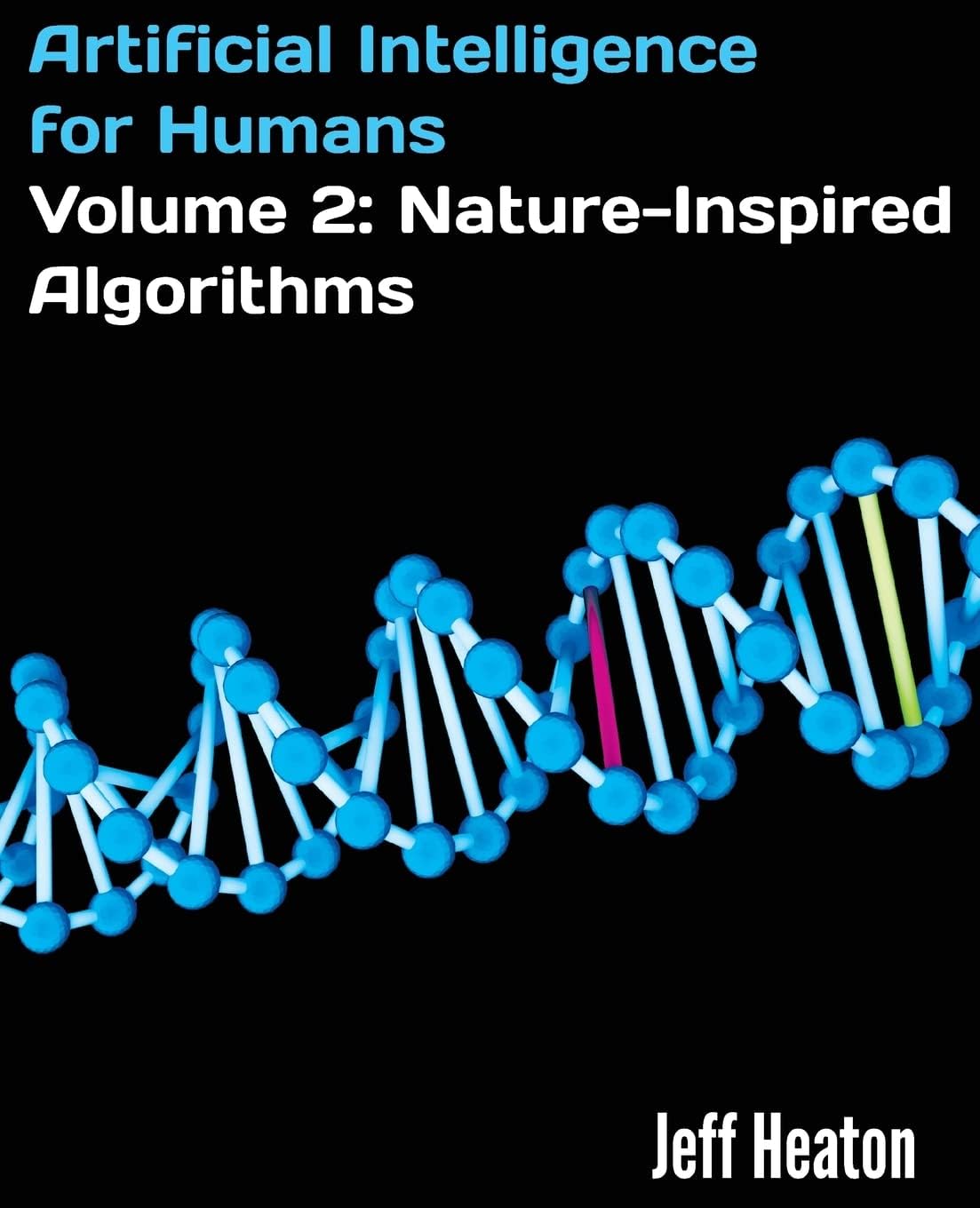
Artificial Intelligence for Humans, Volume 2: Nature-Inspired Algorithms
Product ID: 49602182
Buy anything from 5,000+ international stores. One checkout price. No surprise fees. Join 2M+ shoppers on Desertcart.
Desertcart purchases this item on your behalf and handles shipping, customs, and support to Austria.
Nature can be a great source of inspiration for artificial intelligence algorithms because its technology is considerably more advanced than our own. Among its wonders are strong AI, nanotechnology, and advanced robotics. Nature can therefore serve as a guide for real-life problem solving. In this book, you will encounter algorithms influenced by ants, bees, genomes, birds, and cells that provide practical methods for many types of AI situations. Although nature is the muse behind the methods, we are not duplicating its exact processes. The complex behaviors in nature merely provide inspiration in our quest to gain new insights about data. Artificial Intelligence for Humans is a book series meant to teach AI to those readers who lack an extensive mathematical background. The reader only needs knowledge of basic college algebra and computer programming. Additional topics are thoroughly explained. Every chapter also includes a programming example. Examples are currently provided in Java, C#, and Python. Other languages are planned. No knowledge of biology is needed to read this book. With a forward by Dave Snell. Review: Five Stars - Very instructive set of books, with a practical perspective. Review: Very superficial descriptions, code almost non-existent. Waste of time and money - I feel bad giving such a low review, but this book really is a waste of time. I had seen articles about this subject before, and had played around a little with the algorithms, and was looking for something to explain the algorithms in more depth, and guide me as to how to write code. This book fails miserably at all of that. He gives a very high level overview of the algorithm, not really enough to get the point, then if you're lucky, gives some pseudocode, which is actually a very cut down Python script that doesn't have enough code to tell you much, then says "By running this code I got the following results..." without anything in between. The only way to see what the code does is to download the source and read it yourself. I don't need to buy his book to do that, there are plenty of online bits of code I can download for free. What I wanted was something that would explain the code, which this doesn't. If I hadn't had any previous background to the material, I wouldn't have got anywhere from his scant explanations. If you're interested in this sort of subject, I recommend you read some of the articles by James Mccaffrey (regular columnist in MSDN Magazine , search online and you'll find his articles) which cover these subject much more clearly. He gives an explanation of the algorithm (like one you can understand and has enough detail to tell you were you're going), shows enough code so you can see how he's implemented it, without distracting you with all the little details, then explains the output. You can also download the code and go into it in more detail. The code is in C#, but he deliberately writes very plain C#, which is almost identical to the equivalent Java, and very readable for a Python programmer. Once you've got going with that, the next best thing to do is ask questions on Stack Exchange where you'll get no end of help. In summary, I really can't recommend this book at all.
| Best Sellers Rank | 4,976,293 in Books ( See Top 100 in Books ) 30,307 in Computer Science (Books) |
| Customer Reviews | 4.0 out of 5 stars 83 Reviews |
J**A
Five Stars
Very instructive set of books, with a practical perspective.
Y**U
Very superficial descriptions, code almost non-existent. Waste of time and money
I feel bad giving such a low review, but this book really is a waste of time. I had seen articles about this subject before, and had played around a little with the algorithms, and was looking for something to explain the algorithms in more depth, and guide me as to how to write code. This book fails miserably at all of that. He gives a very high level overview of the algorithm, not really enough to get the point, then if you're lucky, gives some pseudocode, which is actually a very cut down Python script that doesn't have enough code to tell you much, then says "By running this code I got the following results..." without anything in between. The only way to see what the code does is to download the source and read it yourself. I don't need to buy his book to do that, there are plenty of online bits of code I can download for free. What I wanted was something that would explain the code, which this doesn't. If I hadn't had any previous background to the material, I wouldn't have got anywhere from his scant explanations. If you're interested in this sort of subject, I recommend you read some of the articles by James Mccaffrey (regular columnist in MSDN Magazine , search online and you'll find his articles) which cover these subject much more clearly. He gives an explanation of the algorithm (like one you can understand and has enough detail to tell you were you're going), shows enough code so you can see how he's implemented it, without distracting you with all the little details, then explains the output. You can also download the code and go into it in more detail. The code is in C#, but he deliberately writes very plain C#, which is almost identical to the equivalent Java, and very readable for a Python programmer. Once you've got going with that, the next best thing to do is ask questions on Stack Exchange where you'll get no end of help. In summary, I really can't recommend this book at all.
A**R
the sudo code is easy to understand
Lot's of inspiring algorithms, the sudo code is easy to understand! Thanks!
M**L
These books seems to be written more by a hobbist ...
These books seems to be written more by a hobbist than a professional. They often say the same basic things several times, they lack depth, and lack inspriational applications. I don't recomend them to anyone. Sorry.
J**U
Sur la lancée du premier volume
Comme le premier volume, un ouvrage clair avec des exemples détaillés. Algorithmes génétiques, comportements de troupeau, des outils indispensables à l'IA.
A**R
Leicht verständliche Lektüre zum Thema Künstliche Intelligenz. Band 2 mit genetischen Algorithmen.
Die Bücher sind in englischer Sprache verfasst, aber leicht verständlich, sofern man der englischen Sprache mächtig ist. Band 2 gibt einen guten Überblick über genetische Algorithmen und Konzepte im Kontext KI. Die Themen sind recht knapp, jedoch ausreichend beschrieben, sofern man einigermaßen mit der Materie vertraut ist. Gut gefällt mir, dass viele Bilder und anschauliche Beispiele verwendet werden, um die Themen verständlicher zu präsentieren. Oft zeigt der Autor sogar Pseudo-Code-Schnippsel, so dass man direkt Ideen für die Implementierung erhält. Top ist auch, dass online zu allen Kapiteln fertige Implementierungen in einigen Programmiersprachen (Java, Python etc.) zu finden sind (links im Buch). Ich habe mir alle drei Bände als Ebooks gekauft. Im Vergleich zu den Printbüchern ein Schnäppchen. *** Fazit *** Hilfreiche Lektüre, wenn man sich intensiver mit dem Thema KI beschäftigen möchte. 5 Sterne für Inhalt, Struktur und Verständlichkeit. War meine Rezension hilfreich? Wenn ja, dann würde ich mich über einen kurzen Klick auf "ja - hilfreich" sehr freuen.
D**I
Tutto OK
Tutto OKTutto OK
K**N
Another good one.
Haven't made it all the way through this yet, but figured I'd leave a review. The foreword states that you can read these books in any order. The author makes these topics interesting so I feel like it's all worth a read even if you're not interested in things like genetic algorithms.
E**A
Great
Great book!
Trustpilot
2 days ago
3 weeks ago