
Desertcart purchases this item on your behalf and handles shipping, customs, and support to Austria.
๐ Unlock the secrets of molecules with the ultimate organic chemistry guide!
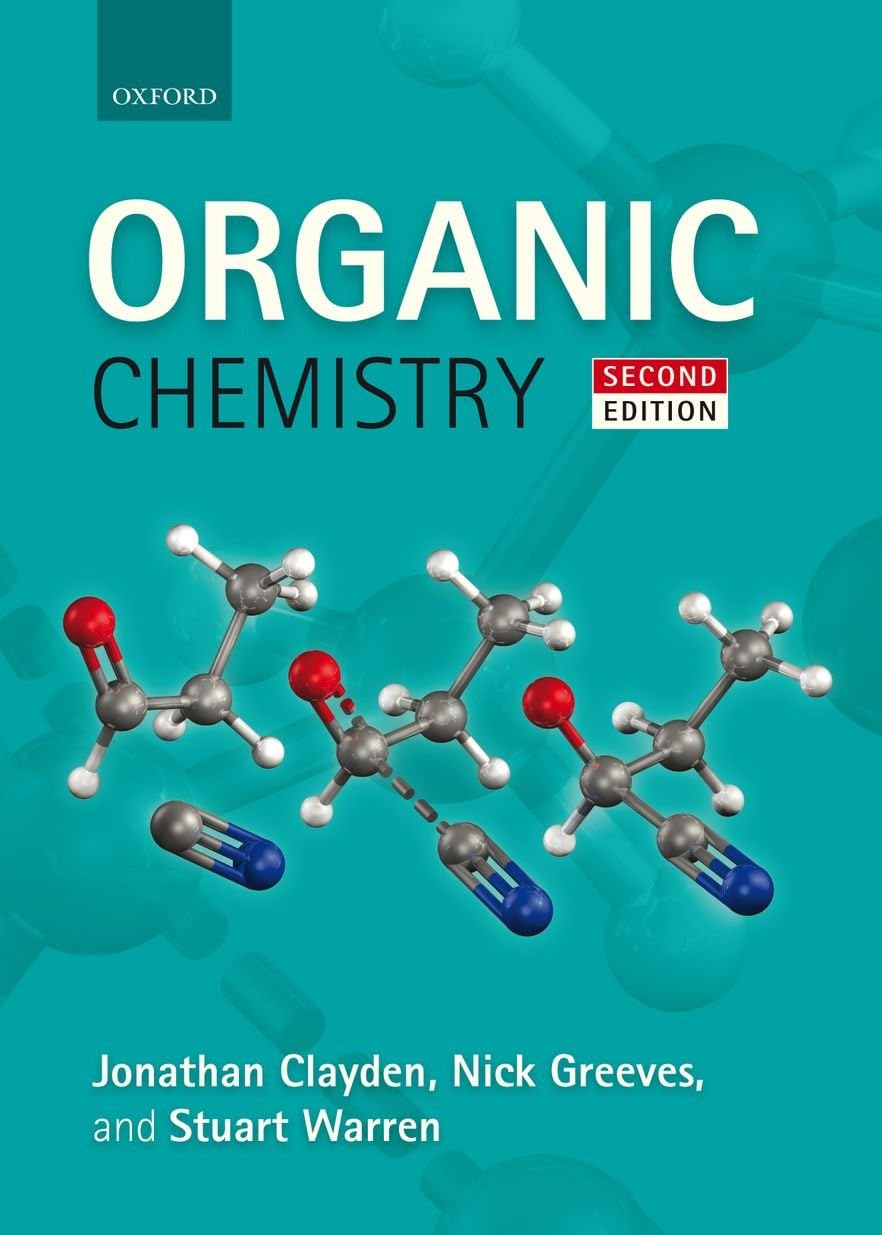
Organic Chemistry by Oxford University Press is the definitive second edition textbook designed for undergraduate students. It combines a student-friendly, mechanistic, and evidence-based approach to organic chemistry, enriched with extensive online resources to enhance learning and mastery of complex concepts.
| Best Sellers Rank | 11,173 in Books ( See Top 100 in Books ) 583 in Scientific, Technical & Medical |
| Customer Reviews | 4.7 out of 5 stars 702 Reviews |
J**N
A Must-Buy For Undergraduate Chemistry Students!
As a student starting their first year of a chemistry degree in the UK in September, I purchased this textbook as it is considered by many to be the โdefinitiveโ publication for undergraduate organic chemistry as it covers the vast majority of organic chemistry content for a 3/4-year degree course. As someone who is greatly interested in the field of organic chemistry, developed from my studies of chemistry at A-level and through wider reading, I spared no thought in buying this text. I must say, I am beyond happy that I purchased this thorough introduction to the field of organic chemistry, as its presentation of reaction mechanisms and molecular structures, and its explanation of key scientific concepts are clear and easy to follow. For any prospective undergraduate chemistry students in the UK, or elsewhere, I couldnโt recommend this textbook highly enough!!
A**Y
Good Book...
Good book, but you will need the problem book also in order to get the true potential from this book. Both books will serve you well for a 1st and 2nd undergraduate degree; and perhaps help for some final year topics. Although, if you wish to become more proficient in organic chemistry, you should consider buying the other books associated with Claydon, i.e., Retrosynthetic analysis and Synthesis; like Claydon's overall organic chemistry book (this one) these books also require the problem books (workbooks) because they're are basically useless without them. Nevertheless, if you purchase all six along side one on reaction mechanisms ('arrow posing'), stereochemistry and organic chemistry analysis, you should acquire full mastery of organic chemistry at undergraduate level and a sound base for study at post-graduate level.
A**I
Great book!
This is probably one of the best books you can have for organic chemistry as an undergraduate. I'm currently in second year and its still proving to be very useful when I find a concept or mechanism hard to grasp. However, some chapters don't go into enough detail and other chapters may go into too much detail (although you can argue that's a good thing). Most books are going to do that because different lecturers at different universities might teach you slightly different things. If your course is accredited by the royal society of chemistry, then I highly recommend this since it has so far covered all I've had to learn! Highly recommended
S**T
Organic Chemistry is a good and comprehensive chemistry textbook
Organic Chemistry is a good and comprehensive chemistry textbook, the fact that the answer book costs somewhere in the region of ยฃ30 is a real letdown though
Y**N
UKCHO
Good book for preparing for UKCHO.
A**G
The best book for organic chemistry.
Great book and very well written. Everything is explained very clearly and easy to understand especially for undergraduates. This is the book to get. Although it is a big book and very heavy, i wouldn't recommend reading through absolutely everything as there is not enough time in a day. But to get the general gist of things, the diagrams works perfectly.
A**5
The undisputed champion.
Claydenโs โOrganic Chemistryโ literally rewrote the textbook, and provides the best introduction to the topic Iโve come across. The coverage is sufficient for most undergraduate courses, and Claydenโs writing style makes even the more challenging topics easy to understand. I especially like the clear chemical schemes (unlike in many American textbooks) and the availability of a problems manual and solutions guide which greatly enhanced my understanding.
A**D
Superb
I'd recommend this to any undergraduate of chemistry, there's nothing to complain about and it covers all the major topics you're every likely to meet in your studies into organic chemistry and serves nicely as a reference to boot. It's very well written, concepts are neatly explained and there's none of this grandiose showing off that you sometimes see in text books.
W**Y
Uszkodzona w wysyลce InPost
Jak na najwiฤkszฤ na ลwiecie ksiฤgarnie to nie zapakowanie ksiฤ ลผki w chociaลผby karton a po prostu wrzucenie jej luzem w foliฤ uwaลผam za dramat
A**R
good, as always
clear, well written matter
T**E
Bad shipment
The book itself is amazing, can't recommend it enough. But it came highly damaged and can't get a hold of the customer service so I would recommend buying it elsewhere
J**H
ๅฐใ้ฃใใใๆ้ซใฎใใญในใ
ๆ้ซใงใใใใไธๅใง้ข่ฉฆใใใใชใงใ
A**R
The best modern textbook for organic chemistry
This is undoubtedly the best modern book for learning organic chemistry. Unlike some other books which present organic chemistry as a set of facts and reactions to be learnt and memorized, this book instead emphasizes the unifying threads between different concepts and also stresses the assimilation of those concepts through real-life applications. Common themes such as syn-anti addition, carbocations and orbital overlap tie together disparate reactions and aspects of organic chemistry. The first edition of this book was published in 2001 and the updated edition in 2012, so the discussion in this book includes reactions and reagents that are often missing from other comparable texts. For instance the volume still provides the most complete and readable description of the Grubbs metathesis reaction that I have come across, clearly emphasizing the mechanism, the effects of different ligands and solvents and applications to complex natural products. Other reactions of paramount importance to both academia and industry which are presented in the book include the palladium-catalyzed Suzuki, Heck, and Sonogashira couplings (which were recently awarded the Nobel Prize). The Buchwald-Hartwig reaction which was not as developed in 2001 but which has since seen immense growth gets an especially detailed mention. The volume covers the whole gamut of current organic chemistry. Apart from its modern and unifying outlook, the other feature that stands out is the way it stresses the practical relevance of all this material. Organic chemistry is really the basis of our modern way of life and the book reflects this fact. The value of almost every important reaction and reagent is demonstrated by its application to the synthesis of an important drug, polymer, food additive or agrochemical. The book also does a great job of illustrating the great value of simple concepts; for instance, one chapter discusses the application of pKa to the development of the bestselling drug ranitidine, another provides an explanation of the lachrymatory (tear-inducing) properties of onions as rooted in sigmatropic reactions involving sulfur compounds. From the clinic to the kitchen, this book drives home the fact that organic chemistry is not just an intellectually rewarding exercise but is at the foundation our daily existence. In addition to these qualities, the book is written in an honest, informal style and the authors admit uncertainty where it exists. Color enhances bonds, atoms and mechanistic arrows while boxed material contains key concepts and intriguing examples. Overall we are treated to an incredible amount of information in an attractive format and the authors must have really spent a lot of efforts in planning and presenting it. In its second edition this book continues to be an extremely useful source for students and practitioners alike and it is highly recommended.
Trustpilot
3 weeks ago
3 weeks ago