Desertcart purchases this item on your behalf and handles shipping, customs, and support to Austria.
🔔 Elevate your doorstep game with smart alerts and sleek style!
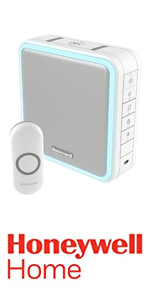
The Honeywell Home DW915S is a versatile wired or wireless doorbell featuring a robust 200m wireless range, adjustable volume with sleep mode, and innovative Halo Light visual alerts. Designed for easy DIY installation, it offers reliable performance powered by 4 alkaline batteries, enhanced by ActivLink technology for superior connection and up to 5 years battery life, all backed by a 2-year warranty.


| ASIN | B0193FW71W |
| Battery Description | Alkaline |
| Battery description | Alkaline |
| Best Sellers Rank | 170,953 in DIY & Tools ( See Top 100 in DIY & Tools ) 76 in Door Bells Chimes |
| Brand | Honeywell Home |
| Colour | White |
| Compatible Devices | Google Nest Devices |
| Compatible devices | Google Nest Devices |
| Control Method | Remote |
| Country of Origin | China |
| Customer Reviews | 4.2 out of 5 stars 2,762 Reviews |
| EU Spare Part Availability Duration | 1 Years |
| Global Trade Identification Number | 05004100965721 |
| Included Components | Quick Start Guide |
| Item Dimensions L x W x H | 12.6L x 4.2W x 12.6H centimetres |
| Item Type Name | Honeywell Wired and Wireless Doorbell for Home with Range Extender, Sleep Mode and Halo Light |
| Item Weight | 150 Grams |
| Manufacturer | Honeywell |
| Manufacturer Warranty Description | 2 years. |
| Maximum Range | 200 Metres |
| Model Number | DW915S |
| Mounting Type | Wall Mount |
| Number of Batteries | 4 AAA batteries required. |
| Number of Items | 1 |
| Part Number | DW915S |
| Power source | Battery Powered |
| Product dimensions | 12.6L x 4.2W x 12.6H centimetres |
| Sensor Technology | Funk |
| Sound Level | 80 Decibels |
| Unit Count | 1.0 count |
| Voltage | 12 Volts |
A**R
Loud and clear ringer and works with Ring Video Doorbell
Very nice doorbell ringer, gets extremely loud and clear sound which was exactly what I was looking for and has a nice range of features (namely the elegant edge light and the ability to mute for a set amount of time). Also has a nice range of sounds, I have it set to the big ben chime as it lasts for a good amount of time. So initially I had a few issues trying to get get this to work with my Ring Video Doorbell however after a lengthy phone conversation with Ring support (who were extremely helpful) I managed to get it to work. For those that are curious about how I got it working, Firstly you will need an 8/12volt and 1Amp rated transformer for this to work properly. The transformer wires plug into the AC1 (postive) and AC2 (ground) terminals of the Honeywell ringer. Then one side of the Ring Video Doorbell needs be wired to the A1 terminal of the Honeywell unit and the other side needs to be wired into AC2 ground terminal (not A2) as it shows you in the Honeywell instructions. Once this is done the white ring should be lit up on the Ring Video Doorbell to indicate it is wired. Also note that the diode that comes with the Ring is not required and you will also need to fit batteries in the Honeywell ringer unit. In conclusion great unit and does what it says on the tin. My only gripe with it is, as others have stated, the instructions are a little vague and could be more clear. It would be nice to have a more range of sounds also.
M**F
Ding dong merrily on high
This is a nice unit which I installed to replace an old wired unit, installed as a wired installation and wall mounted. Installation was fairly straightforward, although I did need to adjust my existing transformer as that bad boy was pumping out 14.8V and this unit is rated for 8-12V. No big deal, most have 2 or more settings so just switched one wire over and boom, I had 9.6V of perfection. The connectors are push-fit and only take one wire. My original set-up had 3 wires to the transformer connection to distribute power to the front and rear bell pushes; this unit assumes you will feed those from the transformer whereas it is of course much more convenient to run the paired wire to a single location. Easily sorted with a connector or a twist and a drop of solder, but would be nice if Honeywell recognised this as I suspect it will be quite common. Note also the wiring diagrams included don't include this scenario. Once wired up, the unit came to life and delivers as expected. We have different chimes for front and back door, with different colour halos. I like that the unit halo flashes for a few seconds after the bell rings and of course this feature is great for anyone with hearing impairment. I am planning to also pair a portable unit for garden purposes. I'm hoping this can be done without the need for the wireless converter as it should pair with this unit (as it acts as a range extender) but yet to be seen. Overall though, this is a great door chime that has retrofitted easily to my 1970s installation.
P**L
Once installed worked great with Nest Hello
My main problem with this door chime is the instructions aren't great. The backplate for connecting the wires especially needed some explanation. Why the wire connectors couldn't be tightened in place using screws like most other electrical devices I've come across was strange. Instead there was these flimsy plastic rocker type connectors that you use a screwdriver to release - but the instructions don't say where you put the pressure on to do this, so inevitably it breaks with very little pressure. I broke AC1,AC2, and one of the others - so wires are pushed in but not clamped in. Not the best way to leave it, but no choice. Back plate very poor. Once connected to Nest Hello its great. I'm very happy with it working, with choice of chimes and volume control. The flashing light looks good, but it's fitted to wall in hall, so I never see it. I do recommend this, especially if you have a Nest Hello. Just be aware about the backplate wiring.
G**Y
Works with Nest Hello, nice quality.
This is a good looking unit and was easy to wire into Nest Hello using the 12v output from a Screwfix BG Transformer. The unit has 6 connections: AC1 and AC2 are power and two pairs of doorbell connections (labelled A and B) to support up to two doorbell buttons. I connected one wire from the transformer and one wire to the Nest Hello into AC1 (both bits of bellwire fitted into the terminal together). The second transformer lead connects to one of the terminal blocks on the Nest Chime Connector and the second Nest Hello wire connects to the other chime connector terminal block. Finally the two plain wire Nest chime connectors go to AC1 and A1. I used the grey one in AC1 and it worked first time but suspect it doesn't matter which you use. One note on the wireless aspect of the chime unit: I thought I'd be able to add a second chime triggered from this one. The unit actually works as a repeater for a wireless honeywell chime button and can't operate a second 'slave' chime when connected to a Nest.Minor issue. Other than that sounds are loud, coloured halo light is neat. A good purchase.
G**M
Unusual wire connectors
I had what I thought was a simple requirement; a wired doorbell which was showing its age. I wanted to replace it with a similar unit which would also allow me to extend the system wirelessly so I could have additional bells throughout the house, workshop and garden. The first difficulty was understanding the Honeywell website. It took me quite a time to identify the parts I actually wanted. Amazon as usual delivered quickly and I installed the doorbell powering it from the transformer used with the old bell unit. Second problem was the silly mounting block for the bell unit. There were no instructions as to how you were to connect the bell push and transformer wires to the block. There are no screw terminals just slots – in the end I just pushed the wires in to the appropriate slots. The system does work, however I do not have confidence that it will last for years which is what I expect from a wired bell. I guess that at some point I will end up soldering the wires in. I appreciate the problem – the mounting bracket wants to be slim but this unit is far from a piece of solid engineering. The actual bell unit just slides onto the mounting block without any sort of locking system. However it does work with a reasonable “bell” noise and optional flashing lights and it is easy to pair additional mains powered or battery powered bells. 5 stars for the operation, 1 stars for the essential mounting hardware design averaging out at 3.
D**D
Well made and works well.
I bought this to work with my Nest Doorbell. As doorbells go, I really can't see how they could improve on this. It really is an excellent bell. A good range of bell themes, good control of the volume from low to very loud, works of batteries or a mains transformer, and add in the ability to connect to other devices such as a motion detector. It's a really good bell unit.
P**N
Very loud - Recommended for Ring Video Doorbell
I bought this to use with my Ring Video Doorbell as the existing mechanical chime was not loud enough and was only a simple ding-dong. This chime needs an 8V 1A transformer as power but can work as portable device if fitted with 4 size C batteries. For Ring it need both batteries and wired power. I wired the 8V power from my mechanical chime into the Honeywell and after some help from Ring support got it working. Note it does not need Ring diode fitted. Sound is 90db and very loud. There are also flashing lights. The Westminster chime is really good - loud and long! Excellent quality. Wiring instructions are poor all graphical no text to guide.
R**Y
Happy that I can keep my old wired doorbell system but now extend it with this Honeywell DW915S
Firstly, thanks to all those previous reviewers whose kind reviews alerted me to the possibility that this was not going to be straight-forward unless I did some of my own research before buying. The look and feel of this product is great and it has a lot of fancy customisable features. This product is very clever and tries to offer many combinations of configurations depending on what you need. This includes the ability to either replace or extend your wired doorbell system while at the same time trying to consider if your current wired doorbell box has no battery, is battery powered, or is powered by a transformer. Once I spent time working stuff out, I bought the system – the connections worked fine and I got it running quite quickly once it arrived. But I have to stress that the most important thing to do is to understand for yourself what you are trying to achieve BEFORE purchasing this item and knowing how your current wired doorbell system is set up. Otherwise, you will get tripped up or will assume that the product does something it does not. In my case, I have a very simple ding-dong wired doorbell box that is connected to its own power supply (an 8V transformer) that has a button push doorbell and none of which I am not going to replace. It is very old and came with the house so I have no idea of the actual manufacturer, but it seems to be the equivalent of a “Friedland Traditional Wired Door Chime D107 Facet” – yes Amazon also sells these as well – see https://amzn.eu/d/7WrvH39. It works well and I don’t fancy drilling more holes in the front door. My intention is to keep the old system (wired doorbell button, doorbell case and chime, transformer) but I wanted to extend the system so that the Honeywell DW915S box sits upstairs because we did not always hear the current doorbell chime when it rang. Put another way, I was keeping all the old wired stuff (button and box) and essentially just adding the Honeywell as a fancy box so that it also rang upstairs when the current downstairs wired system rang. Therefore, as well as buying the Honeywell DW915S I also needed to buy 4 x LR14 C type batteries and some bell wire to join this up with the old doorbell chime box. I do not have a second doorbell (wired or otherwise) and did not buy the Honeywell wireless doorbell. As I mentioned, I opened up my existing wired bell box and checked the connections. In my case, the 1st terminal was a direct connection from one side of the transformer; the 2nd terminal was from one side of the doorbell button, and the third terminal had both the other side of the transformer as well as the connection from the other side of the doorbell button. My set-up matches the wiring of that on the Friedland D107 (see rollover picture on Amazon of D107 Facet) so is relatively common. However, I took a very long time to check the power (yes it is between 8 volts -10 volts AC) and I was 100% sure of which cable was power or button or a combination of both. In terms of the Honeywell DW915S I have included photos of the contents of what has arrived. BIG TIP - As other people have mentioned, the only instructions included is a diagram on a folded piece of A4 (“User Guide” indeed!) that has no words and is useless. Put this straight in the bin. You should instead download the “installation manual” and scan through Page 3 to work out which scenario you are looking to use. In my case it was Scenario two (expansion of a wired doorbell system) so I just connected a long set of two bell wires that I ran from the old box to the Honeywell terminals A1 and AC1. If your scenario is not listed in the wiring diagrams in the “Instruction Manual” then it is probable that this product is not for you. The wording on each scenario is very specific – you should take note about words like “potential-free” (i.e.is not powered), “expansion”, “replacement”, “direct connection” – these are clear guidelines on what you need to check out in your own current set up before purchasing this and it tries to indicate what this device can therefore do for you. The wiring diagrams also make it clear that you will usually have to use batteries with the unit – I think that the only exception is if you are leaving this on the wall as a replacement for your old system altogether. Having said that I did not trying to power it via USB rather than batteries – I just couldn’t face running any more wire to be honest. If you have not got a clue about the setup of your current wired system, then you should be wary as this may not be for you unless you take advice. However, if you want to extend or replace your current wired bell box but keep the wired doorbell then this can work for you, but you do need to know how your current system is powered. There are options in-between and beyond this, but you need to think this through before purchasing. Also, this system allows other add-ons so although expensive may work for you if you’re looking to do more than just extend your wired system. A long review but I hope someone finds the experience useful.
C**N
Mod. DW915S. Dispositivo bellissimo, assistenza molto lacunosa.
Cercavo una bella suoneria Westminster da collegare in parallelo via cavo al semplice campanello a due note posto all'ingresso. Abito in un condominio e i campanelli sono alimentati a 220V. Dopo aver spulciato un po' il web, ho preferito acquistare questo prodotto Honeywell, il cui marchio mi ha ricordato i suoi meravigliosi computer di tanti anni fa, ma il tempo scorre per tutti, anche per le aziende. L'apparecchio è costruito davvero bene, elegantissimo, compatto e solido, esteticamente molto gradevole, senza feritoie o altre sbavature. Emette suoni campionati di ottima qualità e udibilità, apprezzabilissimi sia da vicino che da lontano. Per praticità ho deciso fare a meno di alimentatori aggiunti e ho inserito nell'alloggiamento 4 belle batterie mezza torcia, solide e durevoli. Trovata la canalina e passati i cavi elettrici (solo 2, da collegare in A1 e A2 come da istruzioni cartacee), avendo ora il campanello condominiale a 220V e la suoneria alimentata a pile, come pilotarla via cavo? Ho inviato il quesito all'assistenza che ha capito, o voluto capire, fischi per fiaschi e mi ha suggerito di acquistare un trasmettitore wireless per poi usarlo senza fili. Dalle recensioni ho letto che è un suggerimento DA EVITARE per non dover poi combattere con pile a bottone di durata infima, problemi di ricezione e altre noie. Comunque ho trovato la soluzione: il RELE' (o relay, o relais). Per fortuna il web e anche Youtube sono pieni di suggerimenti e ho risolto acquistando un relè Heschen. A chi dovesse avere la stessa esigenza suggerisco queste caratteristiche: il relè deve essere monostabile, nel mio caso con bobina alimentata a 220-230V (ci sono anche impianti a 12 o 24V), connessione finale a contatti "puliti" (senza la tensione della bobina) e "normalmente aperti". Trattandosi di corrente elettrica a 220V, prudenza mi ha suggerito di effettuare alcune prove preliminari, prima solo alimentando la bobina ed esaminando per bene il funzionamento meccanico del relè che è trasparente, poi collegandovi un motorino elettrico a corrente continua con una batteria da 9V, e quindi dopo aver selezionato i contatti giusti ho collegato i cavi definitivi e fissato, stretto con le pinze e isolati i relativi capicorda per avere un collegamento pulito e senza rischi in parallelo al campanello di casa. Il risultato è davvero ottimo, la suoneria oltre all'audio offre un'ampia gamma di personalizzazioni anche con luci colorate o bianche che lampeggiano oppure silenziamento che può essere anche temporizzato fino a 12 ore, tutto ampiamente selezionabile. Davvero un bell'apparecchio, spero che duri.
M**I
Sesi güzel kendi güzel
Çok sayıda özelliği var. Hepsini burada tek tek saymayacağım. Ancak elektrik kesildiğinde zile basıldığında alet çalışmıyor. Bunun çözümü kendisini çekip çıkartarak tekrar takmak. Bu çok üzücü çünkü dışarıdan biri geldiğinde zilin çalmaması evde kimse yok diye dönmesine neden olabilir. O yüzden yıldızlarını kırdım.
F**B
Très content de sa portabilité
Acheté en combinaison du DCP917S, l'installation est super simple. C'était la solution parfaite pour nous permettre de déplacer cette sonnette que ce soit dans la cuisine, le salon ou même sur la terrasse. Très bon achat.
S**3
DW915S
Top Produkt. Hab eine neue Klingelanlage installiert mit beleuchteten Knöpfen außen, 2 Trafos für beide Haushalte und mehreren Honeywell Gongs. Die Vorteile liegen klar auf der Hand. Sie sind schön laut, abnehmbar oder stummschaltbar und haben einen Lichtring, der noch mit Blitzlicht unterstützt werden kann. Also eine visuelle Benachrichtigung, wenn man sich nicht sicher ist, ob es geklingelt hat (bspw. wenn man aus dem Tiefschlaf gerissen wird, Kopfhörer auf hat oder einfach gerade total in Gedanken war). Man kann es aber auch super für Schichtarbeiter nutzen, wenn die Freundin die Post entgegennehmen aber es den Nachtschichtler nicht aus dem Schlaf reißen soll. Dafür muss man sie nur zb im Flur so montieren, dass sie im Wohnbereich sichtbar ist bzw im Wohnbereich selbst montieren. Weiterer Vorteil dieses Models ist die Erweiterbarkeit, da sie beim klingeln ein Funksignal aussendet (868MHz glaub ich). Ich hab den DC515SP2 im etwas abgelegenen Heizraum/Partyraum montiert, der das Signal mitbekommt und leicht versetzt nochmal klingelt und leuchtet. Jedem Signal, sei es von den 2 Drahteingängen, einen Funktaster, Bewegungsmelder oder anderem Funkgong der Honeywell Serie, kann ein separater Klingelton und Lichtringfarbe zugeordnet werden. Somit kann man sofort erkennen, von wo das Signal ausgelöst worden ist. Sogar das vom DW915S ausgesendete Funksignal unterscheidet sich wenn man die beiden verdrahteten Signale auslöst. In meinem Fall bedeutet das: ein verdrahteter Schalter an der Grundstücksgrenze (Klingelton 2, grüner Ring), ein verdrahteter Schalter an der Haustür (Klingelton 1, weißer Ring) und ein Funkschalter an der anderen Grundstücksgrenze (Klingelton 4, blauer Ring). Egal welchen man drückt, der DW915S und der DC515SP2 leuchten gleich und spielen den selben Ton ab. Es ist also von beiden Gongs aus identifizierbar, woher das Signal kommt, das ist extrem hilfreich und praktisch. Was nicht so praktisch ist, ist der Mute Knopf an der Oberseite. Da man Gongs meistens recht hoch hängt, wäre er an der Seite oder Unterseite praktischer, weil er auch anzeigt, ob man gemutet hat und wie viele Stunden die Mute-Laufzeit beträgt (3,6,9,12h). Und es sind etwas wenig und recht ungeeignete Klingeltöne (Geschmackssache, finde 2 von 8 wirklich nutzbar). Ich entscheide mich trotzdem für 5 Sterne, da die beiden negativen Punkte geschmacksabhängig sind und man das Muteknopf Problem lösen kann, indem man den Gong verkehrt herum aufhängt. Fazit: klare Kaufempfehlung +praktisch und übersichtlich +schön und laut +breite Palette in Sachen Erweiterbarkeit +einfache Installation (auch mit beiliegender Anleitung - wer nichtmal einen Klingelknopf zum laufen bekommt, sollte lieber von allem Elektrischen die Finger lassen) +mutebar sogar zeitlich begrenzt -wenig Klingeltöne -Muteknopf an der Oberseite
A**Y
Shot! ... inspite of following the installation instructions.
Really bad experience.
Trustpilot
4 days ago
1 week ago