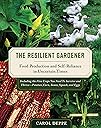
THE RESILIENT GARDENER
Product ID: 5519523
🌱organic & resilient gardening
📚scientific + hands-on guide
🥔5 staple crops mastery
Desertcart purchases this item on your behalf and handles shipping, customs, and support to Austria.
🌿 Grow Resilience, Harvest Confidence: Your Garden’s Secret Weapon
The Resilient Gardener is a scientifically informed, hands-on guide to organic gardening focused on growing five key staple crops. It equips gardeners of all levels to thrive amid climate uncertainty and personal challenges by teaching efficient, sustainable, and resilient food production techniques, including seed saving, crop storage, and integrating poultry for a self-reliant lifestyle.

| Best Sellers Rank | #151,494 in Books ( See Top 100 in Books ) #117 in Vegetable Gardening #127 in Organic & Sustainable Gardening & Horticulture #270 in Organic Cooking |
| Customer Reviews | 4.6 out of 5 stars 334 Reviews |
I**N
A transcendental "gardening" book...
This book is so much more than just a simple "gardening" book. Yes, it includes a lot of useful information about gardening and raising food, but also just as much intelligent information about nutrition, resilience, plant breeding, cooking and natural history. It is a book that you will read and reread and think about for weeks and weeks. It has the potential to alter the way you think about gardening and raising food in general, much in the same way that Michael Pollan's "The Omnivore's Dilemma" shifted the way we view the source of our food, what we are eating and why we should care. For those who criticize that the book is very Pacific Northwest-centric, I think you are missing the point of the book. Yes, Deppe includes an amazing amount of techniques and anecdotes that are specific to gardening in the Pacific Northwest, but this is NOT the purpose of the book! This is in no way a mindless "Copy Me" gardening book like so many others. Deppe is showing us that we need to EXPERIMENT with our own growing conditions to find the right crops, the right way to provide soil fertility, the right way to store food, etc. She is merely providing us with the inspiration and philosophical basis to go out and find ways to do these things for ourselves in OUR OWN GARDENING REGIONS, wherever in the world that might be. My bookshelf at home is filled with many mediocre gardening books, the type you read just once, perhaps absorb a little knowledge from and then never look at again. "The Resilient Gardener," however, fits into the rare category of transcendental reading that might change the way you view certain aspects of the world. In addition, the book is truly a pleasure to read, thanks to Deppe's fluid, down to earth writing style which is free of jargon and pretentiousness. Along with her book "Breed Your Own Vegetable Varieties" (also transcendental reading in its own right), this book will occupy a place of honor on my bookshelf and it is well on its way to becoming dog-eared and tattered from rereading it and lending it out so frequently.
G**N
The Resilient Gardener
I wish I could eloquently sum up this book. Actually, the title does that about as well as anyone could. But I'll give you a couple reasons why I'm so excited about it. There are more good points to make. But I can't take the time to get them all into this review. 1) This book pretty well nails what has been my wife's and my passion in almost everything we do related to self-sufficiency. That is, it addresses something larger and broader than just growing things. It addresses *production for consumption, survival and happiness.* 2) Carol writes uniquely. One does not learn what she has to teach without learning about her own journey. I find this very helpful, as the context helps explain the content. I also find Carol, in her books, to be a delightful person. 3) This book addresses other areas of production, which, in my mind are closely related to gardening, though often not considered so. For example she writes on poultry and other forms of meat production. To me, this is just a logical step from gardening and very important. 4) Carol is a "duck-aholic" and so am I. Okay, so she isn't into Muscovies, like I am. But her Anconas sound like excellent birds. I cannot understand why so few Americans like duck and even fewer like their eggs. Yet, ducks are probably the most practical of all poultry, with the potential of being raised where chickens can not. 5) Carol writes about growing and raising things because they make one feel good. I grow certain crops which I call "feel good crops." That's because, they are dependable and productive and, for one reason or another, when I grow them and am around them, I am happy. Carol expresses this very well. 6) Carol has celiac disease. Because of her wheat intolerance everything she produces is slanted toward a wheat free diet. My wife and I love wheat. But we greatly appreciate Carol's perspective. She has focused on corn, which for the home grower much easier to process. Being a plant breeder, Carol has actually developed some varieties of corn, special for the homesteader type. Also, we know a number of families with celiacs in them. We couldn't resist, we had to send them copies. We can't send out more now. But this book is very high on our list as a "must have," for several reasons. In this book Carol is partly retracing steps of some of our ancestors, in the quest for food security. In part also, she is breaking new ground. I've been gardening for over 40 years and seed saving since the 80s. I have learned quite a bit from this book. Yet, it is written both simply and in a detailed manner. I had a copy sent to a friend who is brand new in gardening and know that she will greatly benefit from it. If one goes to Carol Deppe's web site it is possible to download a copy of the table of contents and the first chapter, for free. This, in itself, would probably sell the book to most who would examine it! [...] One more link: here's another on-line review of the book, on Gardenweb [...]
M**K
Remarkable! A Gardening book written with honest humility and profound wisdom from years of Garden Experience
This book is a sheer joy to read. Whether you are a beginning gardener or a veteran gardener, you will find your horizons expanded with insights, practices and observations to incorporate in you garden, that put you more in touch with your soil, our plant partners, and the adventure and joy of Life. This book is a rich integration of years of garden experience and experiments with all the information found in all the best of other gardening books . Trust me here, I have been reading the best I could find for over the last decade, on all aspects of vegetable gardening and have a whole library of them. The Resilient Gardener credits and references the best. Then presents a clear enthusiastic narrative, detailing the evolution of her experience of years of growing. harvesting and cooking a DELICIOUS year round food supply in a temperate climate. It is full of explanations of questions I have been puzzled by for years and new great ways of putting up and cooking tasty food. The chapters on staples and her experiential knowledge about growing and seed saving varieties for the best taste as well as other virtues are especially valuable and a delight to read. I love everything about this book, starting with the detailed table of contents, that makes it possible to go right to a section of interest, without wading through from start to finish, if you so choose. None the less, it is such a joy to read, so direct, personal, honest, clear, detailed, humble and authoritative at the same time. Whether you skip around as I did or read from start to finish, you will probably find it difficult to put down and,like me, you may have to be up reading through the night. I am a frequent customer on Amazon, but have never bothered to review a book before. This book is such a stand out, I had to share my delight in it. I am already planning to make a gift of it to some of my favorite gardeners. If you love gardening and eating great home cooked food year round this book is for you!
M**D
A treasury of expertise, even in my High Desert climate
The climate I live in is the High Desert. I have also lived in the Pacific Northwest. Within the family of temperate climates, I don't think there are two that could be any more opposite than these. Deppe is in the Pacific Northwest, and garden information is always highly dependent on climate. Yet I have learned more about gardening from this than any other book but one. What I have learned, I have been able to use. The reason is that Deppe is not one of those highly opinionated, didactic, preachy gardeners who think they Know the Truth of how to best grow food (a description that seems to fit the authors of most gardening books). She is thoughtful and experimental. She seems to have no gardening ax to grind or gardening sacred cow to protect. She doesn't say "raised beds are the Messiah," or "raised beds are the devil," she tells you about her experience with raised beds, how she has found them useful, what their disadvantages are, when they work well, when they don't work, etc. She looks at her gardening challenges, applies reasoning to them, experiments with one variable at at time, examines the results, makes adjustments, examines the results. She is not teaching the reader "how to garden." She is teaching the reader to teach herself how to garden, in the reader's own set of circumstances. She shows the reader her thought processes, so I as the reader can learn how she thinks, what she does, and come up with my own ideas of what might work for me. For instance, she has a section where she writes about coming to realize that drip irrigation isn't best for her situation. But she is clear about her thought process, results, and circumstances, so what I came away with as a reader is not that drip irrigation is dumb, but for my situation, it's the best. The other really important advantage of this book is that she does not gloss over the details. So many times I just can't picture how to do what the author is doing because everything seems so vague. She is the first author I have read who has said what you are doing when you are "cultivating" (in the specific sense). "Oh, that's what cultivating is!" I thought. Yet when you read up on seed breeding, you know that this is an author whom you can learn more and more from over time.
W**N
Great book....but
Given the economic forecast and world events, the self-reliant part of me readily ordered this book. As one who has homesteaded for 40 years, I won't say any blinding light bulbs went off, but there is a lot of good information here. This book could be especially valuable to a beginner homesteader. I like how she writes, i.e. her personality and idiosyncrasies come across nicely, something I like in a book. I like a chuckle with my meat. The reason I gave this 4 stars (instead of 5) is because the book description does not indicate that many parts of the book are related to her own climate and her own health issues. Examples include: the overwintering of plants in the northwest, variety of seeds, ducks are a better choice than chickens because they forage better over the winter (I read that while sitting in northern New England looking out at my three feet of snow still on the ground), how she adapts her garden to manage her celiac disease, weight management, and restless leg syndrome... etc. You will also find that some of her set-in-stone practices are in direct opposition to other writers, such as plant spacing, raised bed containment, mulch use, etc. In other words, don't get swept up into thinking this is the bible or last word regarding your own gardening/farming practices. As the years pass, we all grow into what works for us best through our own practice. Having said that, this old-timer learned a number of things from this book, is going to try some of her ideas on my farmstead this year, and very much enjoyed reading Carol's book. Gotta go... another overly-wintered squash to bring out to the chicken coop... great idea, Carol!
A**R
So, so good!
I am rarely effusive when writing book reviews, but I want to be with this book. The author has a very friendly and engaging writing style that I did not expect in a gardening book. One of the highlights for me was her discussion of what she means by "hard times" and how to prepare for them. There was no yearning for the Apocalypse here. Right before I read this book I had read several on survivalism, all regarding worst case scenarios in which people go nuts and you have to defend your family etc. Ms. Deppe stated that her belief is that even in the event of catastrophe, things would be righted by the strength of human endeavor. I personally needed to hear that perspective. I found the focus on the specific crops, seed recovery and storage very helpful and in depth. And although this isn't a recipe book, there are recipes of a sort, I loved that and didn't expect it. The author's suggestions/directions on how to actually use my produce was awesome, I had had no idea about any of that; I can grow things sure, but they haven't always been the most useful or used very well! This is a very timely and informative book, I can't recommend it enough. A note, I bought it for Kindle and realized that I need this kind of book in my hands in paper form in order for it to be as useful (thats just a personal preference)so I will be ordering another copy...
A**D
Absolutely Outstanding!
Incredibly this book does it! It goes into understanding what is going on and why you are doing things... it's NOT a cookbook recipe but instead covers what it's all about and what makes it work (or not). Most garden books tell you to plant so deep, so far apart, and when. Deppe explores the "why" you plant at a particular depth (how you could alter it depending on your particular set of environmental constraints). Here you learn the intelligent approach to working within your food growing set-up. Deppe expands the "how and why" depending on the particular planting style you utilized. Do you use a rototiller, a sm tractor, or hand tools? The creme-de-la creme, is that she discusses growing methods, using the products, and appropriate storage techniques without it being boring and dry. I'm so tired of the usual: take potatoes and store them. Hmm, how, and what makes a difference on getting a potato to store one month vrs 6 months. How do I get them out of the ground without damaging them, what does light actually do to them, what can I do with potatoes that start to sprout, etc. are all questions that are covered in her topic discussion. What are the nutrient values, why would I grow this vrs another crop in terms of protein and calorie count. What about water needs: when, why, and how, instead of " water as needed". Deppe, in essence (AND in a very readable format), brings her depth of knowledge and experience to the table, sharing it so that I have the informational tools to make intelligent decisions. I am able to fine-tune my food production, as needed, to my particular setting. That builds in the resilience that makes my process adaptable to changing conditions... some people would label it as "increased food security"! This is one book that will fill a huge hole in my gardening library, productively speaking (pun intended)!
W**E
Intelligent, charming, eminently readable
There are few garden books that I would read as though they were a novel, yet this is *almost* that, certain sections certainly are. Ms. Deppe has a Ph.D. from Harvard in Biology, so intellectually she is no slouch, yet she is also a Taoist who brings light, warmth and humor to her work. I love that she is relating to us her (unfinished) journey with her gardens. My only regret is that my new gardens will be in the Mid-Atlantic and I won't be able to replicate all of her recommendations. She is very clear about getting references from one's particular area as to what varieties, and what techniques work best there. Her advice on not being to particular about certain aspects of gardening really help to dispel unnecessary perfectionist tendencies. For instance, she says when she pulls weeds she will leave some little piles between the rows -- it gives the slugs and grubs something to eat besides her garden plants. Brilliant! She also uses row gardening instead of intensive raised beds. Heresy? No, a different perspective on water and nutrient requirements that is very helpful when deciding what is best for each of us. In my opinion, she offers herself as guide, not guru, as some writers of technique fall into. I also find it charming that she provides info on how she cooks, it brings the picture full circle. I don't have to adopt every method, but I feel the warmth radiating from this wise and soulful woman.
A**I
love the cover
unfortunately still on my Read list - but great delivery and stuff- thanks Obazon!! (SIX MORE WORDS NEEDED!!! NOW ONLT TWO!
N**R
Highly recommended
I absolutely loved The Resilient Gardener! This book offers a fantastic approach to producing your own seeds, which is essential for anyone looking to become more self-reliant in uncertain times. The in-depth information about beans was incredibly valuable and the book also provides a wealth of knowledge about dealing with pests in the garden. The Resilient Gardener's thorough and insightful information about beans really made me excited to start growing them in my own garden. It's a great resource for anyone looking to expand their gardening skills and knowledge. Highly recommended!
M**N
A very timely book.
Overview This book shows you how to grow four crops (beans/pulses, corn, potatoes and squash) and raise ducks in such a way as to be both sustainable and resilient to bad conditions. These conditions could be through either climate change or bad weather - it does not matter as the techniques laid down here work. Carol also talks about diet, the environment, and other matters that are pertinent, but not immediately apparent, to the subject at hand. Even though she concentrates on the four crops listed above, her methodologies can be applied to other crops that you may wish to grow with a little thought and research. I have found this book to be a most interesting read for political and philosophical, as well as practical, reasons. This comes highly recommended, especially for older gardeners. The Meat A lot of British reviewers' criticism has been that it is hard to grow corn in the north of the country, especially up in Scotland. This is fair comment, despite the fact that we now have hardier open-pollinated cultivars of corn. Leaving the corn issue aside, everything else in this book can be grown quite easily all over the UK, even squash. The gardener will just have to think about his or her own growing conditions and act accordingly. For example, even in the south I would still start summer squashes off in the green house as a given procedure not as an optional method. And if it is a bad spring / summer, keep them in the green house for longer and pot them on from starts. The point of the book is to get the gardener thinking about his or her own conditions. The level of detail Carol Deppe goes into on how she copes with her region's conditions is exactly the level of detail the reader should be going into about their own regional conditions. It is a jumping off point for building resilience into your own gardening practices, especially for those of us interested in old fashioned organic methods as opposed to modern 'conventional' methods. I really cannot stress this point enough about this book - it is a jumping off point into your own research into building resilience into your own vegetable growing practices, whatever crops you grow. I personally would be inclined to use this book along side her "Breed Your Own Vegetable Varieties: The Gardener's and Farmer's Guide to Plant Breeding and Seed Saving" and Joy Larkom's "Grow Your Own Vegetables" rather than as a stand alone work. You can even substitute Carol Deppe's other book for Sue Stickland's "Back Garden Seed Saving" if you want something a little simpler to follow. Its use is not nearly as limited as some reviewers from the UK have said, if you treat it as a guide to further research rather than as a "this is how you do it" book. This is why I have given it five out of five.
N**A
Useful read
The most valuable information in this book is about the different varieties and cooking methods. The gardening techniques I did not find so useful- I was looking for more of a permaculture approach to resiliency and more information on perennial staples.
S**E
Can't say enough about how much I love this book!
I first got this book out of the library but realized I wanted to read this from cover to cover. Not only is this a helpful book for my own personal gardening but I loved all the background information. I mean, did you know there was a mini ice age? But the main reason I ordered it was the specific information I could apply to my own Pacific Northwest garden (although of course it applies to all) and my desire to grow much more of my own food. And if you happen to be aging at all or heading that way she has some very interesting planting techniques that you will want to adopt. So many garden books are just blah, blah, blah...people re-writing other peoples research and experiences and trying to cover the lack of information with pretty pictures. This is the real thing! A lot of hard work, research and thought went into it. Love this book and am looking forward to her next one!
Trustpilot
1 month ago
1 month ago