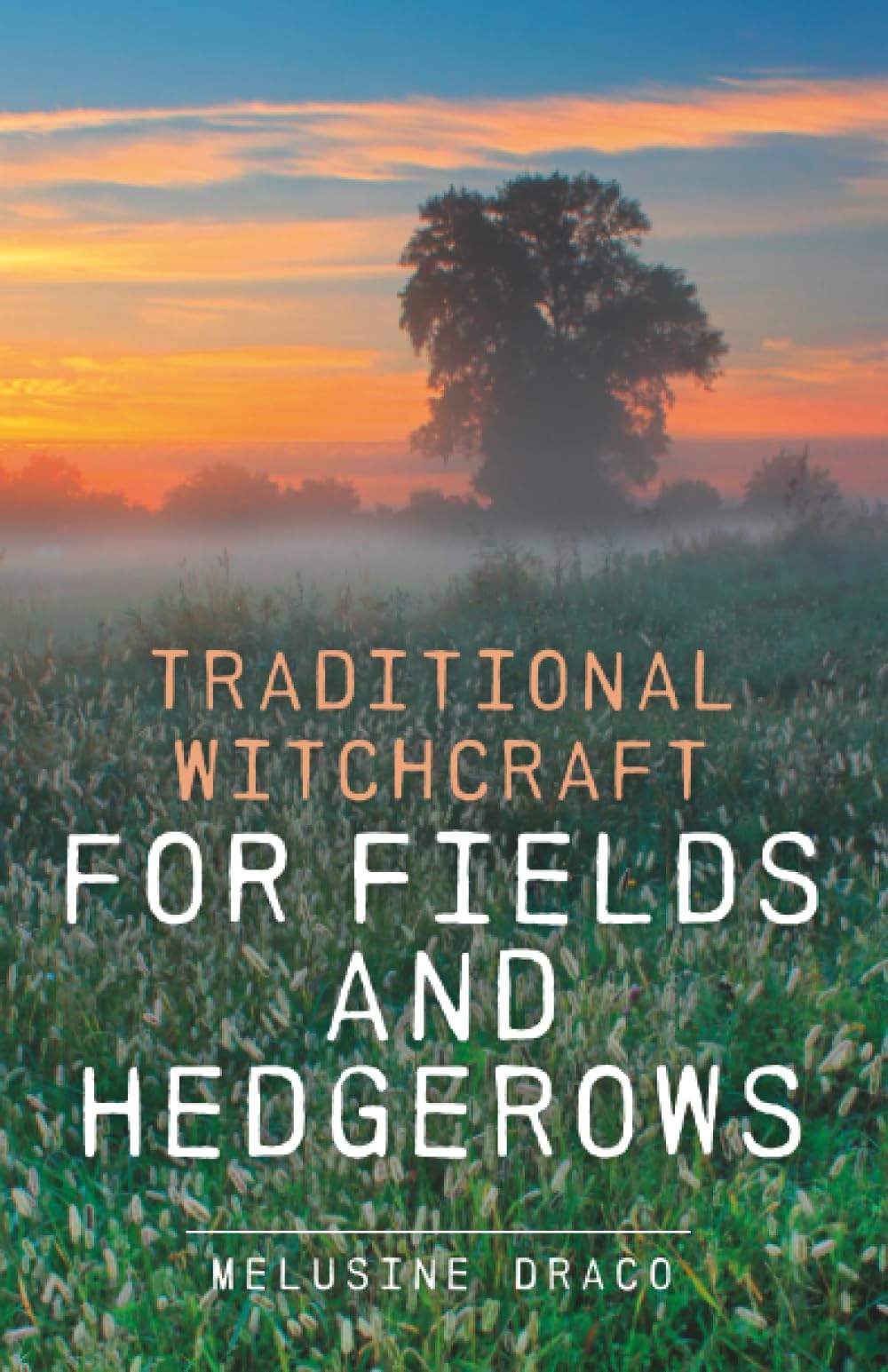
Traditional Witchcraft for Fields and Hedgerows
Product ID: 61830930
Desertcart purchases this item on your behalf and handles shipping, customs, and support to Austria.
Both FieldCraft and its companion title, WoodCraft, assume a certain degree of magical understanding on the part of the reader with regard to routine divination, spell and Circle casting. For this reason the text does not include the basic elements of rudimentary witchcraft that can be found in titles similar to Mean Streets Witchcraft and Sea Change. The books have been written in tandem to avoid any unnecessary repetition, and to provide cross-references where necessary. Review: Great Little Book - Informative. Useful at all levels Review: A treasure trove of tidbits - I loved Draco's Mean Streets Witchcraft (later published as Traditional Witchcraft for Urban Living), so I was very excited to order all the rest of the books in the Traditional Witchcraft series. This one arrived yesterday. It reminds me a lot of Fiona Walker-Craven's book 13 Moons: A Journal of a Natural, though the content is entirely different. They make a lovely complementary pair Traditional Witchcraft for Fields and Hedgerows is organised into seventeen chapters, one chapter per moon plus three extra: 1 - Fields and Hedgerows 2 - Jan Dead Moon 3 - Feb Short Moon 4 - March Awakening Moon 5 - The Witch's Field 6 - April Grass Moon 7 - May Planting Moon 8 - Jun Flower Moon 9 - The Witch's Hedgerow 10 - Jul Lightning Moon 11 - Aug Harvest Moon 12 - Sep Hunters Moon 13 - The Witch's Wildlife 14 - Oct Falling Leaf Moon 15 - Nov Tree Moon 16 - Dec Long Night Moon 17 - Dec/Jan Ice Moon and the Sacred Space You won't find any information here about circle casting, calling the quarters, the Lord and Lady or anything about gods or goddesses. The book is concerned entirely with how a witch would interact with the environment of fields and hedgerows through each moon of the year. Each chapter is packed with folklore, folk medicine, Celtic tree lore, recipes, traditional dates that occur (or used to occur) during each month, a recommendation in the most general terms for what you might consider for your 'circle work' that month. When Draco presents an old tradition, she gives a Then and Now, sights you would have seen in fields and hedgerows then, vs now. For example: Jan-- Then: collecting dead boughs for the hearth fire. Now: Beyond the hedge, the winter wheat is springing up. Jun -- Then: Hawking scene. Now: Ears of corn begin to appear and trees are in full leaf. I love Draco's style because she is extremely realistic in the way she views and presents the practicalities of being a witch in the 21st century. She does NOT make you feel bad if you can't go grubbing around harvesting herbs and putting up 100 bottles of cough remedy every year. Nor does she suggest that it is necessary to become an absolute expert on little-needed skills such as midwifery. If you want something without a whiff of Wicca anywhere near it and the British countryside is at your fingertips, these books may prove useful to you. If you are outside of the UK, they may not be of much use, as Draco is completely UK-centric, practising as she does British Traditional Witchcraft.
| Best Sellers Rank | 1,116,098 in Books ( See Top 100 in Books ) 2,887 in Wicca 3,575 in New Age Occultism 6,175 in New Age Mysticism |
| Customer Reviews | 4.5 out of 5 stars 84 Reviews |
C**M
Great Little Book
Informative. Useful at all levels
C**E
A treasure trove of tidbits
I loved Draco's Mean Streets Witchcraft (later published as Traditional Witchcraft for Urban Living), so I was very excited to order all the rest of the books in the Traditional Witchcraft series. This one arrived yesterday. It reminds me a lot of Fiona Walker-Craven's book 13 Moons: A Journal of a Natural, though the content is entirely different. They make a lovely complementary pair Traditional Witchcraft for Fields and Hedgerows is organised into seventeen chapters, one chapter per moon plus three extra: 1 - Fields and Hedgerows 2 - Jan Dead Moon 3 - Feb Short Moon 4 - March Awakening Moon 5 - The Witch's Field 6 - April Grass Moon 7 - May Planting Moon 8 - Jun Flower Moon 9 - The Witch's Hedgerow 10 - Jul Lightning Moon 11 - Aug Harvest Moon 12 - Sep Hunters Moon 13 - The Witch's Wildlife 14 - Oct Falling Leaf Moon 15 - Nov Tree Moon 16 - Dec Long Night Moon 17 - Dec/Jan Ice Moon and the Sacred Space You won't find any information here about circle casting, calling the quarters, the Lord and Lady or anything about gods or goddesses. The book is concerned entirely with how a witch would interact with the environment of fields and hedgerows through each moon of the year. Each chapter is packed with folklore, folk medicine, Celtic tree lore, recipes, traditional dates that occur (or used to occur) during each month, a recommendation in the most general terms for what you might consider for your 'circle work' that month. When Draco presents an old tradition, she gives a Then and Now, sights you would have seen in fields and hedgerows then, vs now. For example: Jan-- Then: collecting dead boughs for the hearth fire. Now: Beyond the hedge, the winter wheat is springing up. Jun -- Then: Hawking scene. Now: Ears of corn begin to appear and trees are in full leaf. I love Draco's style because she is extremely realistic in the way she views and presents the practicalities of being a witch in the 21st century. She does NOT make you feel bad if you can't go grubbing around harvesting herbs and putting up 100 bottles of cough remedy every year. Nor does she suggest that it is necessary to become an absolute expert on little-needed skills such as midwifery. If you want something without a whiff of Wicca anywhere near it and the British countryside is at your fingertips, these books may prove useful to you. If you are outside of the UK, they may not be of much use, as Draco is completely UK-centric, practising as she does British Traditional Witchcraft.
B**N
Good for going back to
Very good, fluid read. Helpful & could be used as a day to day guide
G**S
Absolutely enthralling book
Absolutely enthralling book packed to the brim with information. A must for country lovers and pagans alike. Melusine paints a picture so rich it history and folklore that you can almost smell the fields and hedgerows described. I can't rate this book high enough, as a pleasure to read it is tops.
C**Y
Five Stars
Really enjoyedreading this book and went on to buy another book by the same author
A**L
Useful interesting book
Great book, interesting read. Full of useful information. I would recommend it.
A**Y
Ok
It's ok, nicely written but not really any real information in it. Its just an overview of whats going month to month, but in no detail. Its similar to the yearly Almanac, but not as in depth. If it had cost anymore I'd have probably wanted a refund as its really not what the description leads you to believe. You're better off getting a book on green witchcraft or one of the many almanacs, which would have all this and much more.
G**N
Interesting book
This is quite useful but I wish she'd gone into more detail about uses of herbs and the history of them.
B**T
Five Stars
Wonderful, informative and beautifully written.
P**Y
Folk Practices from UK
This book to me is more a kind of folk one that witchcraft related, but taking into consideration the fact that old style witchcraft is what today we understand as folk, it's ok. The book is divided by months with traditional UK landscapes and folk, some interesting crafts and recipies (too old and greasy to follow - obviously not vegan). Thin book interesting to read and easy to follow it makes a good overall reading despite the fact that not every tree/plant matches with the place i live in nor the month in which it blossoms but... i've been able to cope with it. There's no spooky, rituals or fancy stuff... all very: "traditional" as the title says. I did like it.
T**D
Beautiful Review of Early European Witchcraft
This book provides a wealth of information on traditional Old Ways from pagan Europe. Its mostly centered around Britain, but as an American I still loved reading about the trees and plants of the traditional hedgerow and their associated magick. The author also goes through the Wheel of the Year and the traditional Pagan/Wiccan holidays, delves into the history behind them, and even provides old recipes and brief overviews of possible rituals and ways to celebrate. A great book, def recommend for beginner and seasoned witches alike!
S**Y
This is sort of a traditional approach with scientific facts ...
This is sort of a traditional approach with scientific facts thrown in. A sensible well-presented outlook on a subject that has lately been overblown and over-written
B**N
secular witch I have found that I don't like most books written for modern witches
As a farm based, from nature, secular witch I have found that I don't like most books written for modern witches. They don't get into how witchcraft came from those who needed it for survival, not just worship but so they could have enough to eat, a roof over their head, a crop or good hunt for next year, etc... Still every year, about this time I feel the need to connect to other witches through the written word. I am usually very disappointed with what I find. So when I was heading off to ginseng camp this fall and bought this book on a whim I actually was kicking myself for spending money on what was probably another disappointing book. Was I ever wrong. The author is amazing in her writings, telling us about how witches of old were the men and women who knew about the world around them by studying it, work in it, living with it and being a part of nature instead of the modern day a part FROM nature. This is my kind of witchcraft. Learning from nature and not from someone who calls themselves a priest or a priestess, as if that gives them a closer connection to the natural world. The wise men and women of old learned how to read the tracks of animals, to know how and when to gather herbs, knew their trees and the wood that came from them, could build cooking fires and how to move quietly without ripples in the energy of the world unless they chose through magic to make ripples. They could heal and kill, love and curse, and hunt, fish, gather, prepare and survive with nature. It was their wisdom and knowledge of the world that set them apart as witches. That wisdom and knowledge was what made them dangerous to some and life savers to others. Being a witch and practicing witchcraft was not about faith in the invisible but knowledge is what is actually there and how to work with it. Something that is lacking in the modern witch movement. So the magic of sleeping under the stars with my bags full of wildcrafted ginseng, blue cohosh, and bloodroot was only enhanced by the reading of this wonderful book. I just bought another on of her books and plan on reading that as I light the winter fires to warm the house this year. Living with nature as the witches of old once did.
Trustpilot
3 days ago
1 day ago