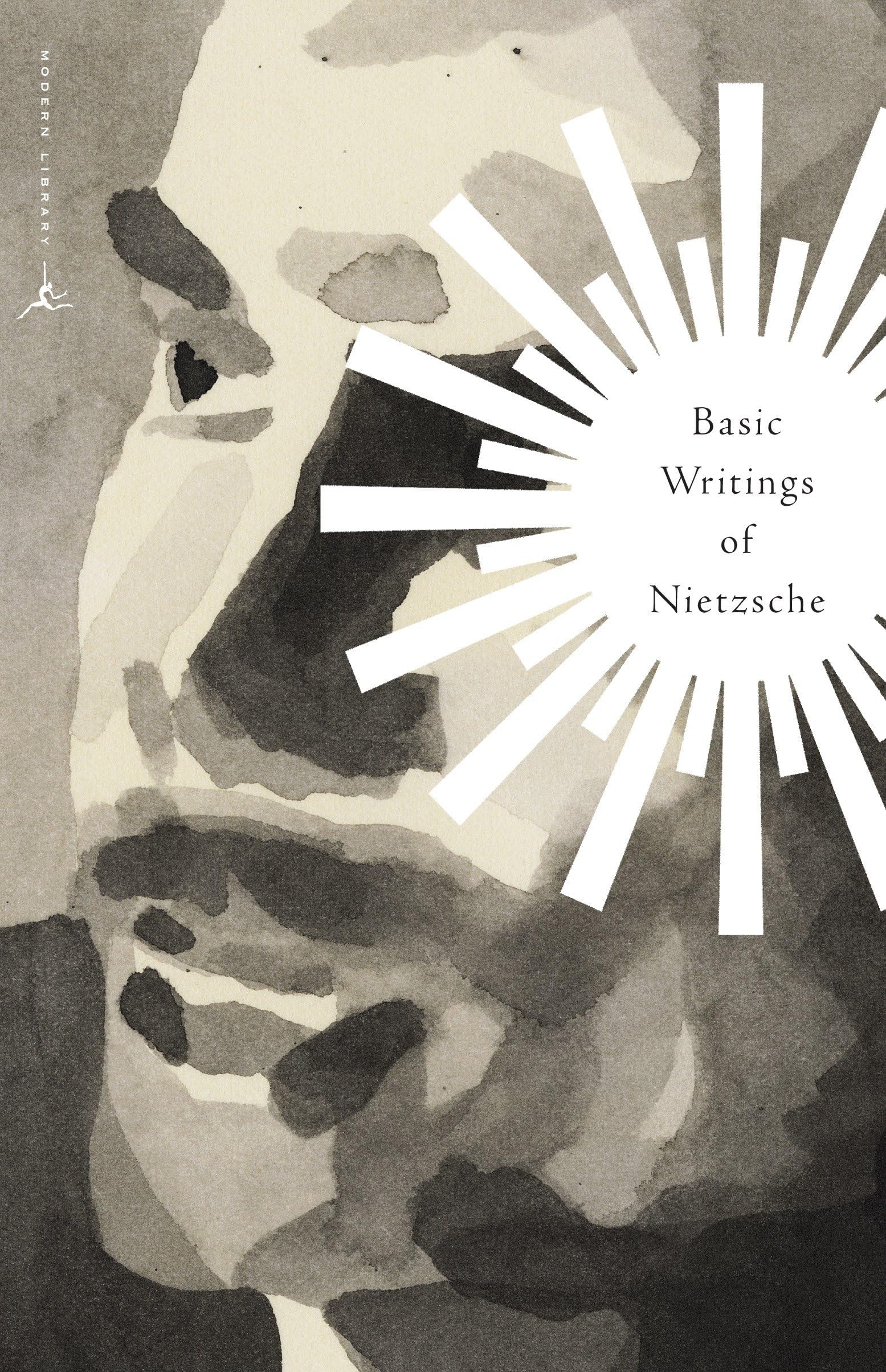
Basic Writings of Nietzsche
Product ID: 64840099
Buy anything from 5,000+ international stores. One checkout price. No surprise fees. Join 2M+ shoppers on Desertcart.
Desertcart purchases this item on your behalf and handles shipping, customs, and support to Austria.
This captivating collection brings together five of Friedrich Nietzche’s most important philosophical works, exploring themes such as nihilism, metaphysics, and the nature of morality—featuring an introduction by Peter Gay and commentary from Martin Heidegger, Albert Camus, and Gilles Deleuze More than one hundred years after his death, Friedrich Nietzsche remains the most influential philosopher of the modern era. Basic Writings of Nietzsche gathers the complete texts of five of Nietzsche’s most important works, from his first book to his last: The Birth of Tragedy, Beyond Good and Evil, On the Genealogy of Morals, The Case of Wagner, and Ecce Homo . Edited and translated by the great Nietzsche scholar Walter Kaufmann, this volume also features seventy-five aphorisms, selections from Nietzsche’s correspondence, and variants from drafts for Ecce Homo . It is a definitive guide to the full range of Nietzsche’s thought. This edition includes a Modern Library Reading Group Guide Review: Five Stars - A very well translated compilation, price is very cheap when compared to buying Netzsche books separately. Review: Not Satisfied - It's a good collection, although it does not include "Thus Spake Zarathustra", but the paper quality is not good at all. I also bought Basic Writings of Kant which had far better page quality. In this one, the paper is too thin and print is visible from the other side.


| Best Sellers Rank | #294,516 in Books ( See Top 100 in Books ) #7,773 in Classic Fiction (Books) #18,375 in Reference (Books) |
| Customer Reviews | 4.6 out of 5 stars 689 Reviews |
H**R
Five Stars
A very well translated compilation, price is very cheap when compared to buying Netzsche books separately.
S**F
Not Satisfied
It's a good collection, although it does not include "Thus Spake Zarathustra", but the paper quality is not good at all. I also bought Basic Writings of Kant which had far better page quality. In this one, the paper is too thin and print is visible from the other side.
A**.
Good Collection
Pages are too thin .
A**.
Extra thin pages
Even though this is a great collection of writings of Nietzsche, this print has very poor quality of pages. Very thin, even utmost care doesn't feel enough.
A**R
Pages quality
The print of the book was so bad,pages so thin and poor quality.One could see the impression of texts printed on the previous page in whole book.Very disappointed ,had to return the book.
R**Y
Different book than shown in Pic.
I received a different edition, though from the same publisher
S**S
Great book, poor print!
Paper quality poor
R**N
Bad quality paper, cover and binding
The paper is too thin. Not good.
閑**閑
もうひとつ・・・
この本の中には、ニーチェの代表作である5編と75個の格言が訳され、しかもこの価格なのでお買い得であることは確かです。 ただ、訳者、編纂者であるKAUFMANNの個人的なニーチェに対する評論や意見も聞きたかった自分としては、少しもの足りなさを覚えました。 本の中身とは関係ありませんが、表紙の絵に感動しました。
D**A
5 stars
Excellent
S**E
Good price
Bought for my grandson
C**3
Great
Wonderful author and great translation
L**T
A fascinating human being of exceptional complexity and integrity (P. Gay)
Nietzsche was the greatest polemist ever. He played the role of Saint-Michael, the dragon slayer, in his Homeric battle with the existing dragons (the Christian moralists). He tried to revalue all generally accepted `good and evil' values and really felt that mankind was pregnant with a new super-species, the `Übermensch'. His influence on philosophy, literature, psychology and politics is immense. Of course, some aspects of his vision on mankind are unacceptable. The all important influence on his Nietzsche's life and philosophy came from Schopenhauer: `I very earnestly denied my `will to life' at the time when I first read Schopenhauer.' The life of a Nietzschean immoralist Life is to express one's will to and lust for power. The cardinal instinct of man is not self-preservation, but the discharge of strength. Everything evil, terrible, tyrannical in man, everything that is kin to beasts of prey and serpents serves the enhancement of the species `man'. This enhancement has always been the work of an aristocratic society. The noble man creates his own morality, his good and bad, with egoism and exploitation as his real nature. He despises the slaves, the unfree, the doglike people who allow themselves to be maltreated. Christian morals, democracy When the aristocratic value judgments declined, the plebeians imposed their own morality of unegoism, pity, self-sacrifice, self-abnegation and ascetic ideals on mankind. The egoistic `good' of the masters became the `evil' of the Christian faith. This faith constitutes not less than a sacrifice of all freedom, enslavement and self-mutilation. By preserving all that is sick, it breads `a mediocre herd animal'. Democracy, `the nonsense of the greatest numbers', with its `equality of rights', is the heir of Christianity. It is a gruesome fact that an anti-life morality received the highest honors and was fixed as a law and a categorical imperative. Art Art is a saving sorceress. She alone knows how to turn the nauseous thoughts about the horrors of life into the sublime and life's absurdity into the comic. Musically speaking, Nietzsche himself was a composer. `The Case against Wagner' compares the Dionysian opera `Carmen' by Bizet, with the Christian opera `Parsifal' by Wagner, the redeemer. Evaluation Besides his unacceptable profound misogyny (`woman's great art is the lie, her highest concern is mere appearance'), Friedrich Nietzsche's brutal evangel is not less than a call for war, not peace. But in an age of nuclear, bio- and chemo-weapons, of veiled State terrorism and of demographic explosions, his call for an uninhibited exploitation of man's basic instincts to fight for the spoils should be categorically rejected. His romantic anti-rational and anti-scientific stances became pipedreams. On the other hand, his attacks on the power of the moralists, his sincere call to live in `Dionysian' freedom and not for `eternal bliss', as well as his vision that art is the only truly metaphysical activity of man, will continue to appeal strongly to many and remain the bright parts of his virulent diatribes. His work is a must read for all philosophers and lovers of truly essential polemics.
Trustpilot
4 days ago
1 month ago