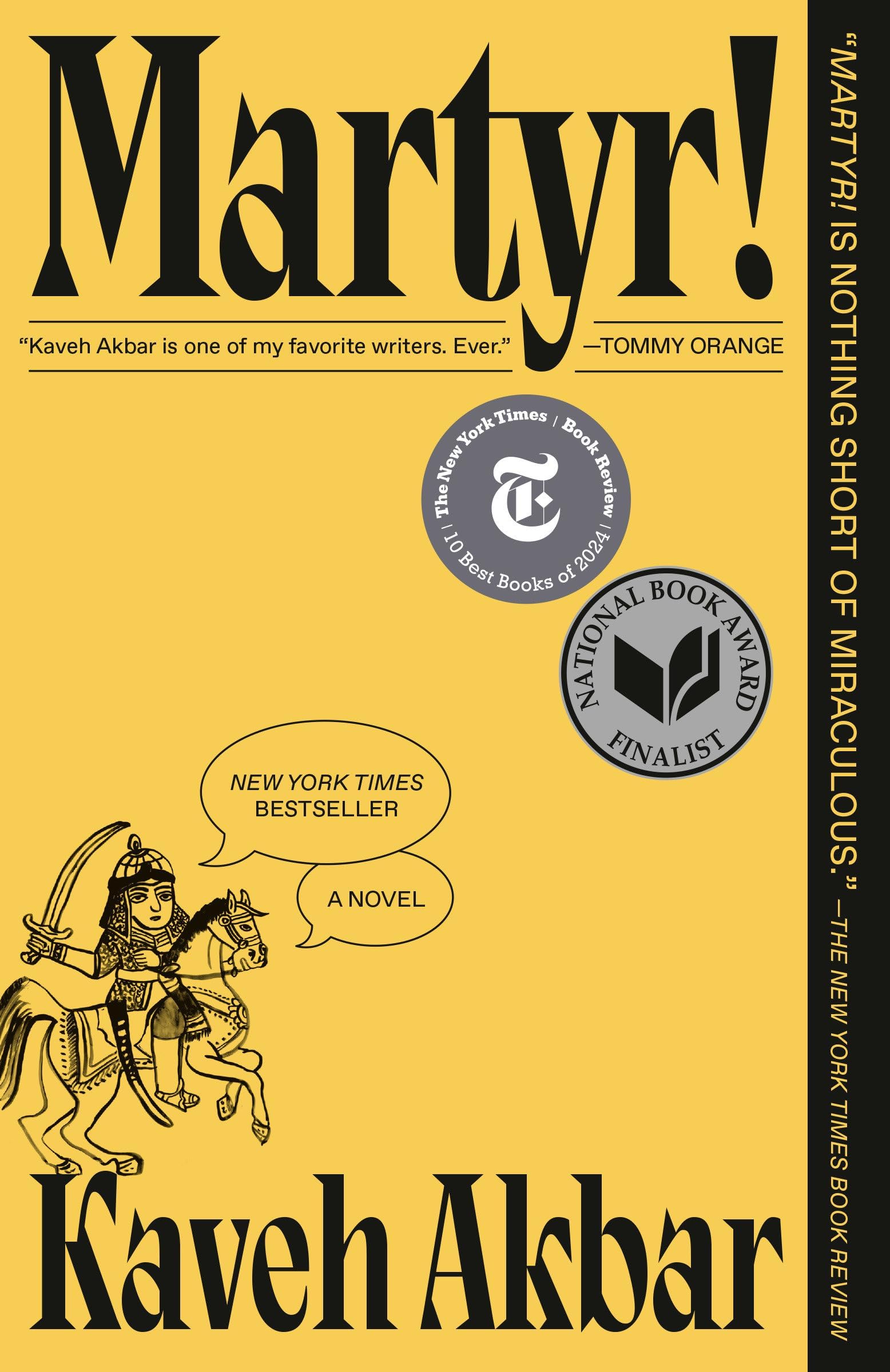
Martyr! (National Book Award Finalist): A Novel
Product ID: 687696384
Desertcart purchases this item on your behalf and handles shipping, customs, and support to Austria.
NEW YORK TIMES BESTSELLER • SHORTLISTED FOR THE NATIONAL BOOK AWARD • ONE OF THE NEW YORK TIMES BOOK REVIEW'S 10 BEST BOOKS OF THE YEAR • A TIME MUST-READ BOOK OF THE YEAR • A newly sober, orphaned son of Iranian immigrants, guided by the voices of artists, poets, and kings, embarks on a remarkable search for a family secret that leads him to a terminally ill painter living out her final days in the Brooklyn Museum. Electrifying, funny, and wholly original , Martyr! heralds the arrival of an essential new voice in contemporary fiction. “Kaveh Akbar is one of my favorite writers. Ever.” —Tommy Orange, Pulitzer Prize–nominated author of There There “The best novel you'll ever read about the joy of language, addiction, displacement, martyrdom, belonging, homesickness.” —Lauren Groff, best-selling author of Matrix and Fates and Furies Cyrus Shams is a young man grappling with an inheritance of violence and loss: his mother’s plane was shot down over the skies of the Persian Gulf in a senseless accident; and his father’s life in America was circumscribed by his work killing chickens at a factory farm in the Midwest. Cyrus is a drunk, an addict, and a poet, whose obsession with martyrs leads him to examine the mysteries of his past—toward an uncle who rode through Iranian battlefields dressed as the angel of death to inspire and comfort the dying, and toward his mother, through a painting discovered in a Brooklyn art gallery that suggests she may not have been who or what she seemed. Kaveh Akbar’s Martyr! is a paean to how we spend our lives seeking meaning—in faith, art, ourselves, others.


| Dimensions | 5.18 x 0.74 x 7.99 inches |
| Isbn 10 | 0593685776 |
| Isbn 13 | 978-0593685778 |
| Item Weight | 8.8 ounces |
| Language | English |
| Print Length | 352 pages |
| Publication Date | December 31, 2024 |
| Publisher | Vintage |
User
THe Author Tickles The Reader's Brain With A Special Kind of Skill
It's an interesting and inventive read about a recovering alcoholic/addict who moved to the Midwest from Iran as a child following a family trauma. It follows the emerging poet who becomes fascinated with the idea of Martyrs and martyrdom, which draws him to a dying painter who’s made her dying a type of performance art. The structure of the telling of this story shifts perspectives and time lines that keeps the reader on their toes. It’s funny and heartfelt and has some truly interesting ideas and perceptions that tickle that part of the reader’s brain which needs a special talent to reach.
User
A Good but Flawed Novel. A Fantastic Audio Book
3.5-stars rounded up to 4-stars.This book was a mixed bag for me. There were a number of things which, ordinarily, would bring my rating way down: the scattershot writing style, the use of highly detailed dreams (no one has these), and using irrelevant characters to help tell the story (e.g., Lisa Simpson, Abdul-Jabbar, Rumi). For me these are unnecessary literary affectations. I'm also not a fan of serious drug-users/drinkers as protagonists.But the story *was* interesting. Some sections were very funny. I loved Cyrus's uncle, Arash, and his tragic story. And the part of the story with Orkideh and Cyrus was original and compelling. Recommended. (Despite the book's cutesy parts.)This was also my first audio book. The narrator - Arian Moayed - did an incredible job. Five big stars for him. But the times I'm in a situation where I can listen to a narrator *and* be intellectually engaged are few. (When is that... driving?, planes?, exercising?) So audio books are a likely dead end for me.
User
The Immigrant Experience
Cyrus Shams is an Iranian immigrant, although he came to the United States as a baby so identifies with both his Middle Eastern and his American backgrounds. His mother was shot down in a plane by the American military on a commercial flight when Cyrus was four months old so he has no memory of her. His father decided to come to the United States to make a new life for he and Cyrus but could only find factory work, killing chickens in a processing plant. Cyrus has one uncle left in Iran, his mother's brother. He suffers from PSTD from his role in the war with Iraq where he rode the battlefield dressed in black, offering comfort to those left dying there.Now as an adult, Cyrus isn't sure what he will do. He went off the deep end for quite a while, drinking and doing drugs. He has been sober for about a year now and considering writing a book about martyrs as he feels he has extensive knowledge of them. Cyrus is a poet and unsure if his book will be in prose or verse. He also plays with the idea of doing away with himself as another example of a martyr.Cyrus hears of an art installation in New York. An Iranian female artist is dying, a victim of cancer. She is choosing to live out her life at the museum, sitting and willing to talk with any of the museum patrons. Cyrus is fascinated with this and along with his best friend and sometime lover, goes to New York to see what the woman has to say about martyrship. Will she change his mind?Kaveh Akbar is an Iranian immigrant himself, born in Iran but now in the United States where he teaches in Iowa. He has two books of published poetry and his work has appeared in many magazines. He is the poet editor of The Review. This is his debut novel and it is shortlisted for the National Book Award, a Times Best 10 Book and a New York Time's Book Review 10 Best Books of the Year. Cyrus will pluck the heartstrings of the reader as they cheer him on, hoping that he can find peace and a reason to live. Poetry, the immigrant experience and the high rate of addiction among those whose lives start in chaos are discussed. This book is recommended for readers of literary fiction and those interested in the lives of those from other cultures.
User
good writing, good story but languid
For me, the strengths of the story, the unique characters, the development of the plot, the unexpected twists – did not outweigh the slow and at times frustrating pace of the book.
User
Choose your media wisely
I will dispense with describing the plot of Martyr! - that's been done enough in other reviews and the novel's publicity communications. To get directly to its net effect...Overall, I found this work very enjoyable, having begun it with no particular expectations and little knowledge of the storyline. HOWEVER, I consumed it as an AUDIOBOOK. Throughout its 10+ hours I wondered if it would be as compelling if I were reading it - indeed, I suspected that certain parts might be outright boring in script form. From what I am seeing in other reviews, I believe those wonderings are borne out. The vocal narration was outstanding. Crucially, it took care of what appears to be the most frequent criticism of the book's multiple POV structure: that, in script, all the characters sounded alike. Narrator Arian Moyayed did a remarkable job of bringing the various players to life and imparting unique personalities/voices to each. To those who rated Martyr! one or two stars, I'd say, well, horses for courses. To the three star raters, I'd say you should have listened to the audio - it might have hit you as a four, or maybe even five.As for other critique points...One, be alerted that Martyr! does not really have a "plot" as such. Like much literary fiction, it is character driven and philosophical point driven. Two, in a couple instances, the "point" being made has little or nothing to do with what is otherwise happening with the main character's life - and it gets a bit soap-boxy. Three, readers/listeners might detect an interesting compare/contrast between the narrative of this protagonist's substance addiction experiences and those of the protagonist in Barabara Kingsolver's "Demon Copperhead". Lastly, I've seen that some folks expected more humor based on the book's promotion; I saw none of that promotion so I didn't expect it, and for me the amount of humor was just right.As with all books, this one has its flaws. But if you are a literary fiction fan this is a very good book. I would speculatively rate it a solid three-stars in its written form, and highly recommend it in audio.
User
Makes me want to read his poetry!
I’m not much of a poetry reader, but I think I’d love Kaveh Akbar’s. This book is a masterpiece, one of the first books in a long time I’ve started over and read the beginning of after finishing. I haven’t read it a second time all the way, but I think I will before too long, and 100% read this book again in 10 years or so.The main character is both aware of and not aware of his own foibles, perhaps like most of us? He wants to think he’s original and yet knows he is not. All ideas I assume the author struggles with, too. Perhaps all artists do in one form or another?I’m not sure I completely understand the ending yet, but I’m also not sure it’s supposed to be black and white. Or that choosing love is like a form of death… but I don’t want to spoil anything.I can see this book being too poetic and metaphorical and “complicated” (it’s not really, thus the quotation marks) for some readers. But someone much smarter than me once said that the best books can be enjoyed twice, at least: once for pure enjoyment and a second time looking for all the “so whats.” I think the Great Gatsby was the example I’m remembering, but sure there are thousands. Some of the symbolism is straight forward, some is personal, some is universal, but I’m sure many an English PhD student (or whatever) could write a paper on the description of language as an idea and both priceless and worthless way of describing life. A few papers about death and light and lies about angels we are all told to, what, make us feel better or feel worse? Again, religion is just language: it’s both powerful and utterly insufficient, like describing love or grief… but it’s all we have until we learn what this death thing is really all about, which we all will eventually.
User
I read my top read of 2024 in January - oops!
“I want to be worthy of the great terror my existence inspires.”This book left me absolutely breathless. 72 hours after finishing it, I’m still suffering from the hangover of how much I loved it. Martyr! follows Cyrus, a yet-to-be-discovered Iranian American poet, as he tries to make sense of his life and his grief. His mother is dead, his father is dead, he’s stuck in a job as a medical actor, and now that he’s sober, he can’t use substances to take the edge off. He’s starting to wonder whether joy is even real anymore when he’s struck by his next great idea: he’ll write a book about martyrs. As he begins searching the world for examples, a friend tells him about a museum exhibit: an Iranian woman, dying of cancer, spending her last days in the museum, talking to people. And thus begins Cyrus’s search for meaning.Being familiar with Akbar’s poetry, I thought I knew what I was getting myself into when I cracked this book open. The goosebumps that peppered my arms and tears that crawled down my face while I was reading would suggest otherwise. Akbar’s lyricism effortlessly echoes through every line of this book. Martyr! illustrates the power and the insufficiency of language, the way it can both elucidate and obscure. Beyond the prose, Akbar’s fiction debut tackles a wide range of topics: grief, racism, sexuality, family dynamics, Persian culture, gender roles. Martyr!’s characters leap off the page as Akbar employs them to explore these diverse subjects. With alternating POVs between Cyrus, his mother, his father, and his uncle, this book becomes both a captivating character study and a heart-rending family saga.This is another must-read recommendation for my diverse lit-fic lovers! Thank you, Kaveh, for such beautiful polysexual and sapphic representation and for everything I learned about Persian culture. I’m already planning to reread Martyr! later this year 🌻 Run, don’t walk, to pick up a copy of this amazing new book!
User
Living and dying so that it all matters
‘The performance of certainty seemed to be at the root of so much grief. Everyone in America seemed to be afraid and hurting and angry, starving for a fight they could win…The genesis of everyone’s pain had to be external, such was their certainty. And so legislators legislated, building border walls, barring citizens of there from entering here. “The pain we feel comes from them, not ourselves,” said the banners, and people cheered, certain of all the certainty. But the next day they’d wake up and find that what had hurt in them still hurt.’ (p209)What does it mean to live a life that matters? To experience a death that matters? If someone’s death matters, to whom does it matter? In what way? Why? These questions are front and center for the protagonist. Nothing else is important – at least when he’s not high or drunk. His life’s work is writing a book about it. But it’s more than an obsession – it’s personal. Will it kill him? Will it matter?The principal characters here are emotionally and morally complicated people – as we all are. There are multiple first-person and third-person narrators, and the story jumps around the timeline. A quiet mystery looms; its resolution may make all the difference.I enjoyed the book, but I expected more than it delivered – I can’t say I came away with new insights on the big questions the book seeks to address. The ending, while plausible, disappointed me: Akbar, in my view, didn’t quite stick the landing. And a critically important conversation struck me as so unrealistic it was silly: late in the book, in a high-stakes moment of profound stress and excitement, two characters engage in a lengthy exchange of highly polished, overly scripted, deeply philosophical insights before wordlessly agreeing to…well, you’ll see. To be fair, though, this is Kaveh Akbar’s tale, not mine, and I’m glad he shared it with me.
User
Surpreendente
Livro incrível!!
User
Great paperback!
What an amazing paperback! The spine is very flexible and its super comfortable to hold, as for the contents of the book im still yet to read it!
User
Thought provoking
Interesting, different, beautifully written
User
I need this again
This book is full of amazing quotes! It is hogging up space my quote diary. 10/10
User
A must read
Amazing book ! Every sentence is a masterpiece
Trustpilot
3 days ago
1 month ago