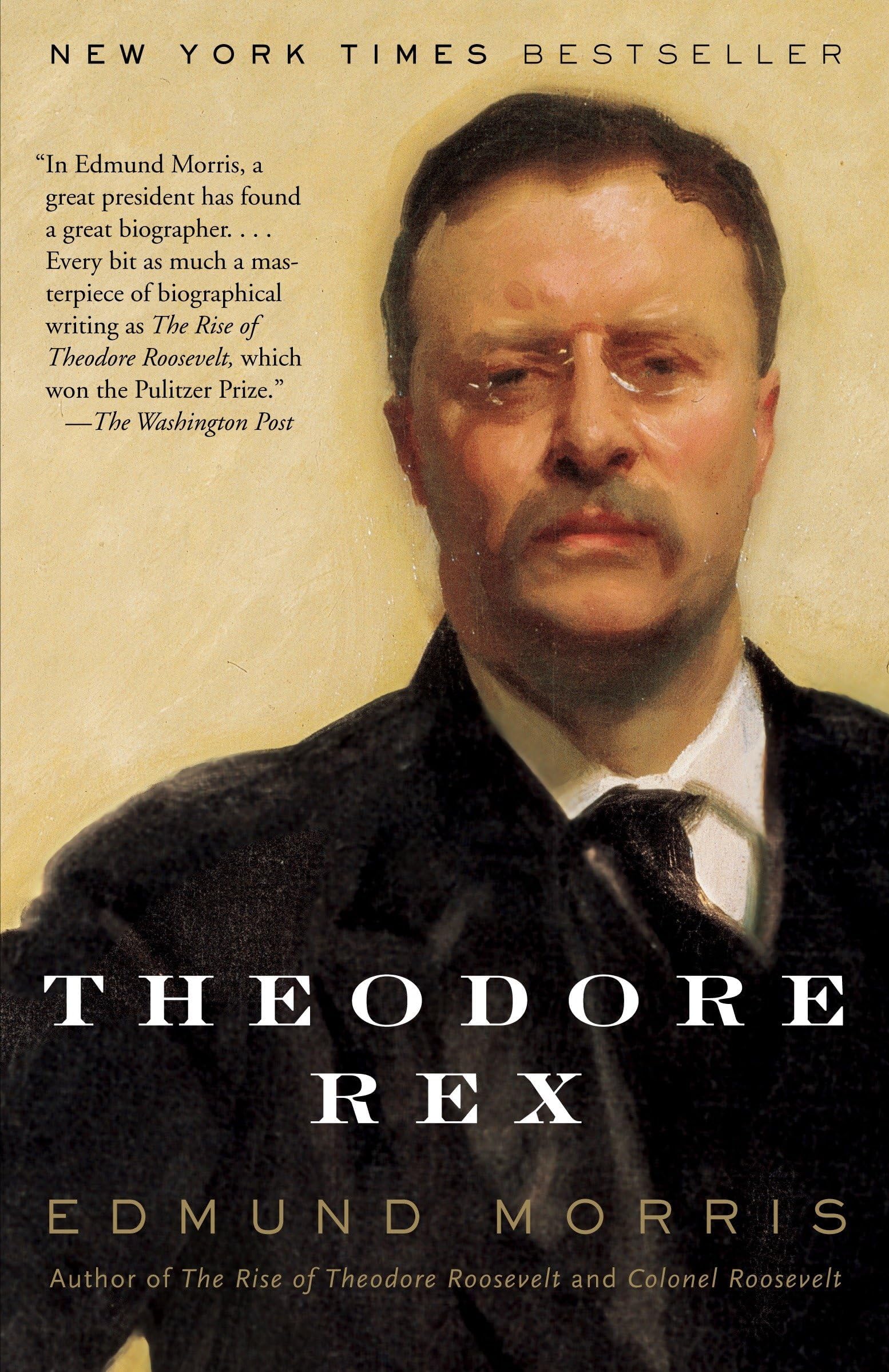
Theodore Rex
Product ID: 8237373
Buy anything from 5,000+ international stores. One checkout price. No surprise fees. Join 2M+ shoppers on Desertcart.
Desertcart purchases this item on your behalf and handles shipping, customs, and support to Austria.
NEW YORK TIMES BESTSELLER • WINNER OF THE LOS ANGELES TIMES BOOK PRIZE FOR BIOGRAPHY • “A shining portrait of a presciently modern political genius maneuvering in a gilded age of wealth, optimism, excess and American global ascension.”— San Francisco Chronicle “[ Theodore Rex ] is one of the great histories of the American presidency, worthy of being on a shelf alongside Henry Adams’s volumes on Jefferson and Madison.”— Times Literary Supplement Theodore Rex is the story—never fully told before—of Theodore Roosevelt’s two world-changing terms as President of the United States. A hundred years before the catastrophe of September 11, 2001, “TR” succeeded to power in the aftermath of an act of terrorism. Youngest of all our chief executives, he rallied a stricken nation with his superhuman energy, charm, and political skills. He proceeded to combat the problems of race and labor relations and trust control while making the Panama Canal possible and winning the Nobel Peace Prize. But his most historic achievement remains his creation of a national conservation policy, and his monument millions of acres of protected parks and forest. Theodore Rex ends with TR leaving office, still only fifty years old, his future reputation secure as one of our greatest presidents. Review: I L L U M I N A T I N G . - An entertaining eloquent portrayal of Theodore Roosevelt as the President of the United States. From the unexpected assassination of President William McKinley, assuming the Presidency, then winning the Presidential election after 3-1/2 years in office, and subsequently, his continued impact upon America and the world, including, the Panama Canal, the successful mediation between Japan and Russia, the establishment of national parks, and, reconfirming the Monroe Doctrine in South America. The Author skillfully resurrects Roosevelt to life. One can almost hear Teddy enthusiastically proclaim "DELIGHTED" or "BULLY" -- his favorite expressions. In 1908, Roosevelt was eerily prophetic in asserting that war with Japan would ultimately happen. He declared "... war with Japan ... would [occur] one day.... The surerst way to postpone it ... was to prepare for it as much as possible, and show evidence of a steely willingness to fight" (Page 534). He was proven correct as Pearl Harbor was devastated 33 years later in 1941, which led to the U.S. participating in WWII, and commanded by his nephew, President Franklin Roosevelt. Theodore's active naval enlargement defined his foreign policy of dealing from strength: "We infinitely desire peace, and the surerst way of obtaining it is to show we are not afraid of war" (Page 229). Although lacking the elusive charismatic flair of the Author's first volume, overall, this book was engaging, detailed, informative. And, at times, subtlety humorous. For instance, in peacefully concluding the possible precipitous conflict with the Columbians at Panama, "... [Columbian] Colonel Torres ... [finally] agreed to accept an 'indemnity' of eight thousand dollars ... [and was] sent a farewell gift of two cases of champagne" (Page 293). Thus, violence was averted. If all hostilities could be so easily solved with money and alcohol. Review: "The greatest herder of emperors since Napoleon..." - "Theodore Rex," the sequel to presidential biographer Edmund Morris's Pulitzer Prize-winning "The Rise of Theodore Roosevelt," is a thorough examination of the seven years Theodore Roosevelt (TR) spent in the White House as the 26th President of the United States. It picks right up where "The Rise of Theodore Roosevelt" ended - with the assassination of TR's predecessor, William McKinley. It ends on March 4, 1909, when Roosevelt reluctantly surrendered the reins of power to his hand-picked successor, William Howard Taft. By today's standards (or at least the standards set by the political pundits in the media), a President's overall "greatness" seems to be guided by whether or not he was responsible for at least one major positive accomplishment during his term(s) of office, while at the same time avoiding any major blunders. If you apply these standards to Theodore Roosevelt as he is portrayed in "Theodore Rex," he arguably ranks as one of the five greatest Presidents in our Nation's history. Not only was he responsible for "one" major accomplishment - he was responsible for many. As Morris points out, Theodore Roosevelt, more than any President before him, and maybe since, transformed the Presidency from an almost figurehead-like office into what it is today: the most prominent and powerful office in the world. In "Theodore Rex," Edmund Morris abandons the highly controversial literary device he used when writing "Dutch: A Memoir of Ronald Reagan" (in which he placed himself as a fictional observer of events), and wisely returns to what he does best: writing Presidential biographies with his stylishly crisp, clear, and highly entertaining prose. Never once does he let the pace of his eloquent narrative in "Theodore Rex" flag. I found myself immediately "hooked" while reading this superb book's first few pages. TR's means of handling his assumption of the Presidency after the assassination of William McKinley is a dramatic story in itself, and it's deftly handled by Morris. Nearly all of the major events of TR's presidency are handled with equal skill. "Theodore Rex" is a highly detailed and polished narrative that places both TR and his presidency in a decidedly positive light. Roosevelt is portrayed as a highly principled man, almost puritanical in his values, and unwilling to compromise on most deeply felt issues. Morris allows TR's youthful vigor, optimism, progressivism, and hunger for approval to shine through on every page. "Theodore Rex" shouldn't be mistaken as an exercise in hagiography, though. It is, at its heart, a scholarly, judicious, and finely balanced biography. Throughout the book, Morris provides an incisive analysis of Roosevelt and what he accomplished during his seven years as President. Successes and failures, good judgments and misjudgments... all are presented in equal measure. Of all the Presidential biographies I've read in recent years, "Theodore Rex" is one of the best. This eagerly anticipated sequel to "The Rise of Theodore Roosevelt," written twenty years after its Pulitzer Prize-winning predecessor, is certainly its equal in quality of writing, scholarship, and insightful historical analysis. Not only that, but it's a great read!


| Best Sellers Rank | #50,562 in Books ( See Top 100 in Books ) #3 in Historical Japan Biographies #12 in Historical Russia Biographies #120 in US Presidents |
| Customer Reviews | 4.6 out of 5 stars 1,806 Reviews |
B**U
I L L U M I N A T I N G .
An entertaining eloquent portrayal of Theodore Roosevelt as the President of the United States. From the unexpected assassination of President William McKinley, assuming the Presidency, then winning the Presidential election after 3-1/2 years in office, and subsequently, his continued impact upon America and the world, including, the Panama Canal, the successful mediation between Japan and Russia, the establishment of national parks, and, reconfirming the Monroe Doctrine in South America. The Author skillfully resurrects Roosevelt to life. One can almost hear Teddy enthusiastically proclaim "DELIGHTED" or "BULLY" -- his favorite expressions. In 1908, Roosevelt was eerily prophetic in asserting that war with Japan would ultimately happen. He declared "... war with Japan ... would [occur] one day.... The surerst way to postpone it ... was to prepare for it as much as possible, and show evidence of a steely willingness to fight" (Page 534). He was proven correct as Pearl Harbor was devastated 33 years later in 1941, which led to the U.S. participating in WWII, and commanded by his nephew, President Franklin Roosevelt. Theodore's active naval enlargement defined his foreign policy of dealing from strength: "We infinitely desire peace, and the surerst way of obtaining it is to show we are not afraid of war" (Page 229). Although lacking the elusive charismatic flair of the Author's first volume, overall, this book was engaging, detailed, informative. And, at times, subtlety humorous. For instance, in peacefully concluding the possible precipitous conflict with the Columbians at Panama, "... [Columbian] Colonel Torres ... [finally] agreed to accept an 'indemnity' of eight thousand dollars ... [and was] sent a farewell gift of two cases of champagne" (Page 293). Thus, violence was averted. If all hostilities could be so easily solved with money and alcohol.
M**S
"The greatest herder of emperors since Napoleon..."
"Theodore Rex," the sequel to presidential biographer Edmund Morris's Pulitzer Prize-winning "The Rise of Theodore Roosevelt," is a thorough examination of the seven years Theodore Roosevelt (TR) spent in the White House as the 26th President of the United States. It picks right up where "The Rise of Theodore Roosevelt" ended - with the assassination of TR's predecessor, William McKinley. It ends on March 4, 1909, when Roosevelt reluctantly surrendered the reins of power to his hand-picked successor, William Howard Taft. By today's standards (or at least the standards set by the political pundits in the media), a President's overall "greatness" seems to be guided by whether or not he was responsible for at least one major positive accomplishment during his term(s) of office, while at the same time avoiding any major blunders. If you apply these standards to Theodore Roosevelt as he is portrayed in "Theodore Rex," he arguably ranks as one of the five greatest Presidents in our Nation's history. Not only was he responsible for "one" major accomplishment - he was responsible for many. As Morris points out, Theodore Roosevelt, more than any President before him, and maybe since, transformed the Presidency from an almost figurehead-like office into what it is today: the most prominent and powerful office in the world. In "Theodore Rex," Edmund Morris abandons the highly controversial literary device he used when writing "Dutch: A Memoir of Ronald Reagan" (in which he placed himself as a fictional observer of events), and wisely returns to what he does best: writing Presidential biographies with his stylishly crisp, clear, and highly entertaining prose. Never once does he let the pace of his eloquent narrative in "Theodore Rex" flag. I found myself immediately "hooked" while reading this superb book's first few pages. TR's means of handling his assumption of the Presidency after the assassination of William McKinley is a dramatic story in itself, and it's deftly handled by Morris. Nearly all of the major events of TR's presidency are handled with equal skill. "Theodore Rex" is a highly detailed and polished narrative that places both TR and his presidency in a decidedly positive light. Roosevelt is portrayed as a highly principled man, almost puritanical in his values, and unwilling to compromise on most deeply felt issues. Morris allows TR's youthful vigor, optimism, progressivism, and hunger for approval to shine through on every page. "Theodore Rex" shouldn't be mistaken as an exercise in hagiography, though. It is, at its heart, a scholarly, judicious, and finely balanced biography. Throughout the book, Morris provides an incisive analysis of Roosevelt and what he accomplished during his seven years as President. Successes and failures, good judgments and misjudgments... all are presented in equal measure. Of all the Presidential biographies I've read in recent years, "Theodore Rex" is one of the best. This eagerly anticipated sequel to "The Rise of Theodore Roosevelt," written twenty years after its Pulitzer Prize-winning predecessor, is certainly its equal in quality of writing, scholarship, and insightful historical analysis. Not only that, but it's a great read!
B**M
First President Of The American Century
Can historians write literature, meaning not just books but works of art, which inform a reader about a specific historic event or character in a way that is artistically expressive? Of course, and it's been done as long as histories have been written. These histories-as-art work better when the historian doesn't get carried away with his or her artistic expression, and that is what ended up bothering me, slightly but naggingly, with this otherwise excellent, very readable follow-up to "The Rise Of Theodore Roosevelt." The problem begins right away, when we get a detached opening section detailing the arduous journey Vice President Roosevelt takes after the assassination of President William McKinley. Edmund Morris can write, alright, and he doesn't mind showing off, as he spends 40 pages describing every bit of visual detail and some extrapolated thought balloons from Roosevelt and those around him in those confused early hours leading to his inauguration. Morris did something very much like this in "The Rise of Theodore Roosevelt," where he started things with a flash-forward to a reception at the White House. That was a brilliant table-setter. The opening here, far longer and fuller of itself, is more of a snooze-inducer. Morris can write and he does have a great story to tell, which he does with greater economy after the rough start. His impressive wit and command of the times shine through, as when he notes Roosevelt's early identification with conservatives, "wealthy Republicans who belonged to the Union League Club, read the North American Review, and were coldly polite to butlers." One of the aspects of Roosevelt's presidency that makes him so fascinating is how that cozy view would be challenged in his time in office, starting with his inviting Booker T. Washington to dinner and then escalating as he hacked away at the trusts that threatened to coil America into plutocratic peonage. He was the "big stick" president, and Morris shines especially when detailing how Roosevelt applied means fair and foul in gaining for his country a "pathway between the seas" that would launch American hegemony over the hemisphere. Yet Roosevelt could be quite circumspect about his use of power. "We are too big a people to be careless in what we say," he observes as the Germans threaten Venezuela. Morris has fun with the 1904 election, a blowout for Roosevelt in which he was opposed by a sleepy appeals-court judge Morris describes as "gray enough to defeat the new science of autochrome photography". At times, he OD's on snark with Maureen Dowd-type gusto, giving short shrift to the people around Roosevelt as a means of demonstrating Roosevelt's greatness. He works his thesaurus overtime to get in as many digs on William Howard Taft's fatness as possible; even the poor man's telegrams are described as "Brobdingnagian." The book took a while to read, but was worth it. If it's not as good as Morris's first book, it's better than most histories I've come across, written in an intelligent, coherent style that at time, yes, approaches high art. Roosevelt would have approved: "When the history of this period is written down, I believe my administration will be known as an administration of ideals."
J**)
"A Complex Mingling of Will and Critical Complexity"
Review of "Theodore Rex," by Edmund Morris. Theodore Roosevelt is one of my favorite Presidents and Twentieth Century historical figures. "Theodore Rex" narrates and discusses the period of time from the assassination of President McKinley in 1901 through his successor Roosevelt's presidential years into early 1909. Morris paints Roosevelt in the light that Roosevelt himself selected through his larger than life attitude, mannerisms, and behavior. It is through his immense character and will that the U.S. was irrevocably transformed into the global power that fought successfully in WWI, and built the foundation which carried us through WWII and into the modern age. Take an excerpt from page 448, for example: "Then came twin measures establishing the liability of federal agencies and common carriers for negligence-caused job accidents. A pleasedly firm presidential signature, inscribed with an eagle quill, granted Oklahoma statehood. The last two days of the month, and of the session, brought protection for Niagara Falls from hydroelectric despoilment, immunity for witnesses in antitrust cases, stricter standards for alien naturalization, a lock system for the Panama Canal, and three major laws Roosevelt most wanted: the Railroad Rate Regulation Act on the twenty-ninth, and the Meat Inspection and Pure Food and Drug Acts on the thirtieth." This paragraph lists one of many string of successes attributed to this great man. In addition to those previously listed he won the Nobel Peace Prize for mediating the Russo-Japanese War, reached a Gentleman's Agreement on immigration with Japan, and sent the Great White Fleet on a goodwill tour of the world after rebuilding America's naval forces. Some of Theodore Roosevelt's most effective achievements were in conservation though where he added enormously to the national forests, reserved lands for public use, and fostered great irrigation projects after seeing and being awed by the American West. Morris does a splendid job of providing day to day interaction between the President, his Cabinet members, and other notable politicians of the day such as Henry Cabot Lodge, etc. Ending with the inauguration of President Taft, Morris' book at 772 pages proves itself as a valuable source of biographical information on one of the most interesting Presidents in U.S. History. Complete with a thorough bibliography and exhaustive endnotes that add to Roosevelt's insights and understandings I rate this book at five stars without hesitation or reservation.
B**T
BRILLIANTLY WRITTEN ....BRING ON VOLUME THREE !!
The critical and public reaction to this wonderful book ought to go a long way towards washing out the bad taste in his mouth Mr. Morris was left with after the "Dutch" fiasco. "Theodore Rex" is so well written that it stands head-and-shoulders above almost any non-fiction book (not just biography)in recent memory. I don't think I'm going out on a limb in predicting another Pulitzer Prize for the author. Yes, that's how good this book is. It is only a slight exaggeration to say that you could open up this book to almost any page and come away with at least one memorable sentence or paragraph. Mr. Morris has the ability to paint personalities with words, with a few impressionistic strokes of the pen. One of the best things about the book is that it isn't only T.R. who is portrayed- many, many people who came into the presidential orbit from 1901-1909 are brought to life in these pages. Here is an example, concerning J.P.Morgan: "There was something volcanic about Morgan. The hot glare and fiery complexion, flushing so deep that the engorged nose seemed about to burst, the smoldering cigar, the mountainous shoulders- merely to look at him was to register tremors. Yet interlocutors soon discovered that Morgan's sparks and smoke were a kind of screen, concealing someone essentially quiet and shy, almost clerical. As a youth, he had dreamed of becoming a professor of mathematics; he was equally attracted to the rituals of the Episcopal Church, in which he had served as a vestryman for forty years.... He sought relief from numbers by collecting indiscriminate quantities of great or ghastly art. His Madison Avenue library bulged with uncut volumes. Occasionally, in country homes, Morgan would fumble at a passing woman." Morris does this over and over throughout the book, seemingly effortlessly. Notice I said "seemingly!" Morris can capture a scene just as well as he can capture a personality. Here he is on the signing of the Panama Canal treaty: "Conscious that Dr. Amador might at any minute knock on Hay's door, Bunau-Varilla was quite willing to forgo the reading. He had not thought to bring a seal, so the Secretary offered him a choice of sealing rings. Bunau-Varilla chose one embossed with the Hay coat of arms. The clock stood at 6:40 p.m. Pens scratched across parchment. Wax melted on silk. Two oceans brimmed closer, ready to spill." Great stuff! After you finish reading this book T.R. will be with you forever, a force of nature- rising above the tired cliche "one of a kind." It will be readily apparent why, if he had wanted to run again in 1908, Roosevelt would have had no difficulty being re-elected by a wide margin. I and countless others had to wait 20 years for this book. I only hope we don't have to wait another 20 for volume three!
T**N
Excellent book, written well
Excellent reading
U**M
Fascinating Roosevelt
After reading the fabulous and fascinating "The Rise of Theodore Roosevelt" by Morris last year, I was anxious to continue the journey. Roosevelt's life leading up to the presidency of the United States was in constant motion and excitement and the first volume of the biography reads the same way. "Theodore Rex" deals only with the 7 1/2 years of Roosevelt's presidency. I became completely engrossed in the political atmosphere at the beginning of the Twentieth Century and Roosevelt's actions and reactions as the president. I found it especially interesting that many of the political issues of 2010 were issues in 1907 too. Politics doesn't really change very much. As president, Roosevelt, who many feared would be a warmonger, negotiated peace between other countries and kept the U.S. out of war. He demonstrated to the international community a willingness to action if necessary which often resulted in peaceful settlements. He "built" the Panama Canal. He negotiated settlements during labor disputes; broke up trusts; called for conservation of natural resources (the first federal land grab which resulted in many of our best known and beloved National Parks); built a much stronger navy; and cleaned up and regulated the food industry. He also brought so much more power to the executive branch and beefed up the federal government. While I believe he believed that he was doing the best thing for the United States, I personally think he may have lacked the foresight to think about the consequences of such a strong post when he was no longer filling it. Again, Morris delivers a readable and enjoyable tome of the amazing life of Theodore Roosevelt.
M**S
daunting at parts, but over all very entertaining
I am a history grad student, and as of yet have not really focused on 20th century American history. Thus, I thought who better to inaugurate a review of America in the last century than the man who really set the mindset: Teddy Roosevelt. Thus, I thought a book about his presidency might be a good place to start. I was impressed with Morris' take on the colossal figure of Teddy. Surely, this was a man who offered even his contemporaries a challenge in attempting to figure him out. But, Morris succeeds in painting a pretty decent portrait of the president, if not a complete one. He describes Teddy as the renaissance man of the century: reading books by classic authors such as Shakespeare and Herodotus; rowing a boat through the waters of Oyster Bay; hiking through the rocks of Yellowstone; playing tennis on a special court outside the executive office; and still managing to be Commander-in-Chief and head of state. I give this book 4 stars for a few very specific reasons. 1) No book, no matter how good and enjoyable it is, deserves five stars -- there is always room for criticism. 2) Morris does a good job of describe Roosevelt's strengths and weaknesses, but his book becomes rather daunting when dealing with outside forces on the President -- such as the coal miner's strike. 3) There is little mention of his relationship with his family: I found myself asking "why does Alice have such resentment for her father?" "Why is Edith so cold to Roosevelt's children through an earlier marriage?" I believe that Morris could have simply tacked on an appendix discussing Teddy's relationship with his children and succeeded in answering several of these questions. None the less, its worth the read. Check it out if you have the time, but also look into H.W. Brands' "TR: The Last Romantic."
通**い
伝記
ルーズベルトの名は知っていても、軍人出身の大統領で、先の世界大戦のときの人という程度の豆知識しかなかったのですが、ボブ・ウッドワードのプラン・オブ・アタックの中でジョージ・W・ブッシュがイラク戦の前のテキサスの自宅牧場で読んでいたという記述に出会い、興味をもって購入しました。強烈なキャラクターの主人公であるだけでなく、伝記中の伝記とアメリカで言われているだけあって、物語の展開などは巧みで、ルーズベルトの詳細はどうでもよい私のような読者も退屈することなく読めました。また、文章がいいので、抄本版のCDも買い、英語の勉強のために聞いています。たまたま読んだ本に引用されていて、厚い本なのに安いから買った程度の動機でも十分に満足できるものでした。
M**H
Soddisfatto
quello che cercavo
L**4
Very detailed biography
This is a terrific and very detailed biography of Theodore Roosevelt's presidential years. I highly recommend it for anyone who wants to learn more about this great American president.
M**S
Bom livro
Detalhada biografia de um grande presidente.
H**H
An Excellent Chronicle of the First Modern Presidency
Theodore Rex by Edmund Morris is a very good book detailing the presidency of Theodore Roosevelt. It is a well-written, informative and detailed work outlining the effect that Roosevelt had upon both the office of the President and the United States. Theodore Roosevelt was a politican of firm views. A supporter of the market system, who nevertheless saw its flaws and inequities, he worked to reform a system which seemed stacked in the favour of cartels and monopolies. A Republican who was not afraid to challenge his own party on a variety of issues - although this ultimately caused problems and storred up resentments for the future - and was willing to use his undoubted popularity to appeal to the wider electorate in order to bring about change. A conservationist and a global statesman whose actions and measures preserved millions of acres of wilderness, but who was also one of the driving forces behind that great monument to industrial progress, the Panama Canal. Overall, an excellent book examining the extraordinary presidency of a remarkable man.
Trustpilot
1 month ago
2 months ago